
What Is Evalyze? AI That Runs Your Startup Fundraising
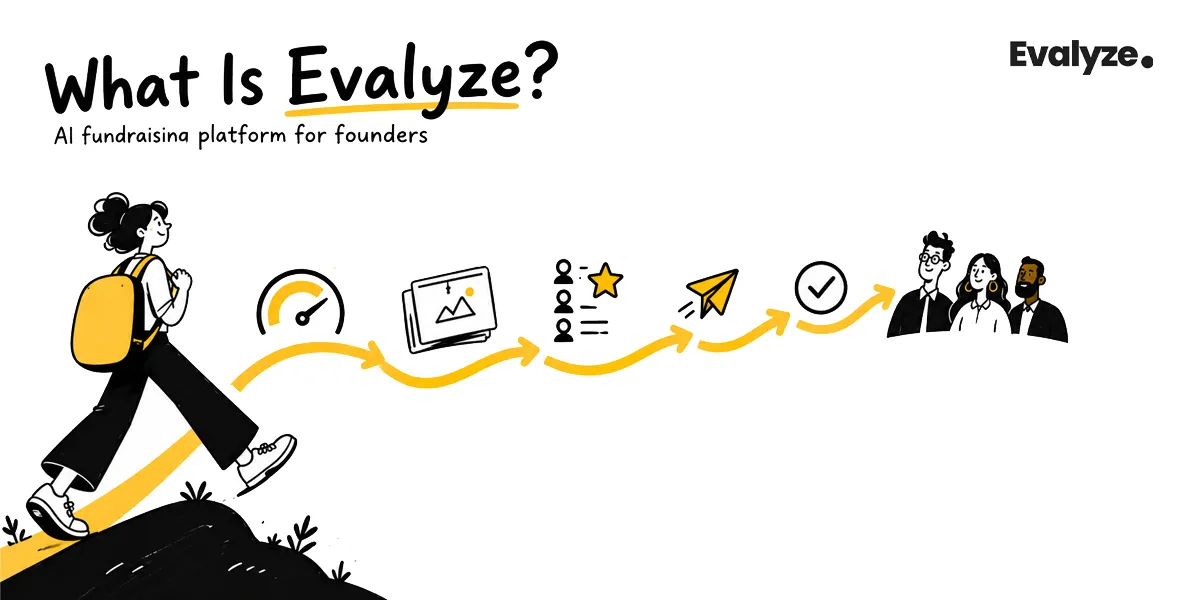
Evalyze is AI that runs your fundraising for pre-seed to Series A founders: readiness scoring, deck review, investor matching, and outreach you approve.
October 26, 2026
An AI fundraising platform helps startup founders score readiness, fix the deck, match investors and run outreach they approve. See how it compares to CRMs.
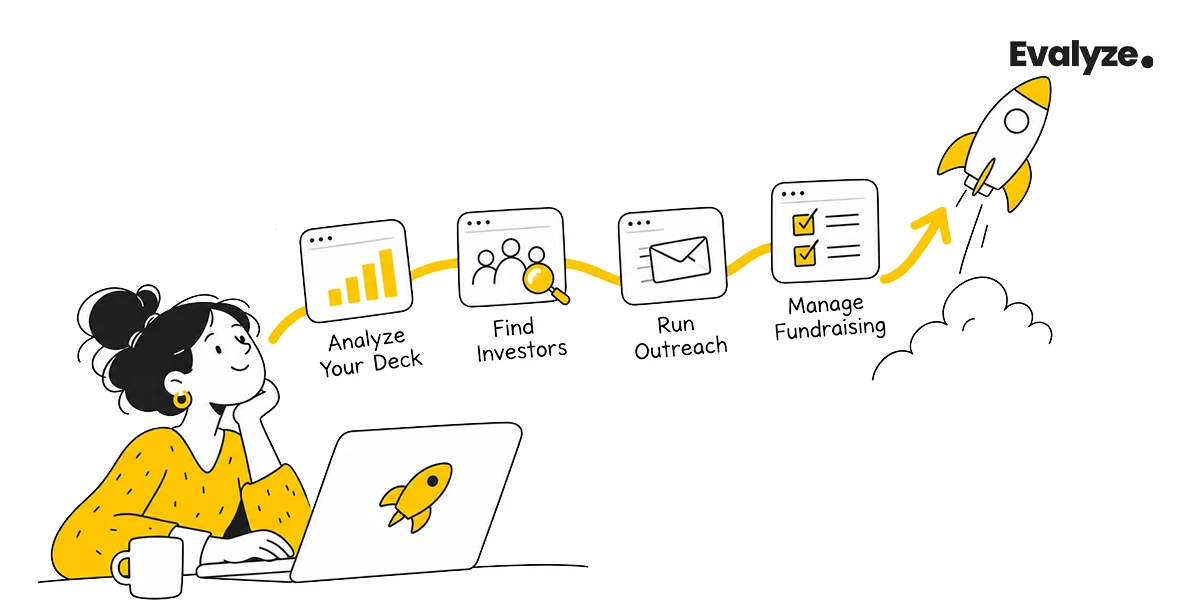
An AI fundraising platform is software that uses AI to run the research-heavy steps of a startup's raise (readiness assessment, pitch deck review, investor matching, shortlisting and outreach drafting) while the founder approves every message and makes every decision.
Evalyze is one example: AI fundraising platform for pre-seed to Series A founders. It scores readiness, reviews the deck, matches the company against 20,000+ verified investors, and drafts outreach that the founder approves and sends from their own Gmail.
Like every platform in this category, Evalyze is not an investor and does not provide capital.
AI fundraising platforms emerged because the early-stage market now rewards precise investor targeting over mass outreach.
Carta’s State of Pre-Seed: Q2 2026 report shows similar total cash flowing into noticeably fewer deals, driving average check sizes up 27% year over year to record highs, while AI startups continue to capture roughly half of all pre-seed dollars.
Evalyze interprets these numbers clearly: Fewer, larger checks and heavy competition mean founders gain far more from better investor targeting than from sending more emails.
This shift created a natural demand for software designed to evaluate investor fit before the first message goes out a necessity further compounded by growing timing pressures in fundraising.
An AI fundraising platform works as a seven-step pipeline in which the founder supplies company information and the AI returns scores, a ranked investor list and draft emails, with the founder approving each step before anything is sent.
On an AI fundraising platform, AI handles research, scoring and first drafts, while the founder owns message approval, investor relationships, pitch meetings and every financing decision, including which investors to accept into the round.
| Step | AI does | Founder owns |
|---|---|---|
| Investor research | Filters thousands of investor records by stage, sector, geography, check size and history | Final judgment on fit, conflicts and reputation |
| Readiness and deck scoring | Scores the company and deck, flags gaps | Deciding which fixes matter and rewriting the story |
| Outreach drafting | Writes a first draft per investor from thesis and past deals | Editing tone, facts and the ask |
| Message approval | Nothing | Approving or rejecting every message |
| Decision to send | Queues approved drafts | Choosing who to contact and when |
| Relationships | Tracks replies and reminds | Building trust over calls, updates and follow-through |
| Pitch meetings | Can help prepare materials | Running the meeting and answering diligence questions |
| Term negotiation | Nothing | Valuation, terms, legal advice |
| Choosing which investors to accept | Nothing | Picking partners for the cap table |
The split matters for a practical reason: Investors respond to founders, not to software. When outreach goes out from the founder's own inbox after approval, replies land with the person who has to take the meeting, and the investor sees a real sender. That model of founder-approved outreach also limits the damage a bad draft can do.
For a broader look at which tasks are safe to hand to software, see what to automate in fundraising.
For startups raising venture capital, a fundraising CRM tracks investor conversations you already have, an investor database lists who invests, an AI fundraising platform ranks who fits and drafts the outreach, and a managed service runs the raise for you.
Prices below come from each vendor's site, accessed November 2026. Prices change, so check the vendor before you buy.
An investor database lists investors and their activity so you can filter them yourself.
A fundraising CRM tracks pipeline stages, decks and investor updates for conversations already underway.
An AI fundraising platform scores your readiness, ranks investors by fit and drafts the outreach.
A managed fundraising service is a team that runs strategy, outreach and meeting booking for you.
Every approach fails in a predictable way:
Because of these trade-offs, most founders combine two approaches to build an investor funnel. For named products beyond these examples, check out our full list of AI fundraising tools.
An AI fundraising platform decides who to contact and what to say before your pipeline exists a fundraising CRM records and tracks those conversations after they start.
Simply put: a CRM’s input is your list; an AI platform’s output is that list.
It comes down to sequence, not preference:
AI intro networks are an adjacent category. Boardy, for example, describes itself as an AI superconnector that learns what you are working on, looks across its network for people who fit, and says it will "only make the intro once you both say yes."
The output is a double opt-in introduction rather than a ranked investor list or a draft email, so an intro network complements matching and outreach tools rather than replacing them.
An AI fundraising platform does not invest, does not guarantee meetings or funding, and does not replace the human parts of a raise: personal vouching, investor due diligence and the judgment behind a term sheet.
If equity from VCs and angels is the wrong fit for your company, no matching tool changes that; review alternatives to venture capital first.
In an AI-run raise, warm intros still matter because AI can identify who to ask and draft a forwardable blurb, but only a person who knows you can vouch for you.
Use the platform to find the investors who fit, then check your own network for people connected to them: former colleagues, existing angels, founders the investor has backed.
A short, forwardable paragraph makes the ask easy for the connector. The mechanics are covered in our warm intro playbook.
The right AI fundraising platform depends on your round and your bottleneck: a pre-seed founder without an investor list needs matching, a seed founder with many conversations needs tracking, and a Series A founder needs a lead.
| Your situation | Best starting setup | Why |
|---|---|---|
| Pre-seed, no investor list | AI platform free tier plus a spreadsheet | The bottleneck is knowing who invests at your stage; tracking can stay simple |
| Seed, many active conversations | AI platform plus a fundraising CRM | You need new names and a reliable record of every thread |
| Series A, need a lead | Research database plus selective outreach | Lead investors are fewer; depth of research on each one matters more than volume |
| No time to run the raise | Managed service | You are buying hours, not software |
Before a pre-seed raise, run through the pre-seed fundraising checklist; at later stages, the startup fundraising checklist covers materials and metrics. Then ask every vendor five questions:
If you are still comparing sources of investor names, see our roundup of platforms to find investors. Current plan limits for Starter, Pro and Managed Fundraising are on the Evalyze pricing page.
AI fundraising platforms for startups help founders sell equity to venture investors, while nonprofit fundraising AI helps organizations raise donations from donors; search results mix the two because both use the phrase "AI fundraising."
| Startup (equity from VCs and angels) | Nonprofit (donations from donors) | |
|---|---|---|
| Goal | Close a priced or SAFE round | Grow gifts, grants and recurring donations |
| Counterparty | VCs, angels, accelerators | Individual donors, foundations |
| Data used | Investor thesis, stage, check size, portfolio | Donor history, giving capacity, engagement |
| Output | Ranked investor list, deck feedback, outreach drafts | Donor segments, prospect lists, appeals |
| Example tools | Evalyze, Metal, Investor Match | Bloomerang, Blackbaud, DonorSearch |
If a search result talks about donors, campaigns and gift officers, it belongs to the nonprofit category and will not help a venture raise.
The fastest way to judge an AI fundraising platform is to run your startup through one and check whether the investor list makes sense for your stage, sector and check size.
On Evalyze, you start with your company details or your pitch deck. Eva scores your readiness, reviews the deck and ranks investors from 20,000+ verified VCs, angels and accelerators by fit, with a reason for each match. When you are ready to reach out, Eva drafts each email. You edit it, approve it and send it from your own Gmail. Nothing goes out without your approval.
The free Starter plan includes up to 30 investor matches. Pro adds more capacity for founders running an active raise.
FAQ
Self-serve AI fundraising platforms offer free and paid plans. Evalyze has a free Starter plan, while its current pricing page lists Pro at $49/month or $199/year. Metal uses custom pricing, and managed services quote separately. You can compare Starter and Pro plans on Evalyze.
Yes. The two tools can cover different stages of the same raise. An AI fundraising platform helps build a target list and draft personalized investor emails, while a CRM organizes investor conversations, meetings, data room access, and next steps. Some AI fundraising platforms, including Evalyze, also provide outreach tracking. Many founders combine tools from different categories, including those in our roundup of 20 startup fundraising tools.
Different tools support investor discovery. Databases such as Crunchbase let you search and filter investor records yourself. Matching platforms such as Evalyze rank investors against your company's characteristics and fundraising criteria. Our guide on how to find investors covers the wider process.
Usually, but coverage varies by platform. Evalyze supports investor discovery and matching across VCs and angel investors. Check whether a platform's database includes angels and supports filtering by funding stage, sector, geography, and check size before relying on it for an angel round. Our list of AI angel investors shows the types of investor profiles available.
A general chatbot can draft an email or critique a pitch deck slide. A dedicated AI fundraising platform combines investor research, matching criteria, outreach workflows, and campaign tracking in one system. ChatGPT alone does not provide a dedicated, verified investor database or automatically manage your fundraising pipeline. For individual writing tasks, these ChatGPT prompts for fundraising are a reasonable starting point.
It depends on the platform's privacy policy. Before uploading a deck to any platform, check three things: whether your files are used to train models, who can access them, and how you can delete them. If the policy does not answer all three questions, ask the vendor for written clarification before uploading sensitive materials.
Evalyze is AI that runs your fundraising for pre-seed to Series A founders: readiness scoring, deck review, investor matching, and outreach you approve.
October 26, 2026

Use AI for fundraising the right way in 2026. Score your pitch deck, match with the right investors, and skip 40 hours of cold research. Free tool inside.
April 30, 2026