

How to Write a Pitch Deck Storyline to Get You Funded
Have you ever poured your heart and soul into a startup, only to feel like your brilliant idea just isn't resonating with investors?
January 7, 2025
Use AI for fundraising the right way in 2026. Score your pitch deck, match with the right investors, and skip 40 hours of cold research. Free tool inside.

Using AI for fundraising in 2026 means following four steps: 1) score your pitch deck, 2) fix what's broken, 3) match with investors who actually write checks in your stage and sector, and 4) personalize outreach at scale.
This guide walks you through each step with the tools and signals founders use right now, including the free analyzer and investor matcher you can try inside the post.
AI fundraising is the use of machine learning to handle the research-heavy, pattern-based parts of startup capital raising, investor discovery, pitch deck scoring, outreach personalization, and pipeline tracking, so founders spend more time on what actually closes deals.
The term “AI fundraising” gets used in two unrelated worlds:
nonprofits raising funds from individual donors,
and startups raising from angels, VCs, and family offices.
This guide covers the second one. If you’re a founder raising your first $250K through a Series A, you’re in the right place.
Investor research used to take 40+ hours a round, and most founders did it badly. AI compressed that to a few minutes. (For the other reasons, rounds still fail; the structural fundraising mistakes are here.)
The numbers tell the story. Global AI startup investment hit roughly $202B in 2025, about half of all venture capital deployed worldwide, per Eqvista's 2026 fundraising report. Seed-stage AI companies are now closing at a 42% valuation premium over non-AI peers.
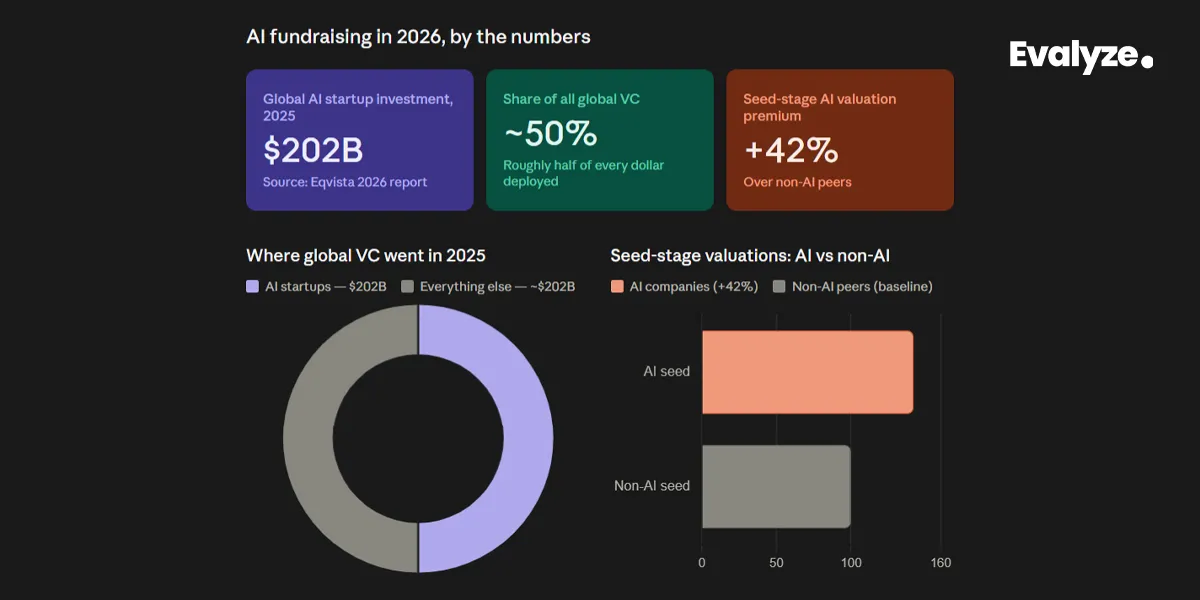
That money isn't evenly distributed. Most of it went to a handful of foundation-model players. Everyone else is fighting harder than ever for what's left, and investors are pickier about who gets a meeting.
Three things shifted in the last 18 months:
Investor research stopped being a moat. Anyone with $50/month can query 10,000+ investor profiles, filtered by stage, sector, and check size, in under a minute. Founders still building lists by hand are paying a tax.
Pitch deck scoring became reliable. Models trained on thousands of decks that did or didn't raise can flag the exact slide that loses investors before you send it. The AppDeck review of 2026 tools called this the highest-ROI use of AI in the category.
Investor inboxes got harder. Cold outreach is now AI-assisted on both sides. Generic emails get ignored faster than ever. Personalization at scale isn't a flex, it's the floor.
Founders raising in 2026 without using any of this are bringing fists to a fight where everyone else brought tools. For a deeper look at how AI is reshaping early-stage fundraising, the shift goes well beyond efficiency.
Strip away the marketing, and AI fundraising tools do five jobs. Most founders only need three.
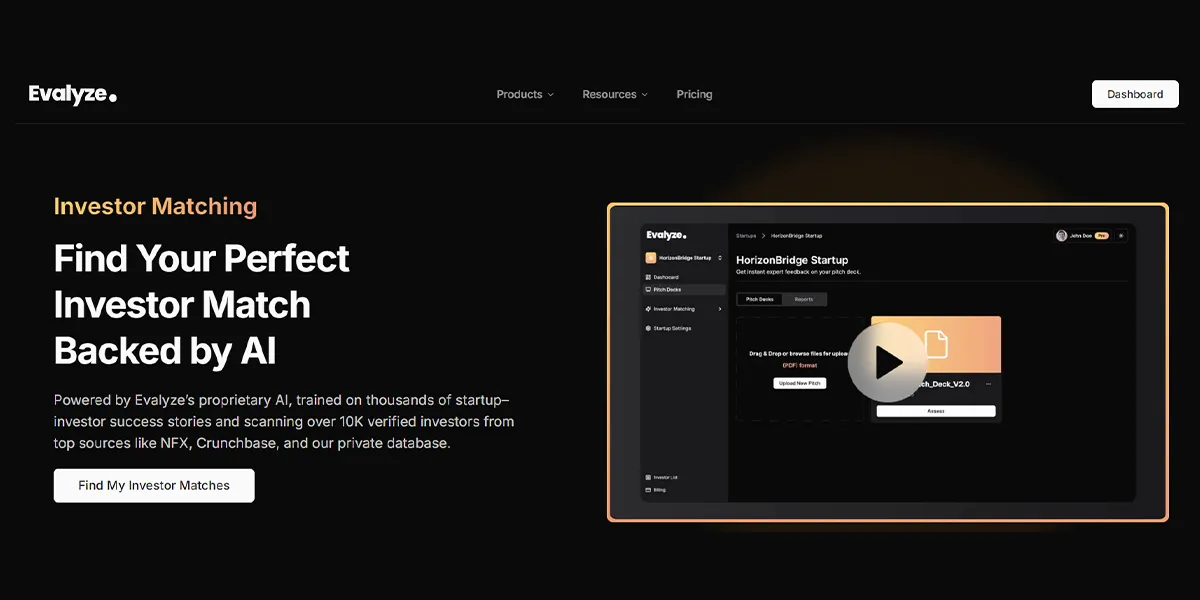
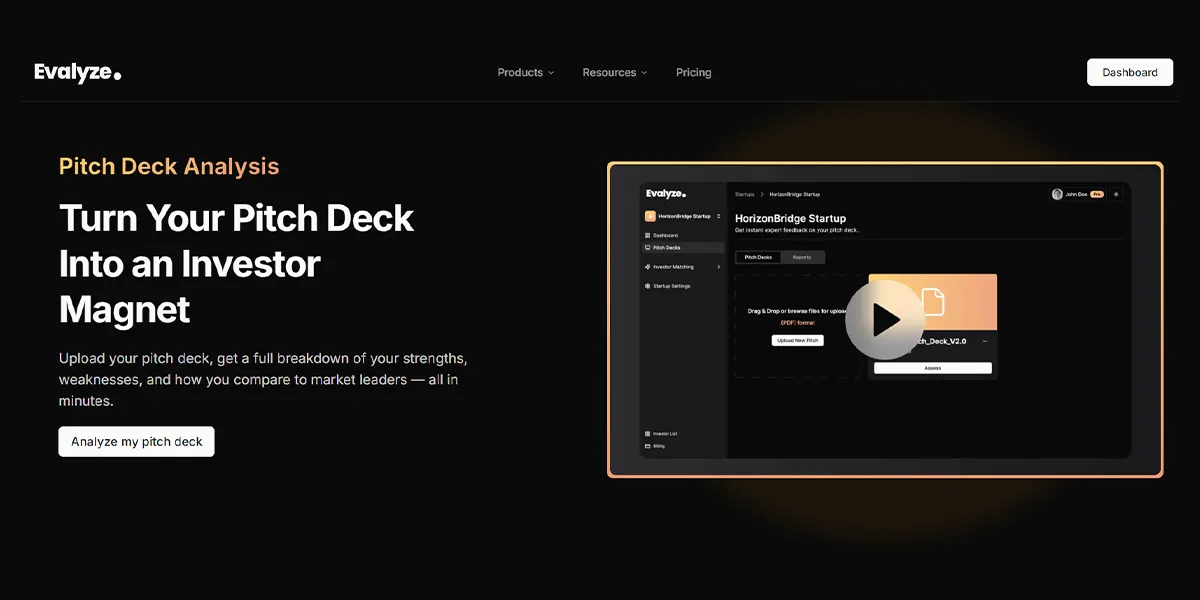
Most pre-seed and seed founders need #1, #2, and #4. Series A founders add #3 and #5.
Most investor matching claims fall apart under three minutes of inspection. Real matching scores investors on at least six signals: stage fit, sector fit, check size band, geography, portfolio overlap or conflict, and recency of activity. Anything simpler is filtering, not matching.
Here's the flow. You give the platform your basics: stage, sector, business model, geography, ask size, and either a deck or a 200-word company summary. The model ranks every investor in its database against those six signals:
A good engine ranks against all six. A bad one filters by sector and calls itself AI.
The bigger payoff is what you don't see:
The 8,500 investors filtered out. Founders who fundraise without matching tend to spend 60-70% of their outreach on investors who were never going to invest. Matching is the difference between sending 200 emails and sending 35.
If you're starting from scratch, How to Find Investors for Your Startup covers the inputs you need before you run a match. If you already have a half-built list, building a focused investor list is where to tighten it.
See your top investor matches before you build a single list.
Drop your one-line pitch, and we'll show you investors actively writing checks at your stage.
The hardest part of fundraising is that investors rarely tell you why they passed. By the time you've heard "not for us" from 15 funds, you've burned half your runway, and you still don't know if the problem is your deck, your traction, or your TAM.
An AI pitch deck analysis partially solves this. Tools trained on thousands of decks can flag the issues investors silently penalize: 1) a vague problem statement, 2) traction numbers without time context, 3) a business model slide that contradicts the GTM, and 4) an ask without a clear use of funds.
Evalyze's model has been trained on 8,000+ analyzed fundraises, making per-slide feedback specific instead of generic.
What you get back, ideally, is a per-slide breakdown of:
Which slides are doing the work?
Which slides confuse the reader?
Which slides VCs typically skip (and what to do about it)?
Where your story breaks the "investor logic" that sequences problem → solution → traction → why-you → ask
It's not a replacement for human feedback from a founder who's been raised before. But it catches the obvious mistakes you've stopped seeing because you've stared at the deck for six weeks.
If you suspect the deck is the issue but can't pinpoint where, why your pitch deck might not be working breaks down the most common patterns. For the inverse view, what investors are actually looking for in a deck starts there before you rewrite a single slide.
Want the unfiltered version of what's wrong with your deck?
Upload the PDF. Get a slide-by-slide score in 2 minutes. Free, and the feedback is direct enough that some founders close the tab.
This is where most AI fundraising hype goes off the rails.
The pitch is seductive: AI writes 200 personalized emails, sends them on a schedule, and follows up on the right cadence. Your inbox fills with replies. You raise faster. The reality is messier.
Investor inboxes in 2026 are saturated with AI-generated outreach. The pattern-matching has gotten good enough that investors can spot a templated email referencing their last portfolio company in three seconds. The good operators flag and ignore. The angry ones tell other investors. Your name shows up in a "do not respond" Slack channel before you finish your sequence.
Used well, AI outreach automation is a research and drafting copilot, not an autopilot. It pulls the investor's recent activity (a portfolio post, a podcast appearance, a LinkedIn comment), drafts a reference, and hands you a 90% email. You write the first line in your own voice, you decide whether to send, and you adjust the tone for the relationship you're building.
Used badly, it's a faster way to burn investor relationships you didn't know you had.
For the longer breakdown, what works and what doesn't in AI investor outreach is worth the read. The same goes for fundraising automation for startups; it splits the parts you should automate from the parts you absolutely shouldn't.
There's no single best AI fundraising tool. There's a stack, and the mistake most founders make is paying for 6 of them before they know what their workflow actually looks like.
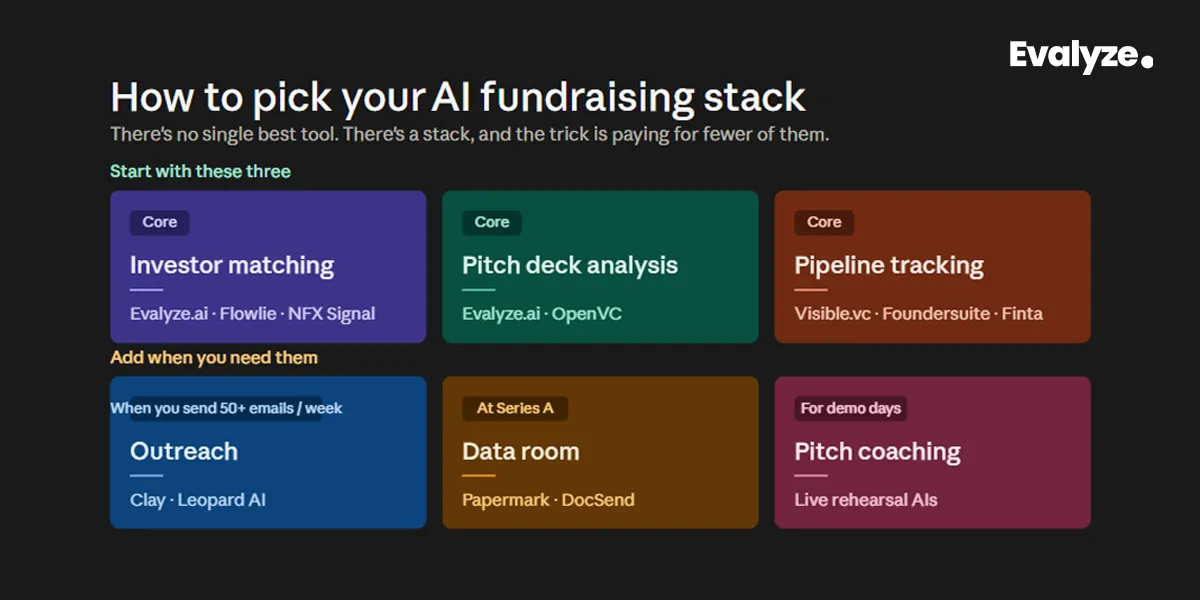
Think of the tools as falling into six categories. Most pre-seed and seed founders really only need three of them:
Later, when you're sending more than 50 emails a week, add an outreach personalization tool like Clay or Leopard AI. Once you hit Series A, add a data room, Papermark, or DocSend. Pitch coaching sits at the edge; it becomes useful when live demo days are on the calendar.
The decision rule that saves the most money:
Pick one workflow tool that handles matching + deck + pipeline together, then add a single outreach tool if you need it.
When matching, deck analysis, and pipeline live in the same product, your scores update as your deck improves, your match list refreshes when your positioning shifts, and your follow-ups know which investors actually opened the latest version. Stitching six standalone tools together loses all of that.
Tools without a workflow are just expensive subscriptions. Here's the sequence that works for most pre-seed and seed founders raising in 2026.
Run it through an AI deck analyzer. Fix the top three issues. This takes a weekend, not a quarter.
Aim for 80-120 ranked investors, not 500. List quality matters more than length. If you're matched to fewer than 50, your positioning is too vague; go back to step 1.
Top 20 are your dream investors. Middle 40 are the ones you'll actually convert. Bottom 40 are warm-up reps to test your story before you contact the top 20.
Use those calls to sharpen your story. By the time you reach the top 20, you've heard the questions four times, and you know your answers cold.
Personalize every email yourself. Track responses in a CRM (any CRM, Visible, Foundersuite, or even a shared Notion doc).
AI nudges you when an investor has gone quiet for 7 days. You decide whether to send. The cadence rules in follow-up emails that actually get replies are a useful starting point.
Update your deck and your prep doc. By meeting 15, your live pitch is twice as sharp as it was on meeting 1.
This sequence takes 6-10 weeks for a typical pre-seed round. Without AI tools, it usually takes 4-6 months and ends with a different deck than the one that started. For the longer planning view, the full step-by-step fundraising checklist and the guide to building an investor funnel cover what sits around this workflow.
The whole workflow above takes about 10 minutes to set up in Evalyze. Score your deck. Get your top matches. See the gap between where your story is now and where investors need it to be.
A short, honest list because the founders who get this right tend to raise faster than the ones who don't.
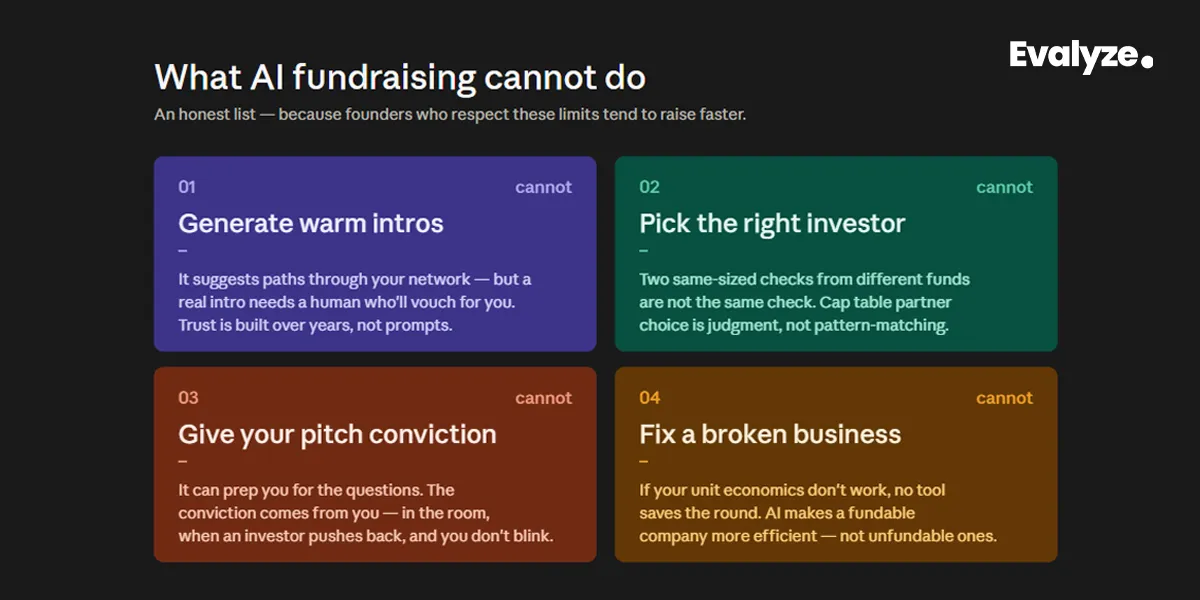
Founders who treat AI as leverage raise faster. Founders who treat it as a magic button burn time and credibility. The difference often comes down to how investors actually decide. Once you understand that part, the limits of AI become obvious.
Three risks worth understanding before you build a stack.
AI fundraising tools are trained on past raises. If your business doesn't look like the patterns the model was trained on, non-US founders, non-traditional business models, or non-tech sectors, the matching and scoring may be biased against you.
Treat AI signals as input, not verdict. The model isn't seeing your unfair advantage. (For what reasonable evaluation criteria look like, and how Evalyze evaluates startups, see the framework.)
When you upload a pitch deck to any AI tool, ask the obvious questions: where does the data go, who can see it, and is it being used to train future models?
Reputable platforms answer these in plain English. The ones that hide behind legalese are telling you something.
The fastest way to lose a round is to outsource judgment to a tool. AI can score your deck. It cannot tell you whether your business is worth building. Founders who use AI to do less work, faster, raise faster. Founders who use AI to think for them get found out in the meeting.
FAQ
Have you ever poured your heart and soul into a startup, only to feel like your brilliant idea just isn't resonating with investors?
January 7, 2025
Evaluating a company's pitch deck is a critical part of assessing its potential for raising capital and long-term success. This blog post of Evalyze.ai will showcase 15 standout companies whose pitch decks helped secure millions of dollars in funding, fueling their growth and market impact. From innovative tech platforms to sustainable brands, each of these companies used a compelling pitch to connect with investors. We also provide downloadable links to their pitch decks, giving you a behind-the-scenes look at what it takes to create a winning presentation for potential backers.
December 23, 2024