
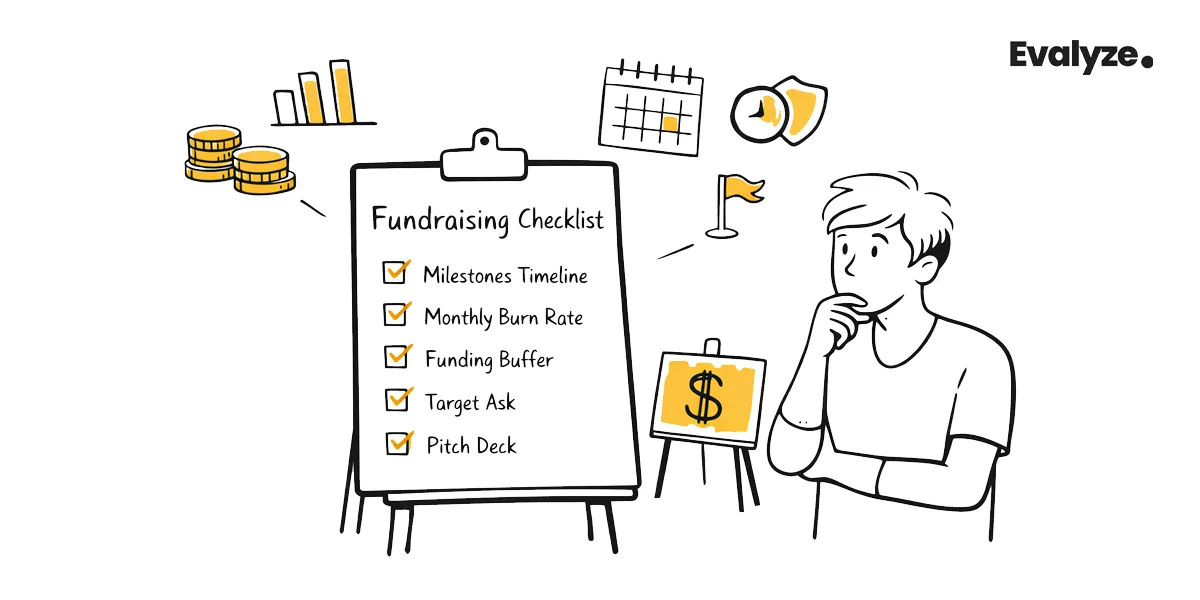
Startup Fundraising Checklist: A Step-by-Step Guide
Use this startup fundraising checklist to prepare your pitch deck, financial model, and investor outreach strategy step by step.
February 18, 2026
Pre-seed fundraising in 2026 is a sequence problem. Learn when to raise, how to size the round, build the list, pitch, close, and protect your cap table.

Pre-seed fundraising usually fails because founders do the right work in the wrong order. They polish the deck before qualifying investors, set the raise before defining the milestone, and start outreach before testing the story. In 2026, sequence matters as much as the materials.
Key Takeaways
Pre-seed fundraising in 2026 should be run as a sequence, not a loose set of tasks.
The investor list should come before the final deck because investor fit shapes the story.
The raise amount should come from milestone math, not founder confidence or peer comparison.
A tracked deck, clean follow-up cadence, and prepared first-call answers make the process easier to diagnose.
SAFE rounds still require discipline. Model dilution before accepting another check.
The first 30 days after close should improve the odds of the seed round.
Follow the order below before you touch the deck, send investor emails, or open your data room.
Pre-seed funding is expensive capital. You sell ownership early, when the company has the least proof and the highest uncertainty.
That can make sense for a venture-scale company. It can hurt a profitable services business, a niche product, or a company that could reach revenue without outside money.
Before writing the deck, I would answer three questions:
| Question | Why it matters |
|---|---|
| Are you building a venture-scale business? | Venture investors need a path to outsized returns. If your realistic outcome is a strong but smaller cash-flow business, equity capital may push you toward the wrong strategy. |
| Will you burn more than you earn for at least the next 12 months? | Pre-seed usually funds the gap between product, traction, and the next financing milestone. If you can reach profitability without outside capital, selling equity may be the wrong move. |
| Can this round get you to a milestone that makes the next round believable? | That milestone might be 10 to 20 paying customers, 50 to 100 engaged daily users, or 3 to 5 paid pilots. The round must buy progress investors can underwrite later. |
If the answer is no, I would not force a VC round.
Better options may include:
revenue-based financing if you already have recurring revenue
a leaner bootstrap path
a friends-and-family SAFE
an accelerator if you need structure and early credibility
For a broader preparation view, use our startup fundraising checklist.
Many founders pick the raise amount backward. They look at what peers are raising, add a little ambition, then land on a number that sounds fundable.
Investors hear the gap immediately.
I prefer milestone math:
(months to milestone + 6 months buffer) × monthly burn = raise size
A simple example:
| Input | Value |
|---|---|
| Monthly burn | $80K |
| Months to milestone | 12 |
| Buffer | 6 months |
| Raise size | $1.44M |
| Rounded ask | $1.5M |
Now the ask has a reason.
For 2026, I would treat $1.2M as a useful median reference point for pre-seed, with many rounds landing somewhere between $250K and $2.5M. For dilution, I would usually want the round to sit around 15% to 18%, with 20% as a serious ceiling, not a casual target.
Those numbers are not a script. They are a sanity check.
If your ask sits far above the milestone, investors will push back. If your ask is too small, you may run out of runway before the proof arrives. The right raise amount gives you enough time to hit the next financing bar without selling more of the company than the milestone justifies.
For the deeper math, read how much to raise at pre-seed.
Fundraising under time pressure changes the room.
Investors can feel it. Your answers get softer. Your follow-ups get needier. Your terms get worse.
I would start when the company still has at least 9 months of runway:
| Runway | What it means |
|---|---|
| 12+ months | You have leverage. |
| 6 to 9 months | You can still run a process, but the margin is thin. |
| Under 6 months | You are not really fundraising. You are trying to survive. |
A realistic 2026 pre-seed timeline looks like this:
| Phase | Typical timing | What happens |
|---|---|---|
| Preparation | 2 to 4 weeks | Deck, list, narrative, references |
| Active fundraising | 6 to 10 weeks | First meetings to verbal commitments |
| Diligence and closing | 4 to 6 weeks | Term sheets, legal, wires |
| End-to-end process | 12 to 20 weeks | Start to money in the bank |
This is why “we will start fundraising next month” can be dangerous if runway is already tight.
I would pause and rebuild if I saw these signals:
30+ meetings with zero follow-ups
the same 2 to 3 objections in every call
less than 6 months of runway
The third one is painful, but clean advice helps more than optimism: if you are below 6 months of runway, stop treating institutional VCs as the only path. Talk to angels, existing supporters, customers, bridge investors, and anyone who can stabilize the company faster.
For timing strategy, link this section to when to seek funding.
Most founders write a deck for “investors.”
That is the problem.
A climate software seed fund, a fintech solo GP, an AI infrastructure fund, and a healthcare angel do not read the same deck in the same way. The proof points they care about are different. The risks they notice first are different. The check size and timing may be different.
The investor list should shape the deck, not follow it.
For a $1M to $2M pre-seed round, I would plan around this kind of funnel:
| Stage | Target |
|---|---|
| Qualified investors identified | 200 |
| Investors contacted | 80 to 120 |
| First meetings | 30 to 50 |
| Second meetings | 15 to 20 |
| Diligence processes | 5 to 8 |
| Verbal commitments | 2 to 4 |
| Closed round | 1 |
That math is not warm and comforting. It is useful.
Build the list in tiers:
| Tier | Who belongs here | How to use it |
|---|---|---|
| Tier 1 | Dream leads | Pitch last, after the story has been tested |
| Tier 2 | Strong-fit funds | Pitch in the middle of the process |
| Tier 3 | Warm angels and operators | Pitch early to build feedback and momentum |
| Tier 4 | Solo GPs and micro-funds | Pitch in parallel because they can move fast |
Do not send the same cold email to every tier. Do not ask a dream lead to be your first practice call. Do not waste warm operators by treating them like names in a spreadsheet.
A smaller, qualified investor list beats a giant weak one. If an investor does not match your stage, sector, geography, check size, or thesis, they are not “pipeline.” They are noise.
Stop sending your deck to investors who were never a fit.
Evalyze matches your startup with relevant investors based on stage, sector, geography, check size, and investor type, so your list starts cleaner before outreach begins.
Build My Investor List
For the deeper workflow, read to how to build an investor list and the investor funnel template.
Your deck does not need to tell every story. It needs to earn the next conversation.
I care most about the first three slides. If those do not create enough conviction to keep reading, the rest of the deck rarely saves the round.
A strong pre-seed deck usually follows this order:
| Slide | Content |
|---|---|
| 1 | Vision + top traction stat |
| 2 | Problem |
| 3 | Solution + why now |
| 4 | Market |
| 5 | Product |
| 6 | Traction |
| 7 | Business model + pricing |
| 8 | Competition + moat |
| 9 | Team |
| 10 | Ask + use of funds |
| 11+ | Appendix slides for cohorts, unit economics, hiring plan, and deeper proof |
The main deck should usually land around 12 to 14 slides, with 4 to 6 appendix slides behind it.
Pricing deserves a real slide. Many founders hide pricing because the model still feels early. I think that backfires. Investors know the model will change. They still want to see how you think money flows through the company.
Not sure if your deck is doing its job?
Upload your pitch deck to Evalyze and get an AI-powered review of your structure, investor-readiness, weak slides, and missing proof points before you send it to another fund.
Score Your Pitch Deck
Send the deck as a tracked link, not a static PDF attachment. You need to know:
who opened it
which slides held attention
whether it was forwarded
A forwarded deck before the meeting is often a stronger signal than a polite reply.
For deck improvement, read what investors look for in pitch decks and AI pitch deck review.
Investor outreach is not broadcasting. It is sequencing.
A clean cold email needs:
one company description
one proof point
one raise amount
one milestone
one investor-specific reason
one tracked deck link
That is enough.
The subject line should carry a meaningful number if you have one. Not a vague “investment opportunity.” Not a clever line that hides the company.
A simple format works better:
[Company] — [one number that matters]
The body should explain what you are building, why it is working, what you are raising, what the round funds, and why that investor is a fit.
Personalization should be specific. “Loved your post” is not research. A relevant portfolio company, thesis, recent investment, or sector focus is research.
The follow-up cadence should stay disciplined:
| Timing | Message |
|---|---|
| Day 3 | One-line nudge with a fresh data point |
| Day 7 | Forward the original email with a short bump |
| Day 14 | Final soft close |
Three follow-ups. Then move on.
Dragging the same investor through six vague nudges rarely changes the answer. A stronger move is to keep building, hit a new milestone, and re-approach with a real update.
For templates, use cold email templates for investors, investor follow-up emails, and the warm intro playbook.
The first call is not a casual introduction. It is where the investor tests whether the deck survives contact with the founder.
I would prepare 60-second answers to these questions before outreach starts:
| Investor question | What they are testing |
|---|---|
| Why is this team going to win? | Founder-market fit and execution edge |
| Why now? | Market timing |
| Who has tried this and failed? | Competitive awareness |
| What is the path to $100M ARR? | Venture-scale logic |
| What is defensible? | Moat quality |
| What kills this company? | Risk awareness |
| How are you using AI? | Product and market relevance in 2026 |
| What is your follow-on capacity? | Ability to raise the next round |
Founders often over-prepare the product demo and under-prepare the business logic. That creates a strange call: the product sounds alive, but the company sounds untested.
A strong answer has three layers:
| Layer | What to give |
|---|---|
| Fact | The number or current reality |
| Context | Why that number looks the way it does |
| Forecast | Where it goes next and what could break it |
If an investor asks about CAC, do not stop at “CAC is $40.” Explain why it is $40, which channel drives it, how it changes with scale, and what would break the model.
Investors are not buying the number. They are testing whether you understand the machine. The most common pre-seed pass is some version of “we need to see more traction.” Treat it as a bar, not a personality judgment.
Respond with:
the 60 to 90 day milestone you plan to hit
a short offer to send an update when you hit it
a direct question: would that milestone change their conviction?
A data room is not a public folder. Sequence matters here, too.
| Before a term sheet | After a term sheet |
|---|---|
| tracked pitch deck | customer references, with permission |
| one-page executive summary | technical architecture overview |
| basic financial model | hiring plan |
| clean cap table | incorporation documents |
| team bios | IP assignments |
| signed LOIs or contracts |
Do not share detailed customer data, source code, proprietary technical specs, vendor contracts, or anything you would hate to see in a competitor’s hands before a term sheet.
If an investor pushes for sensitive material too early, ask for a term sheet first or use a focused NDA for the specific request.
Good investors respect the sequence. Founders should, too.
Keep your fundraising materials in one place.
Evalyze’s Data Room helps you manage pitch decks and PDF fundraising materials so you can share the right documents at the right stage without losing control of the process.
Organize Your Data Room
For a detailed breakdown, read startup due diligence checklist.
For most pre-seed rounds, SAFEs are faster and cheaper than priced rounds. That does not make SAFEs harmless.
The danger is not one SAFE. The danger is the stack.
| Issue | Why founders should care |
|---|---|
| Cumulative dilution | Several small checks can quietly sell too much ownership before priced seed. |
| Different SAFE caps | Messy terms make the next round harder to explain. |
| Side letters | One-off rights can create cleanup work later. |
| Small-check pro-rata rights | A $25K check should not control future financing flexibility. |
I would treat 20% to 25% cumulative SAFE dilution before priced seed as a hard warning zone.
Model every check. Model every cap. Model the conversion. If you are past the guardrail, stop stacking SAFEs and consider pricing the round.
Push back on terms that do not fit the stage:
board seats at pre-seed
veto rights
restrictive pro-rata rights for small checks
anti-dilution provisions attached to SAFEs
messy side letters that create future cleanup work
After close, your cap table should be readable. If it takes a long explanation, you have created a seed-stage problem before reaching seed.
Closing the round is not the finish line. It starts the clock for the next financing story.
In the first week, onboard your lead investors. Schedule short calls and ask three things:
How do you prefer to receive updates?
Where can you actually help: intros, hires, customers, follow-on investors?
What is one specific ask we should make of you now?
Then send clean monthly updates. Keep them short enough that people read them.
Use this structure:
| Section | What to include |
|---|---|
| The number | One headline metric |
| What worked | 1 to 2 concrete wins |
| What did not | 1 to 2 honest misses |
| Asks | Specific intros, hires, customers, or help |
| Cash | Cash remaining |
| Runway | Months remaining |
The tone should be honest, not performative. Investors can help with specific asks. They cannot help with vague confidence.
Hiring needs the same discipline:
| Timing | Hiring guidance |
|---|---|
| First 30 days | Hire one person max |
| Days 30 to 90 | Hire 2 to 3 more only if the company is hitting milestones |
| After 90 days | Reassess burn against progress before adding more fixed cost |
Pre-seed money is expensive. Spend it like you still remember that.
Founders do not lose pre-seed rounds only because the market is hard. They lose because they do the work out of order.
They:
Write the deck before building the list
Pick a raise amount before defining the milestone
Email investors before pressure-testing the story
Share sensitive data before a term sheet
Close money, then hire faster than the milestone requires
The better path is quieter and more disciplined: decide if pre-seed is right, size the round from the milestone, start with enough runway, build a qualified investor list, shape the deck around that list, run outreach as a campaign, prepare for the first call, protect the data room, close cleanly, and use the first 30 days to set up the next raise.
For the full benchmark tables, templates, source list, and deeper step-by-step guidance, read 👉 the Pre-Seed Fundraising Playbook 2026.
Run your pre-seed raise with fewer blind spots.
Evalyze helps you review your deck, find matched investors, build a cleaner shortlist, model dilution, and manage your fundraising process from first email to close.
Try Evalyze For Free Now
FAQ
Use this startup fundraising checklist to prepare your pitch deck, financial model, and investor outreach strategy step by step.
February 18, 2026
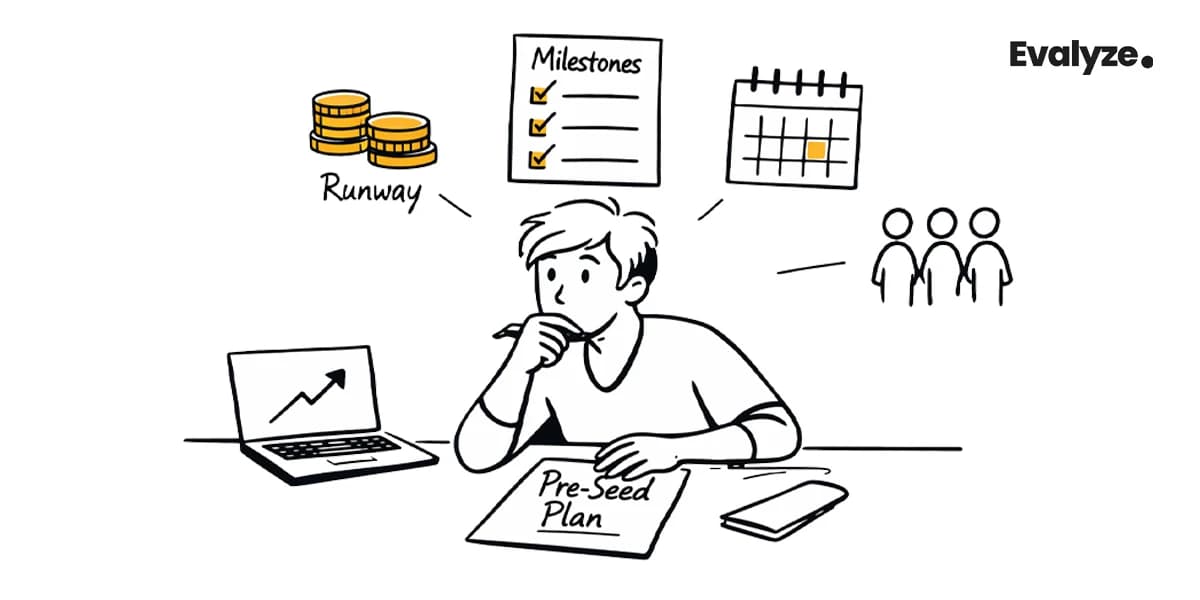
Learn how to calculate your pre-seed funding ask using runway, burn rate, milestones, and market benchmarks.
February 7, 2026