
What Makes a Startup Investor-Ready? 6 Signals VCs Look For
Learn how investors evaluate startup readiness and the six signals that help founders build confidence before raising funding.
September 6, 2026
Learn how AI pitch deck scoring works, what Evalyze’s Investor Readiness and Pitch Scores mean, and how to use your results before fundraising.
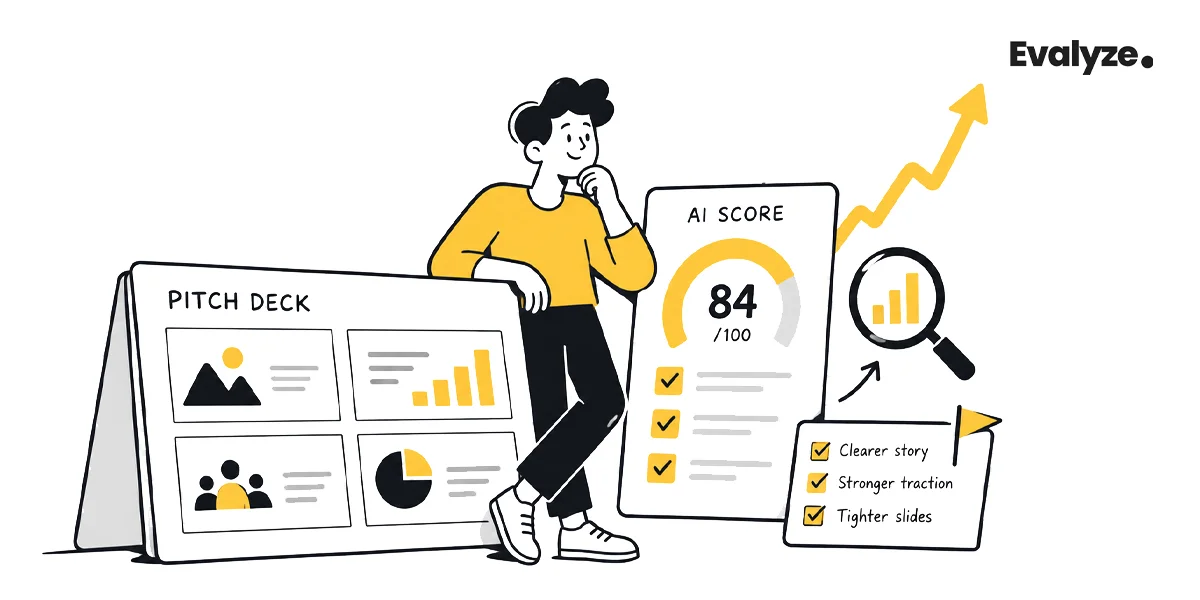
AI pitch deck scoring reviews your startup and presentation against fundraising criteria, then turns that assessment into a score and specific feedback.
Evalyze separates two questions founders often combine: Startup Analyzer measures investor readiness on a 350-850 scale, while AI Pitch Coach scores how effectively your deck presents the investment case on a 0-100 scale.
Key Takeaways
An AI pitch deck score is a structured assessment of the information you present to investors and how effectively that information supports your fundraising case.
Evalyze reviews your startup and pitch deck against fundraising criteria, identifies strengths and gaps, then summarizes the assessment through an overall score and recommendations.
The number gives you a clear starting point. The detailed analysis explains where to focus next.
That distinction matters because startup quality and pitch quality are related, but they are not the same thing. A strong company can be presented through a weak deck. A polished deck can also leave important business questions unanswered.
Evalyze evaluates both.
If you want to understand the investor criteria behind those questions, read our guide to what investors look for in a pitch deck.
Founders preparing to raise need answers to two different questions:
Startup Analyzer addresses the first. AI Pitch Coach addresses the second.
Evalyze Startup Analyzer gives your startup an Investor Readiness Score from 350 to 850.
The assessment looks across six areas:
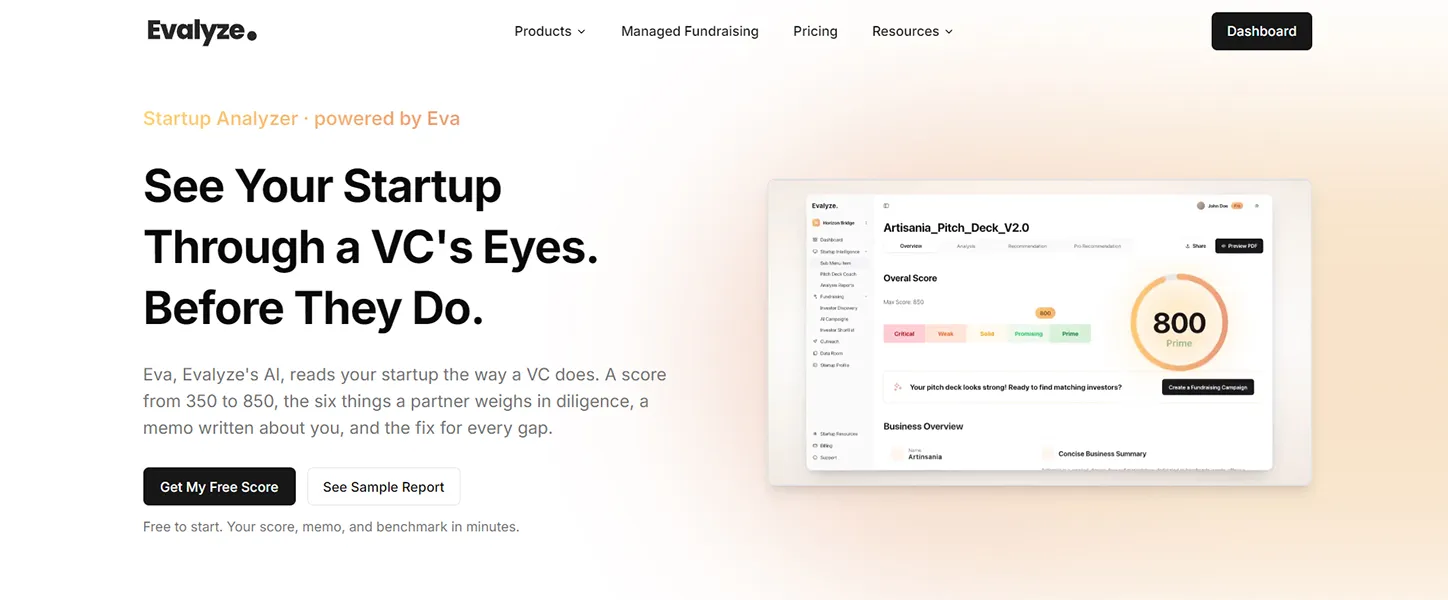
Each area is assessed separately, so you can see what is supporting your overall result and where the fundraising case needs more work.
For example, your team may score strongly while your traction evidence or competitive positioning needs clearer support. Another founder may have strong traction but need to make the market opportunity easier to understand.
The overall score is also placed into one of five readiness bands:
The bands give you a quick view of your current investor readiness. The dimension-level analysis explains what is influencing that position.
Startup Analyzer is benchmarked against 8,000+ closed funding rounds, and you can make improvements and re-score as your startup and fundraising materials develop.
For a deeper look at the signals behind fundraising readiness, see what makes a startup investor-ready.
Evalyze AI Pitch Coach focuses on the deck itself.
It gives you an overall 0-100 Pitch Score, then adds context through slide-level scoring, green and red flags, and specific feedback on what needs improvement.
AI Pitch Coach analyzes the deck across 14 key areas and reviews individual slides rather than treating the presentation as one block.
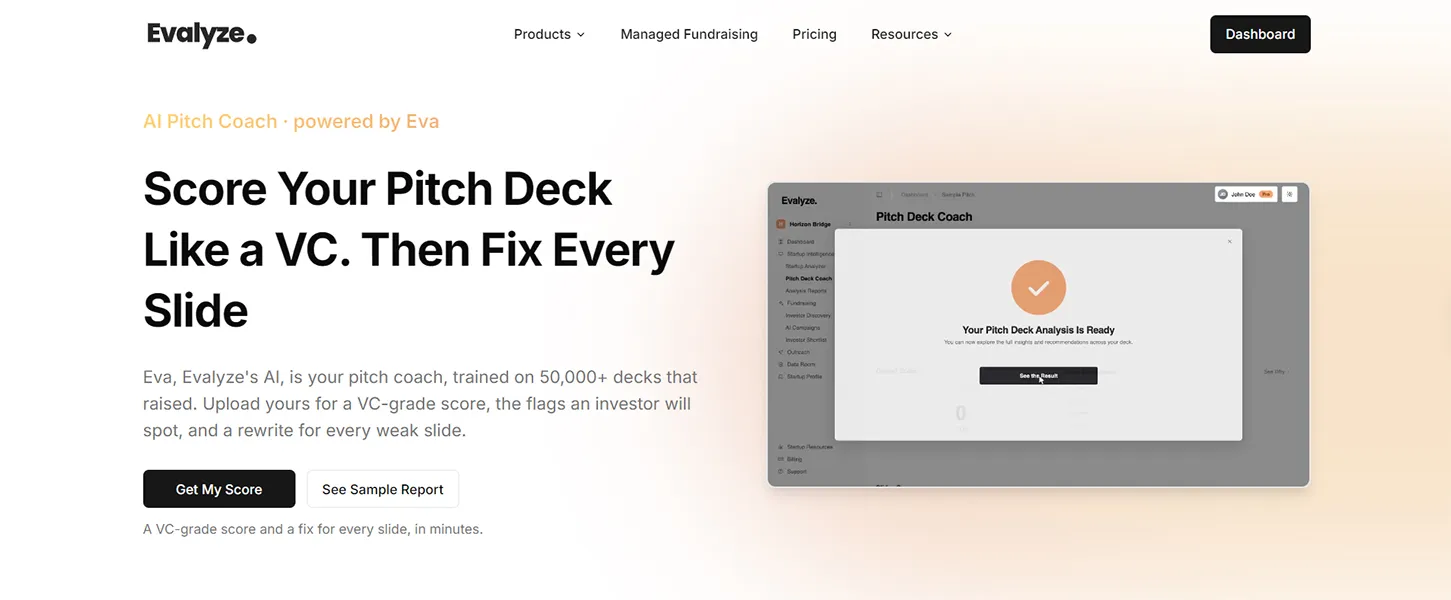
It can also examine the deck from an investor perspective, including the strength of the investment case, questions the presentation may raise, and execution risks that need a clearer answer.
When a slide needs work, AI Pitch Coach can provide feedback on its content, presentation, language, and revised copy.
Evalyze AI Pitch Coach is informed by 50,000+ pitch decks that raised funding.
Its score answers a focused question:
“If an investor opens this deck today, how effectively does it communicate the opportunity?”
Want to see what happens beyond the overall score? Read how Evalyze AI Pitch Coach reviews your pitch deck.
The two Evalyze scores measure different parts of fundraising preparation.
| Investor Readiness Score | Pitch Score | |
|---|---|---|
| Product | Startup Analyzer | AI Pitch Coach |
| Scale | 350-850 | 0-100 |
| What it evaluates | The startup and its fundraising readiness | The pitch deck and how it presents the investment case |
| Analysis | Six startup and fundraising dimensions | 14 key areas plus slide-level analysis |
| What you receive | Overall score, readiness band, strengths and gaps | Overall score, slide scores, flags and fixes |
| Best time to use it | When preparing the startup for a raise | Before sending or presenting the deck |
A startup can perform well in one assessment and still have meaningful work to do in the other.
A founder may have strong traction, an experienced team, and a credible market opportunity, but bury those strengths inside an unclear deck. The startup may be better prepared than the presentation suggests.
Another founder may have a polished, persuasive deck while the underlying business still needs stronger evidence around traction, differentiation, or scalability.
Using both scores helps separate those problems.
Your Investor Readiness Score gives you a high-level view of how your startup currently presents as a fundraising opportunity.
A higher position on the scale indicates a stronger overall assessment, but the most useful information sits underneath the headline score.
Look at the six dimensions.
This is also why two founders with similar overall scores may need very different improvements.
Imagine two founders with broadly similar Investor Readiness Scores. One has a strong team and business model but limited traction evidence. The other has stronger traction but a weaker competitive case.
Their headline scores may look similar. Their priorities should not.
Use the overall score to understand your position. Use the dimension scores to decide what deserves attention.
If traction or financial evidence is one of the weaker areas, start with our guide to presenting startup metrics in a pitch deck.
Your Pitch Score tells you how effectively the current deck communicates the investment case.
The overall number matters, but it should not be read in isolation.
Suppose your deck receives a moderate overall score while several slides perform well. The main issue may be concentrated in two or three slides that leave investors with unanswered questions. Another deck could have consistent slide scores but a weak overall narrative connecting the problem, traction, market, and ask.
AI Pitch Coach helps you identify those differences.
The analysis can surface issues such as missing evidence, inconsistent numbers, weak slides, unclear storytelling, visual problems, or questions an investor is likely to raise.
You can then work on the specific problem rather than rewriting the entire deck without direction.
A composite score summarizes several signals into one number. That makes the breakdown especially important.
Consider two fictional startups with similar Investor Readiness Scores.
One has an experienced founding team and a scalable model but needs stronger market validation. The other already has traction but has not explained its competitive advantage clearly.
The same principle applies to Pitch Scores.
One founder may have several incomplete slides. Another may have the right information but present it through dense copy, inconsistent data, or a narrative that makes the opportunity harder to follow.
The score tells both founders that improvement is possible. The analysis tells each founder what to work on.
Start with the overall score to establish your current benchmark, then move directly to the weakest areas.
Then fix the underlying issue.
After making meaningful changes, re-score the startup or deck. Both Startup Analyzer and Pitch Coach support this iterative workflow.
Once the major gaps are addressed, use the startup fundraising checklist to check the rest of your materials before starting investor outreach.
Once the fundraising case and deck are stronger, you can proceed to Investor Matching, Shortlisting, and Investor Outreach within Evalyze.
A better score does not guarantee meetings, replies, introductions, or funding. It gives you a more informed starting point before those conversations begin.
If you're raising at pre-seed, our pre-seed fundraising guide covers the broader sequence from preparation through investor targeting and outreach.
An overall score tells you where you stand. Evalyze Pro helps you understand what to do next.
Startup Analyzer Pro goes deeper into weaknesses, missing information, and recommendations across the startup assessment.
Instead of learning only that an area such as traction needs attention, you can get more specific guidance about the information that would strengthen that part of your fundraising case. The deeper Startup Analyzer report includes prioritized recommendations tied to the assessed dimensions. Startup Analyzer
AI Pitch Coach brings the same level of detail to the presentation.
You can see which slides need work, understand why they were flagged, and receive specific suggestions for improving the content and presentation. AI Pitch Coach can also provide revised copy for weaker slides.
See what is affecting your score and what to improve next with Evalyze.
Go Pro for personalized outreach and much more.
FAQ
Learn how investors evaluate startup readiness and the six signals that help founders build confidence before raising funding.
September 6, 2026

what exactly are investors looking for in a pitch deck? While every investor has their own preferences, there are universal elements that can make or break your pitch.
February 6, 2025