

Why Did Investors Reject My Startup? 20 VC Pass Lines Decoded
What does “too early,” “need more traction,” or “stay in touch” actually mean? Decode 20 common VC rejection lines and decide what to do next.
August 19, 2026
What are the best alternatives to venture capital for startups? Compare 9 options by dilution, repayment, stage, and fit, from bootstrapping to RBF.

Venture capital is one way to finance a startup, but it is far from the only one. Alternatives include bootstrapping, customer funding, friends and family, angel investors, accelerators, grants, crowdfunding, revenue-based financing, and venture debt.
Some preserve founder ownership but limit available capital. Others provide outside capital in exchange for equity or create repayment obligations. The right fit depends on how much money you need, what you need it for, your revenue and cash flow, and the financial obligations your startup can realistically support.
Key Takeaways
A pre-revenue startup and a company generating predictable recurring revenue can need the same amount of capital and still have very different financing options.
Use this table as a first filter.
| Funding Option | Dilution | Repayment | Revenue Usually Required? | Common Fit | Main Trade-Off |
|---|---|---|---|---|---|
| Bootstrapping | None | None | No | Startups with manageable initial costs | Capital is limited to founder resources and business cash flow |
| Customer Funding | None | None | Customer demand required | Companies able to sell pilots, contracts, or subscriptions early | Requires customers willing to commit before full delivery |
| Friends & Family | Depends on structure | Depends on structure | No | Very early-stage startups | Financial risk overlaps with personal relationships |
| Angel Investors | Usually yes | No scheduled loan repayment | Usually no | Pre-seed and seed companies needing outside capital | Founder dilution |
| Accelerators | Often | Usually no loan repayment | Usually no | Early teams that value capital plus structured support | Program value and investment terms vary |
| Grants | Usually none | Usually none | No | Companies that match specific programs | Eligibility, timing, and use restrictions |
| Crowdfunding | Depends on model | Depends on model | No | Startups with an audience, community, or consumer product | Campaign execution or securities requirements |
| Revenue-Based Financing | Usually none | Yes | Yes | Businesses with consistent, trackable revenue | Future cash flow is committed to repayment |
| Venture Debt | Limited dilution may occur through warrants | Yes | Not necessarily, but commonly venture-backed | VC-backed companies extending runway | Interest, repayment, covenants, and possible warrants |
The relevant comparison goes beyond VC versus non-VC. Every source of capital has an economic or operating cost.
VC alternatives fall into three broad groups.
These categories also expose an important distinction: a funding source tells you where the money comes from, while a funding instrument describes how that money is structured.
An angel investor, for example, is a funding source. A SAFE is an instrument that can be used to structure an early-stage investment. Y Combinator defines a SAFE as a contract that allows an investor to fund a startup now in exchange for rights to shares later when specified conversion conditions are met.
For founders comparing capital options, the cost can appear as dilution, repayment, interest, warrants, restrictions, or reduced future cash flow. "Non-VC" and "non-dilutive" are not interchangeable terms.
For a deeper look at the instrument itself, see What Is a SAFE?
Bootstrapping means financing the company primarily through founder resources and business-generated revenue instead of raising outside investment.
At the beginning, that might mean using savings to build an MVP while keeping operating costs low. Once customers begin paying, revenue can be reinvested into product development, hiring, marketing, and operations.
The main advantage is ownership. Founders do not give an investor part of the company or take on financing repayments simply to get started.
The constraint is the amount of capital available.
A software founder who can build and sell an initial product with a small team may be able to bootstrap through meaningful early milestones. A company that requires expensive hardware, clinical trials, manufacturing capacity, or years of R&D has a different capital profile.
Bootstrapping works best when the next meaningful milestone can realistically be reached with founder resources and business cash flow.
Some startups can finance part of their growth directly through customers.
For a B2B company, this might take the form of a paid pilot, an annual contract paid upfront, an advance purchase agreement, or a strategic customer helping fund development of a product they need.
Customer funding has one advantage that outside investment does not automatically provide: the capital comes with evidence that somebody is willing to pay for the product.
A paid pilot can finance development while also testing pricing, demand, and the commercial value of the problem being solved.
The limitation is straightforward. You need customers willing to commit before everything is complete.
Customer-funded growth is therefore more realistic when the startup can deliver value early or when the customer's problem is important enough to justify an advance commitment.
Public pre-order campaigns are slightly different. Those fit more naturally under rewards-based crowdfunding, where many individual backers participate through a campaign rather than through direct customer contracts.
Friends-and-family financing is often one of the earliest sources of outside capital available to founders.
The investment can be structured in different ways depending on the company, jurisdiction, and agreement. It may involve equity, a loan, a SAFE, or another appropriate instrument.
The personal relationship does not remove the need for clear financial terms.
Both sides should understand what the money represents, what rights or repayment obligations exist, and what can happen if the startup fails. Appropriate legal documentation matters even when the investor is someone the founder knows well.
The distinctive risk is personal.
An institutional investor usually approaches the investment as part of a broader portfolio. A relative or close friend may be putting a meaningful portion of personal savings into one company.
Friends-and-family capital can help a startup move beyond what the founders can finance themselves, but the people providing the money should understand that startup investments can result in a complete loss.
Angel investors use their own capital to invest in startups rather than managing money through an institutional venture fund.
They are particularly relevant to companies that have moved beyond what the founders can finance themselves but may still be too early for many traditional VC funds.
An angel investment can help finance product development, early hiring, initial go-to-market work, or the milestones needed before a larger funding round.
The capital commonly comes with ownership dilution, either directly or through an instrument that can later convert into equity.
Angels also differ in what they contribute beyond money. Some remain largely passive. Others have operating experience, sector expertise, industry relationships, or connections to later-stage investors.
Those benefits should be evaluated investor by investor. A founder should not assume that every angel automatically provides strategic value.
If this route fits your startup, continue with How to Find Angel Investors for Your Startup.
Accelerators combine a structured startup program with some mix of mentorship, investor exposure, network access, operational support, and, in many cases, investment capital.
That makes them different from simply taking a check from an investor.
An accelerator can be useful when an early-stage company needs help alongside funding: refining its product, sharpening its positioning, improving go-to-market execution, or building relationships with investors and other founders.
The economics vary substantially between programs. Some invest through equity or convertible instruments. Others offer different funding structures, and the resources provided can differ just as much as the financial terms.
Founders should therefore evaluate both sides of the deal: what the program receives and what it can realistically contribute to the company.
A prestigious name alone does not determine fit. Sector relevance, mentor quality, network, investment terms, program structure, and the startup's current needs all matter.
Evalyze covers specific options separately in YC vs. Techstars and 18 Startup Programs to Launch Your Pre-Seed Journey.
Startup grants can provide capital without requiring founders to sell equity or repay the award, making them one of the clearest forms of non-dilutive funding.
Availability, however, is much narrower than the phrase "startup grants" often implies.
Programs may be restricted by geography, technology, industry, research activity, founder eligibility, economic-development goals, or the way the money will be used. Reporting requirements and spending restrictions may also apply.
For example, the Small Business Administration states that it does not generally provide grants for starting or expanding a business. Its grant programs are concentrated in areas such as research, manufacturing, exporting, and entrepreneurship support.
The practical starting point is therefore not "I need capital, so I should find a grant."
It is:
Does my company already qualify for a program whose objectives match the work we need to fund?
Grants can preserve ownership, but founders also need to consider application effort, timing, competition, and award restrictions.
Evalyze has separate guides covering small business grants in the US, startup grants in Canada, and small business grants in Europe.
Crowdfunding raises money from a larger group of people rather than relying on one investor or lender.
The financial structure changes considerably depending on the campaign type.
Rewards crowdfunding usually involves a public campaign where many backers contribute money in exchange for a product, early access, a special edition, or another non-equity reward.
Best fit
This can be particularly useful for consumer products that are easy to demonstrate and already have an identifiable audience.
Main advantage
A campaign can provide two things at once: working capital and evidence of demand.
Main obligation
It also creates obligations. The startup has to manufacture products, fulfill rewards, communicate delays, and support customers.
Money received through a campaign cannot be treated as unrestricted cash when a meaningful portion of it is needed to deliver what backers purchased.
Equity crowdfunding is different because contributors are investors rather than customers receiving a reward.
How it works
They provide capital in exchange for securities or ownership rights, so this form of crowdfunding can still dilute existing shareholders.
Rules depend on jurisdiction
In the United States, Regulation Crowdfunding currently allows eligible issuers to raise up to $5 million during a rolling 12-month period through an SEC-registered intermediary, subject to disclosure and other regulatory requirements.
Important distinction
Founders should therefore distinguish between rewards crowdfunding and equity crowdfunding before comparing crowdfunding with other VC alternatives.
Revenue-based financing, or RBF, provides capital in exchange for repayment tied to future revenue rather than a conventional sale of company equity.
A financing provider advances money to the business and receives repayment according to the agreement, often based on a share of future revenue until the required amount has been paid.
The exact structure varies by provider and jurisdiction.
RBF is generally designed for businesses with consistent, trackable revenue. SaaS companies, subscription businesses, ecommerce companies, and other models with measurable cash inflows can fit that profile.
The attraction is ownership preservation. Many structures do not require a traditional equity sale.
The economic cost moves to cash flow instead.
Revenue that could otherwise fund payroll, marketing, product development, or expansion is partly committed to repayment. A company can preserve its cap table and still take financing that puts too much pressure on operations.
RBF therefore makes the most sense when the company has a sufficiently predictable revenue base and can model the repayment burden realistically.
Venture debt is a loan designed primarily for fast-growing, venture-backed startups.
Unlike conventional bank lending, underwriting may rely less on profitability or hard assets and more on factors such as existing equity backing, growth, investor support, and the company's ability to raise additional capital.
Companies often use venture debt to extend runway after an equity round, finance equipment or working capital, or reach another milestone before returning to the equity market.
It still creates debt obligations.
Terms can include interest, origination fees, repayment schedules, financial or operating covenants, and warrants that give the lender rights to acquire shares.
Silicon Valley Bank describes venture debt as financing that commonly accompanies or follows an equity round and emphasizes that it generally supplements equity rather than replacing it.
Venture debt is not an easy substitute for VC for a founder with no institutional backing and no credible path to repay the loan.
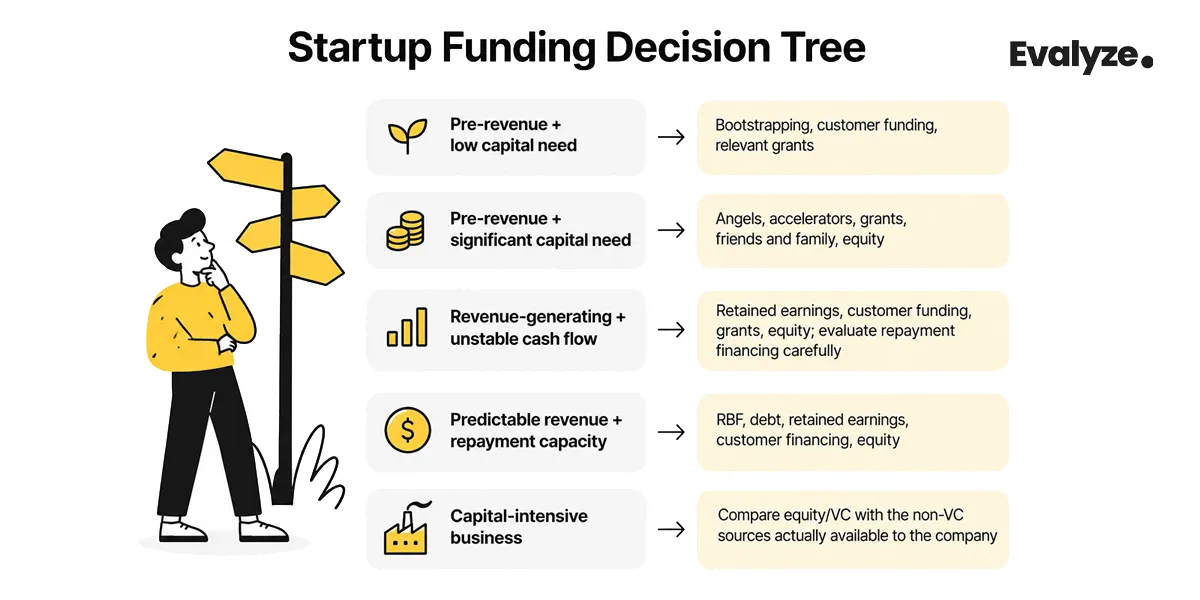
Stage is useful, but cash flow and capital needs often tell you more.
A pre-revenue company has fewer practical repayment-based options because it has no established cash flow to service financing.
Depending on the business, founders may investigate bootstrapping, direct customer commitments, friends and family, angels, accelerators, eligible grants, or other equity capital.
Focus on the next milestone: Product completion, technical validation, regulatory progress, first customers, or another event that materially changes the company's financing position.
Revenue expands the menu, but inconsistent cash flow can make repayment obligations risky.
Reinvested revenue, direct customer financing, grants where eligible, crowdfunding, and equity may remain relevant. Debt availability depends on the company and lender, but eligibility alone does not mean the repayment profile is healthy.
Predictable revenue makes additional financing structures easier to compare. Retained earnings, customer financing, RBF, debt, and equity may all be on the table.
At this stage, the decision becomes less about which option is technically available and more about the relative cost of using future cash flow versus selling additional ownership.
A useful financing decision starts with the business problem the money has to solve.
A company that needs $50,000 to finish an MVP faces a different financing problem from one that needs $5 million before commercialization.
Define the milestone first.
Ask:
What should be true about the company after this capital has been spent that is not true today?
Then calculate what reaching that point realistically costs.
The use of funds affects which capital structure the company can support.
The more uncertain the outcome, the more carefully founders should evaluate financing that requires repayment regardless of whether the initiative succeeds.
For RBF, conventional debt, credit facilities, and venture debt, model the downside rather than only the expected case.
What happens if revenue comes in materially below plan? Can the business still pay employees, maintain operations, and fund critical development?
Preserving equity is useful only when the repayment structure remains manageable.
VC, angels, equity crowdfunding, equity-taking accelerators, and some friends-and-family structures can dilute founder ownership.
Dilution has a meaningful long-term cost if the company succeeds.
It should still be compared with what the capital makes possible. Selling equity to reach a milestone the company could not otherwise finance is different from selling the same equity for capital the business could reasonably generate itself.
Some companies can reach major milestones with modest outside financing. Others require substantial capital before the business can generate meaningful revenue.
Ask what large-scale outside capital changes.
Does it finance expensive development, build infrastructure, fund a time-sensitive expansion, or allow the company to pursue an opportunity that internal cash flow cannot support?
If capital is structurally important to the company's ability to compete, equity deserves a serious comparison with non-VC alternatives.
Consider two hypothetical SaaS companies. Both need $500,000. The amount is identical. Their financing choices are not.
Startup A is still building its MVP. It has no revenue, no predictable cash flow, and needs $500,000 for engineering and its initial go-to-market effort.
The company cannot point to an existing revenue stream that could comfortably service repayment-based financing.
Depending on the founders, market, and eligibility, the realistic pool might include angels, an accelerator, grants, or another form of pre-seed equity.
The capital provider is taking product and market risk that the company cannot yet finance from operations.
Startup B generates $80,000 in MRR, has established gross margins, and has identified a customer-acquisition channel with repeatable economics. It also needs $500,000, this time to expand that channel.
Its founders may now compare retained earnings, customer financing, revenue-based financing, debt, and another equity round.
The difference is not the fundraising target.
Startup B has existing cash flow and can model what a repayment obligation would do to the business. Startup A cannot.
The example shows why generic rankings of the "best" startup funding sources are not particularly useful. Financing fit comes from the economics of the company and the milestone the capital has to fund.
VC can remain a practical option when a startup needs substantial risk capital before it can generate enough cash to support repayment.
That can apply to companies facing expensive product development, long commercialization cycles, infrastructure requirements, or time-sensitive opportunities where slower self-funded growth would materially change the outcome.
Equity also shifts part of the financing risk to investors instead of placing a repayment obligation on the company. The trade-off is ownership and the rights and expectations attached to institutional investment.
The comparison should therefore focus on which capital structure can finance the required milestone without creating an unacceptable repayment burden or ownership cost.
For the mechanics of VC itself, continue with What Is Venture Capital?
Once equity fundraising makes sense, the challenge shifts from choosing a funding source to running the raise well.
Evalyze.ai helps founders move through the full investor fundraising workflow in one place:
Instead of piecing together separate tools for deck feedback, investor research, shortlisting, and outreach, you can manage the process from one fundraising workspace.
Go Pro for personalized outreach and much more.
FAQ
What does “too early,” “need more traction,” or “stay in touch” actually mean? Decode 20 common VC rejection lines and decide what to do next.
August 19, 2026
Learn how investors evaluate startup readiness and the six signals that help founders build confidence before raising funding.
September 6, 2026