
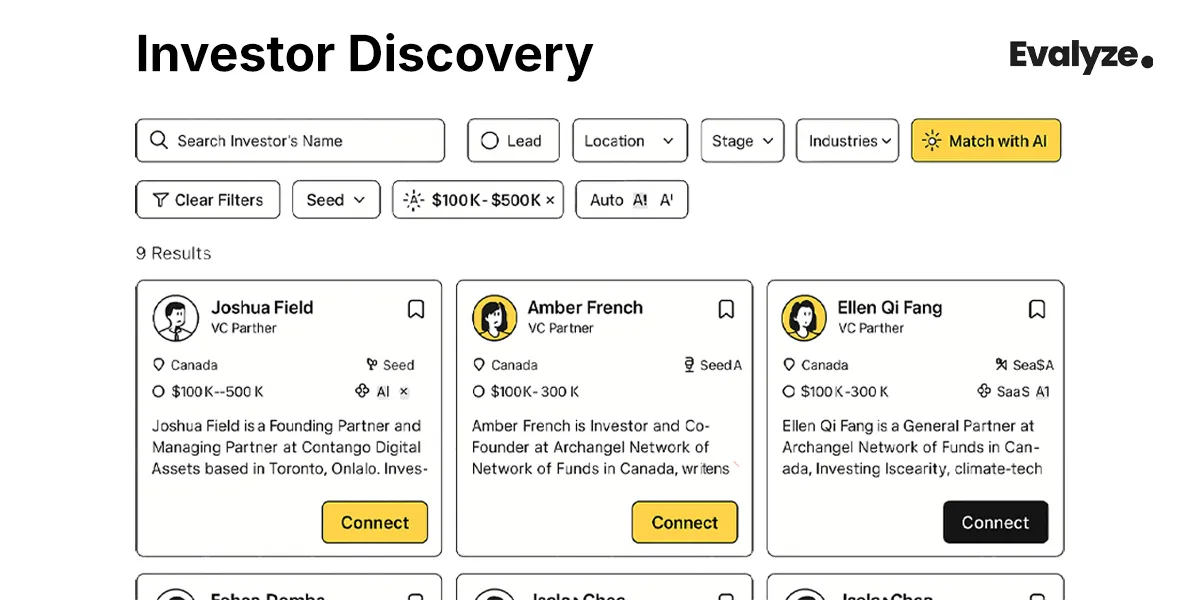
How to Use Evalyze Investor Discovery
Learn how to use Evalyze’s new Investor Discovery tool to search, filter, and shortlist investors without AI.
November 11, 2025
Learn what an AI investor match score means, what should sit behind it, and how to evaluate investor fit before outreach.
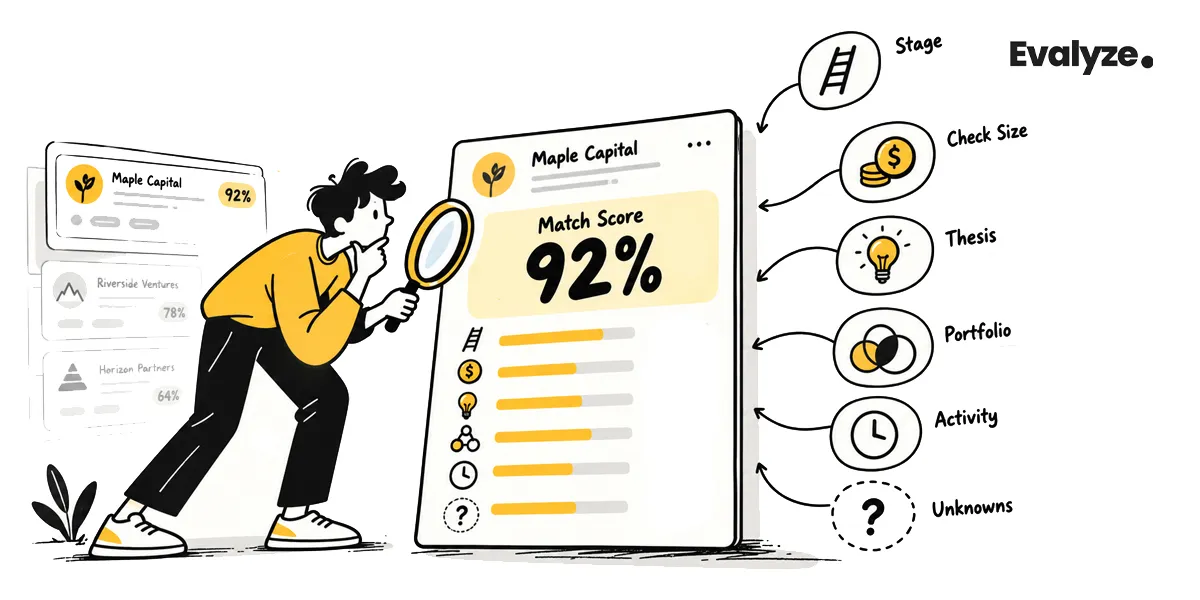
AI investor matching can reduce a long investor list into a smaller group worth researching. The score alone is not enough. Founders also need to know which signals produced the match, where the fit is weak, and which information still needs verification before outreach.
Quick answer:
AI investor matching compares information about a startup and its fundraising round with investor criteria and activity.
A useful recommendation explains why an investor appears relevant, identifies possible conflicts or missing information, and helps the founder decide who deserves further research.
A match score represents apparent fit based on available information. It does not predict who will invest.
Imagine your dashboard shows: Investor A - 92% match
The question is why 92%?
Does the investor fund companies at your stage?
Do its initial checks fit your $2 million round?
Does the investment thesis actually cover what you are building?
Is a similar portfolio company evidence of expertise or a potential conflict?
Without those answers, the score ranks the investor but gives you limited help deciding if that investor belongs in your outreach pipeline.
AI investor matching uses information about your startup and fundraising round to rank investors that appear relevant.
How the startup itself is classified also affects the result. A treasury automation company could reasonably sit under fintech, B2B SaaS, AI, financial infrastructure, or workflow automation. Overweighting one label can change which investors appear relevant.
If you are still building the initial universe rather than ranking an existing set, start with a broader process for finding investors for your startup.
Database filters and matching solve different research problems.
| Capability | Database Filtering | AI Investor Matching |
|---|---|---|
| Stage | Narrow by selected stage | Evaluate relevance to the startup |
| Sector | Filter by category | Compare the startup with investor focus |
| Geography | Narrow by region | Evaluate geographic fit |
| Check size | Apply a range | Compare investor participation with the current raise |
| Portfolio | Review companies manually | Surface potentially relevant overlap |
| Recent activity | Research manually | Use activity as a fit signal when available |
| Explanation | Depends on the database | Explain factors behind the recommendation |
| Missing information | Founder discovers it | Can flag areas that need verification |
| Final decision | Founder | Founder |
Filtering works well when you already know the criteria you want to apply. Evalyze's Investor Discovery workflow follows that research model.
Matching starts from the startup and asks a different question: which investors appear most relevant to this company and this round?
Research into investor/company recommendation systems has also examined the value of providing explanations with recommendations rather than returning rankings alone.
An investor match score is best used as a prioritization signal.
Suppose two investors receive:
| Investor | Match Score | What could be behind the score |
|---|---|---|
| Investor A | 91% | Fits your stage, sector, and check size, but may have a portfolio conflict |
| Investor B | 87% | Has stronger sector alignment, but limited activity in your geography |
The four-point difference tells you little without the reasoning behind it.
Some criteria behave more like constraints. If a fund primarily joins Series B rounds, strong sector alignment does little for a pre-seed founder.
Other criteria require interpretation. A broad interest in enterprise software does not tell you how closely the investor's current focus aligns with a vertical AI product sold to insurance teams.
The final investment decision can depend on information a matching system cannot fully observe, including the investor's current pipeline, partner conviction, fund strategy, competing deals, diligence findings, reserve allocation, and internal approval.
A high match score means the available information suggests that the investor deserves closer research.
Small score differences should also be treated carefully. An 89% match should not automatically outrank an 87% match in your outreach plan unless the underlying reasoning supports that choice.
Evalyze's seven-part framework for evaluating an investor recommendation covers stage fit, check-size fit, thesis alignment, supporting evidence, portfolio overlap, data freshness, and uncertainty.
These seven questions turn a percentage into something a founder can evaluate.
Confirm that the investor actually participates at your stage.
A fund may describe itself as "early stage" while most recent investments are Seed or Series A. If you are raising pre-seed, the broad label is less useful than the investment history behind it.
A clearer explanation would say:
Strong Seed-stage fit based on recent Seed investments.
Recent deals give you something concrete to assess instead of relying on a category label.
Stage fit does not guarantee round fit.
Suppose your company is raising $1.5 million, while an otherwise relevant fund typically writes $3 million to $7 million initial checks.
The investor may understand your sector well, but its normal investment size creates an obvious question.
Check-size analysis should compare the investor's typical participation with the actual raise.
Fund fit and round fit are separate questions.
Sector tags are useful for narrowing a list, but they can hide large differences in investor focus.
Compare:
Fintech investor.
with:
The investor has backed financial infrastructure companies serving mid-market businesses, while your startup automates treasury operations for the same customer segment.
The second explanation connects the startup to a more specific investment pattern.
Public thesis information can still be incomplete. An investor may apply internal criteria that never appear on a website or database profile.
A recommendation should make clear what information supports the assessment.
Possible evidence includes recent investments, the investor's published thesis, portfolio companies, fund announcements, and current partner activity.
Compare:
Interested in AI.
with:
The investor has recently backed several B2B AI workflow companies.
The second claim is specific enough to check.
This approach is also consistent with broader explainable-AI principles. NIST's Four Principles of Explainable Artificial Intelligence states that explainable systems should provide evidence or reasons for outputs, make explanations meaningful to users, and recognize limits in their knowledge.
That framework is not a fundraising methodology. It provides a useful standard for judging how much context an AI recommendation should expose.
A similar portfolio company can indicate domain experience or create a competitive concern.
The recommendation should help you separate different kinds of overlap:
A related portfolio company does not automatically disqualify an investor.
A useful warning might say:
Possible overlap with an existing treasury-management portfolio company. Review product and customer overlap before outreach.
That gives the founder a specific research task instead of a generic conflict label.
Investor fit changes over time.
A fund can shift its sector focus. A partner can leave. A new fund can target a different stage. An investor that was active in a category two years ago may have a different mandate today.
Recent investments, fund announcements, current partner information, and updated thesis pages help establish how fresh the recommendation is.
If two investors look similar on stage and sector, the one with recent relevant activity may deserve research first.
Missing information should remain visible.
Compare:
Strong fintech match.
with:
Sector alignment appears strong, but current check-size information could not be confirmed.
The second recommendation tells you exactly what still needs research.
Another example:
Similar portfolio company detected. Direct competitive overlap has not been established.
This leads to a useful separation between two concepts:
A high-fit investor supported by limited information may require more research than a slightly lower-fit investor with clear, recent evidence.
Consider a Seed-stage B2B fintech company operating in the US and Canada.
Startup
A recommendation could look like this:
Positive signals
Questions to verify
Interpretation
Strong candidate for further research. Review the portfolio overlap and confirm participation preferences before outreach.
The score now shows why the investor ranks highly and what the founder should verify before outreach.
Use the score to decide your research order, then use the underlying fit to decide who moves into outreach.
Start with higher-ranked investors instead of manually researching the entire investor database.
A higher score earns attention first. It does not automatically earn an email.
Check which factors are driving the recommendation.
A match based mostly on stage and broad sector fit is different from one supported by check-size alignment, relevant portfolio activity, and recent deals.
Review criteria that could make the investor unsuitable for the current round:
One hard mismatch can outweigh several weaker positive signals.
Check the investor's current website, relevant partners, portfolio, recent investments, and recent fund information.
You do not need to rebuild the entire analysis manually. Verify the facts that could change your decision to contact the investor.
Turn the research into an action.
| Classification | Meaning |
|---|---|
| Priority | Strong fit with no obvious disqualifier |
| Research | Promising fit, but important information still needs verification |
| Nurture | Potential fit after another milestone or in a later round |
| Pass | Clear mismatch with the current raise |
The classification gives you a cleaner handoff from research into investor outreach.
Evalyze AI Investor Matching starts with information about your startup and raise, then returns scored investor matches with a Why This Investor explanation. The current product experience evaluates fit using signals such as stage, sector, geography, raise size, and investor information available in the platform.
The workflow connects investor research with the rest of the fundraising process:
Startup or pitch deck → matched investors → shortlist → outreach
A match means the investor appears relevant enough to investigate and potentially add to your outreach pipeline. It does not mean the investor has reviewed your company, expressed interest, agreed to a meeting, or indicated an intention to invest.
If you want a broader view of where matching fits alongside pitch analysis, investor research, and outreach, see Evalyze's guide to using AI for fundraising.
Find Investors and See Why They Match
Build a ranked investor shortlist around your startup and current raise, review why each investor may fit, and decide who belongs in your fundraising pipeline.
Find My Investor Matches →
Learn how to use Evalyze’s new Investor Discovery tool to search, filter, and shortlist investors without AI.
November 11, 2025

Use AI for fundraising the right way in 2026. Score your pitch deck, match with the right investors, and skip 40 hours of cold research. Free tool inside.
April 30, 2026