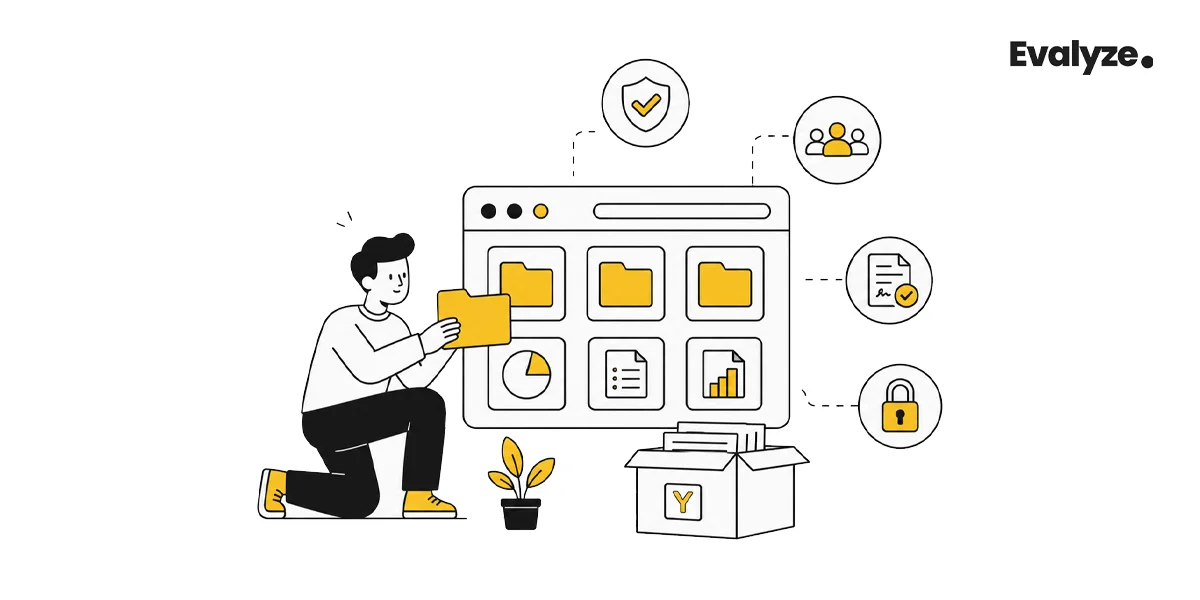
Three weeks into investor diligence, the partner asks for your MRR cohort retention by acquisition month across the last 18 months. Your data isn't organized that way. Then, legal notices a missing IP assignment from a contractor you hired two years ago. Every delay erodes the firm's confidence in the deal.
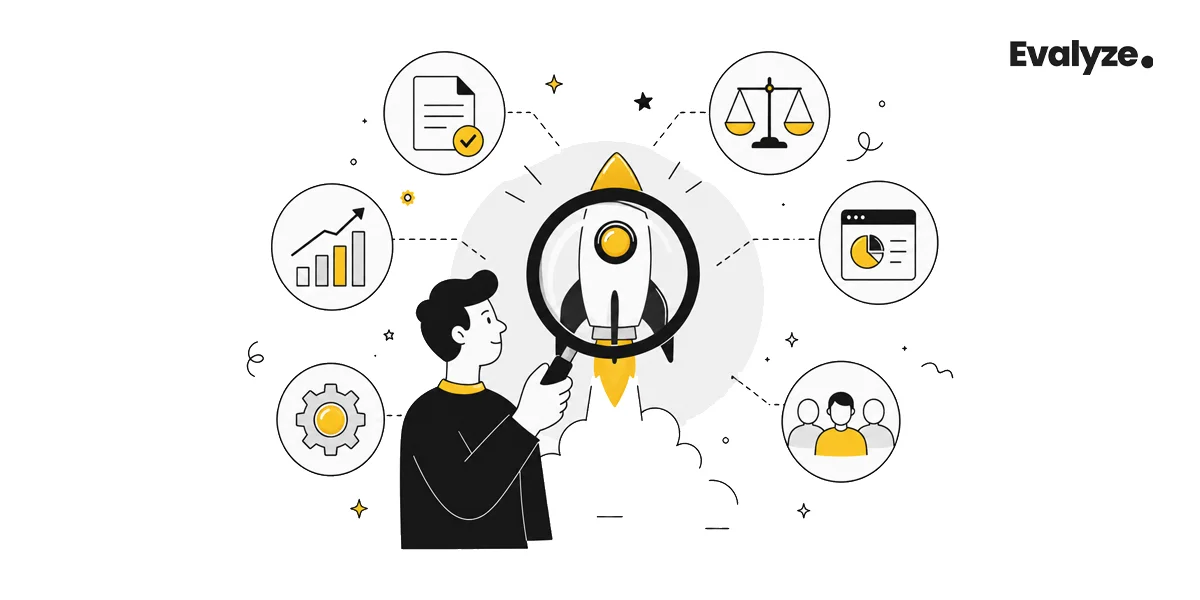
That is what startup due diligence looks like in practice: a review of the financial, legal, operational, and technical decisions behind the company.
Key Takeaways
Modern AI scans now compress document review by 40-70%, leaving no room for manual errors.
One-third of deals collapse at the final hurdle due to preventable cap table or history gaps.
Compliance standards like SOC 2 and AI bias audits are now mandatory at the Seed stage.
Using tools like Evalyze lets you resolve "deal-killers" before investors ever spot them.
A structured, README-led data room acts as an immediate signal of founder excellence.
What Is Startup Due Diligence?
Startup due diligence is the process investors use to verify a company's financials, legal structure, product, market claims, operations, and team before investing.
Most startup diligence processes last between 4 and 10 weeks, depending on stage, and deal delays often come from issues founders overlooked, such as incomplete financial reporting, outdated contracts, or missing IP assignments.
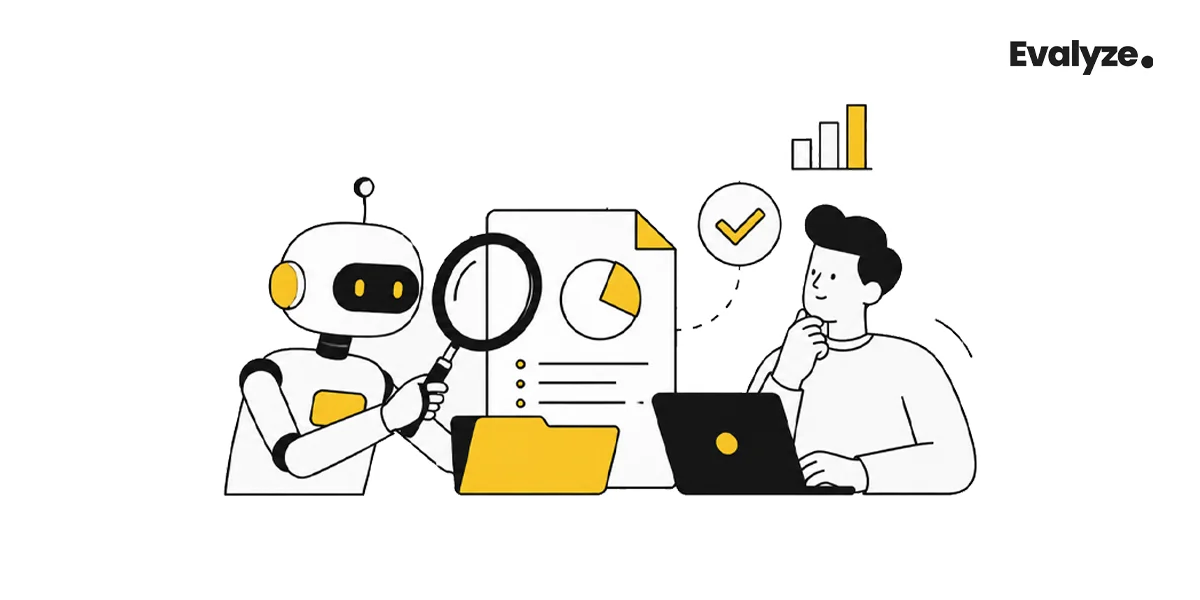
The process has become faster, not lighter. Modern investor workflows and AI-assisted review tools, including platforms like Evalyze Data Room, surface cap table errors, compliance gaps, customer churn patterns, and legal inconsistencies much earlier in the fundraising process.
The 7 Categories of Startup Due Diligence
Every diligence process breaks into the same seven buckets. Investors weigh them differently depending on stage and sector, but no one skips any of them.
1. Financial Due Diligence
Investors use this phase to audit your past, present, and projected capital. They scrutinize P&L statements, balance sheets, cash flow, burn rate, and unit economics to verify your financial health.
Seed Stage focus: Investors prioritize unit economics and burn discipline.
Series A+ focus: Scrutiny shifts to cohort retention, gross margins, and the accuracy of forecasts compared to your trailing 12-month performance.
💡The Founder’s Blindspot: The cap table audit is often underestimated. Investors re-model every SAFE, option grant, and convertible note from scratch. A messy cap table is the most frequent reason a "clean" deal is delayed by two weeks or more.
When planning your capital needs, understanding how much to raise at the pre-seed stage is a high-authority starting point for ensuring your financial model remains defensible.
2. Legal Due Diligence
This phase verifies your company’s existence, ownership, and liability. Investors confirm that no employees, contractors, or former co-founders have valid claims against your assets.
Core Audit: Covers incorporation, governance, active contracts, and regulatory compliance.
Deal Killers: Open or unresolved litigation is a major flag that typically ends a deal.
The "Delaware Standard": For C-corps, you must provide incorporation certificates, bylaws, board/stockholder consents, and stockholder agreements.
💡Critical Checklist Item: Missing 83(b) elections for founders remain a frequent and preventable friction point during legal review.
3. Intellectual Property (IP) Due Diligence
Investors must confirm that your company holds absolute ownership of its assets, including patents, trademarks, copyrights, and trade secrets. For software startups, the priority is verifying that every line of code is owned by the entity.
Contractor Risk: Agreements lacking explicit IP assignment clauses are the most frequent red flag in this category.
Open-Source Hazards: License compliance is often overlooked. A single GPL violation can force a company to relicense its entire codebase.
💡Audit Focus: Ensure every employee and contractor who has touched the product has a signed IP assignment on file to avoid ownership disputes during the raise.
4. Technical Due Diligence
Investors audit your architecture, code quality, and security to ensure the product is scalable and defensible.
Seed Stage: Usually a 90-minute call with the CTO.
Series A+: A formal audit by an outside firm, often resulting in a 30-50 page report.
High-Scrutiny Sectors: Cybersecurity and AI/ML startups face this rigor earlier.
💡What’s Checked: Expect deep dives into your infrastructure, engineering roadmap, and data security to ensure the platform supports your growth projections.
5. Commercial & Market Due Diligence
Investors verify your traction by analyzing retention, NPS, churn, sales pipeline, and competitive positioning. They will call your customers to validate your claims.
The Outreach: Your five largest customers will be asked how they use the product, their likelihood to renew, and their perception of its value.
The Risk: Reference calls are frequently where confident pitches fail.
6. Operational Due Diligence
Internal processes, supply chain, vendor relationships, key dependencies, and operational KPIs. Light at seed. Heavy at Series B and later, especially for hardware, marketplaces, and physical goods companies.
Verification: Funds run background checks and verify LinkedIn claims against employer records.
Reference Checks: Investors speak with former colleagues to validate your history.
The Consequences: Any inflated CV details that get caught typically result in a dead deal.
The Complete Startup Due Diligence Checklist
This is the version a Series A fund would expect to see in your data room. If you're at pre-seed or seed, the items marked [Early] are non-negotiable. The rest become standard from Series A onward.
Financial Documents
[Early] Profit and loss statement (monthly, last 12 months minimum)
What gets checked at pre-seed isn't what gets checked at Series C. Misreading the stage is how founders over-prepare on the wrong things and under-prepare on the rest.
Pre-Seed & Seed Due Diligence
At the pre-seed stage, there are no audited financials. There's barely a P&L. Diligence focuses almost entirely on founder credibility, problem-solution fit, and the smallest signals of traction. A pre-seed lead is buying the founder more than the company.
What pre-seed investors check:
Founder background and prior outcomes (verified through references, not LinkedIn alone)
Does problem framing help the founder understand it deeply enough to find a non-obvious angle?
Early customer or design partner interest, even if unpaid
Cap table simplicity, clean structure, no co-founders, with 5% leftover from an earlier project
Basic legal hygiene incorporated correctly, 83(b)s filed, no surprise IP claims
At seed, traction starts to matter. Customer logos, signed pilots, $10K MRR if you have it. The diligence is light by Series A standards, but the bar on financial hygiene moved up. Expect a cap table audit and an IP assignment review even at $1M raises.
The real diligence. 6-10 weeks is now standard. The fund's analyst will live in your data room. The partner will call 5-10 of your customers. The legal counsel will produce a 20-page issues list.
What changes at Series A:
Cohort retention is the single most-scrutinized metric
Sales pipeline gets stress-tested against historical close rates
Customer reference calls become formal, not casual
Technical architecture gets reviewed by an outside CTO advisor
Security and compliance reviews start (SOC 2 questions for SaaS, HIPAA for healthtech)
💡The two biggest reasons Series A diligence stalls: messy cap tables (SAFE conversions modeled wrong, options not granted on schedule) and customer references that contradict the pitch.
Before you reach this stage, ensure you've completed the full startup fundraising checklist to bridge the gap between initial preparation and final verification.
Series B Due Diligence
By Series B, the company is a real business, and diligence reflects that. Expect:
Full quality-of-earnings analysis by a third-party accounting firm
Sales efficiency benchmarks against the fund's portfolio (magic number, CAC payback)
Management background checks and 360-style reference calls
Detailed technical and security audit
Commercial diligence with 15-25 customer reference calls
This is where late-stage funds run market-validation studies on your category before they wire. If your TAM model doesn't hold up to a McKinsey-style stress test, the deal slows.
Series C & Growth-Stage Due Diligence
The same as Series B, plus public-company-grade disclosure. Cybersecurity, ESG, and regulatory posture become first-class concerns. Quality of earnings is mandatory. Insurance review is mandatory.
For cybersecurity startups specifically, late-stage diligence now standardly includes a financial-controls penetration test verifying the finance team's processes against fraud and ransomware exposure before funding closes.
Acquisition Due Diligence
Acquirer diligence is more aggressive than any investor's diligence, because the buyer takes all the risk. Expect:
Comprehensive financial audit, including tax exposure analysis
Deep IP review, including patent landscape and freedom-to-operate
Customer contract assignment analysis (which contracts survive the acquisition, which don't)
Employee retention plans and key-person risk assessment
Cultural and operational integration assessment
Full QofE report
💡The single biggest acquisition deal-killer: change-of-control clauses in customer contracts. Top 10 customers with these clauses can require renegotiation before the deal closes, and that's where the price gets cut.
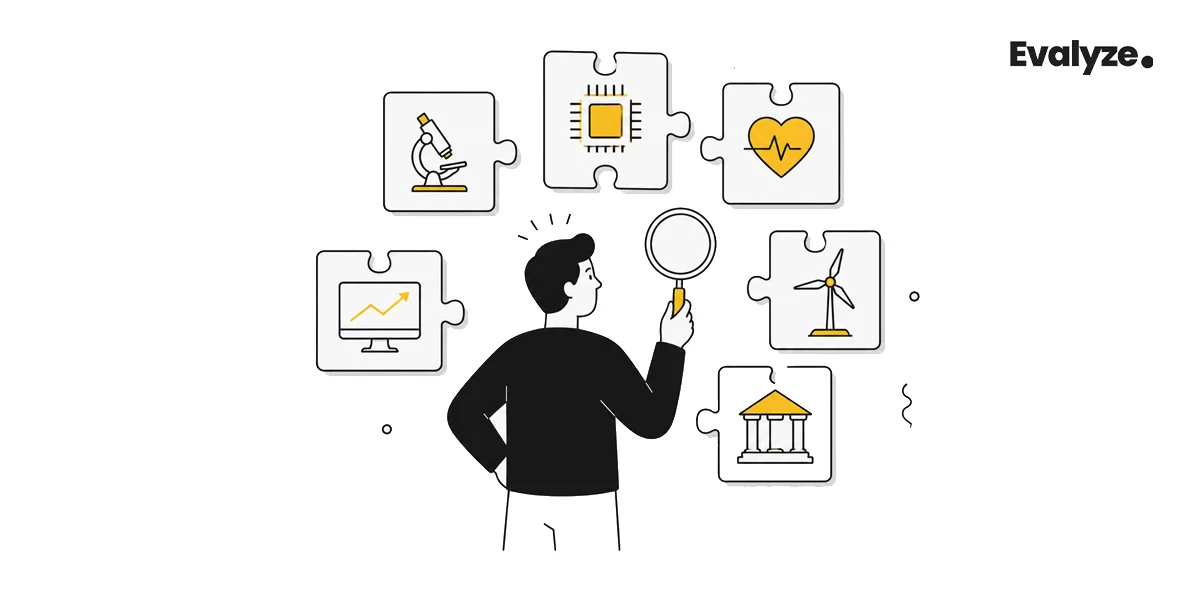
Sector-Specific Due Diligence
The sector matters more now than it did three years ago. Investors specialized in a sector check things generalists wouldn't even know to ask about.
AI and AI-Healthcare Startups
AI-specific diligence questions investors ask:
What's the provenance of your training data, and do you have rights to all of it?
How do you handle model drift and retraining?
What's your dependency on third-party foundation models (OpenAI, Anthropic, Google)?
Have you audited your model for bias, especially in regulated use cases?
What's your defensibility if a foundation model commoditizes your wrapper?
For AI healthcare specifically, add HIPAA compliance, FDA classification (is your model a regulated medical device?), clinical validation evidence, and informed-consent processes for any patient data used in training.
This is checked at seed, not Series A. The bar moved.
Cybersecurity Startups
Cybersecurity diligence at later stages now standardly includes:
A penetration test on your own product (yes, your security product gets pen-tested)
SOC 2 Type II report
Vulnerability disclosure history
Customer breach history involving your product
Financial-controls audit (the late-stage standard added in 2025)
💡Founders here often forget: your own internal security posture matters as much as the product's. A cybersecurity company with weak internal MFA discipline gets penalized.
Fintech Startups
Licensing review dominates fintech diligence. Money transmitter licenses by state, MSB registration with FinCEN, BSA/AML compliance, and partnership agreements with banks all get reviewed. For lending products, add state lending licenses and disclosure compliance. For payments, add PCI DSS attestation.
SaaS startups
SaaS gets the cleanest diligence template because the metrics are standardized: ARR, NDR, GRR, magic number, CAC payback, gross margin, and rule of 40. Where SaaS deals slow:
Customer concentration above 20% from a single account
NDR below 105% at Series A+
Long enterprise sales cycles are dragging the close-rate forecast
Self-serve products with weak retention beyond month 3
Red Flags That Kill Startup Deals
These are the patterns that consistently end deals in the last week of diligence. From analyzing 8,000+ fundraisers at Evalyze, these are the ones that show up over and over.
Cap table inconsistencies.
SAFE notes were never converted on the books. Option grants were made verbally and never papered. Co-founders with vested equity from a project that never separated cleanly. Investors model the cap table from scratch, and gaps surface fast.
Customer references that contradict the pitch.
"We're seeing 95% retention" → customer says, "we're not renewing." This is the single most common late-stage deal killer.
Unassigned IP.
Contractor wrote 30% of the codebase in 2022 with no IP assignment agreement. Investors will require remediation before close, and sometimes the contractor uses the opportunity to renegotiate.
Founder background discrepancies.
LinkedIn says "VP at Stripe." Stripe says "contractor for 4 months." This ends deals, every time.
Open litigation that wasn't disclosed.
Anything not surfaced by the founder that the investor finds via a court records search is a trust killer.
Stale customer contracts.
The MSA expired in 2023, no one renewed it formally, and the customer relationship runs on a handshake. Acquirers especially hate this.
Aggressive financial projections without trailing data to support them.
A 5x year-over-year forecast against trailing 1.5x growth is a credibility hit.
Misrepresented traction.
Counting paid pilots as ARR. Counting LOI revenue as committed revenue. Counting freemium users as customers. Investors verify the definitions you used.
Founders ask which tools to use to prepare for diligence. Investors ask which tools to use to run diligence on you. The two lists overlap more than you'd think.
Comparison Of Leading Due Diligence Tools
Tool
Primary use
Built for
Standout feature
Best for
Evalyze.ai
Pre-DD readiness
Founders
Investor Readiness Score + red-flag detection across 8,000+ fundraises + Data room
Founders running pre-DD self-check
DiligenceVault
DD workflow + AI document review
Investors (LPs, GPs)
AI-powered DD questionnaires + response analytics
Funds running structured DD at scale
Kira Systems
Contract analysis
Law firms, investors
ML-trained contract clause extraction across 1,000+ clause types
Legal DD on complex contracts
Carta
Cap table + equity management
Founders + investors
Auto-generated 409A valuations and cap table audits
Cap table hygiene before DD
DocSend
Data room + analytics
Founders
Per-page deck and document analytics
Data room sharing with read tracking
Papermark
Open-source data room
Founders (technical)
Self-hosted DocSend alternative with deck analytics
Cost-sensitive founders who want control
Crunchbase
Investor research + DD prep
Both
Funding history + investor activity tracking
Sourcing-side DD on competitors
PitchBook
Institutional DD data
Investors (institutional)
Deal terms, valuations, comparables
Comparables analysis at Series B+
Harmonic.ai
AI-native startup discovery
Investors (VCs)
20M+ company graph with signal-based scoring
Sourcing and competitive benchmarking
Tracxn
Sector-specific market mapping
Investors
Live-updated sector and country reports
Market-validation DD in specific verticals
Synaptic
Alternative data on private companies
Investors
Web traffic, employee headcount, sentiment data
Quant-driven DD on growth-stage companies
Specter
Private company alternative data
Investors
Real-time growth signals across 50M+ companies
Pre-deal sourcing + DD validation
Grata
Private company search
PE, M&A teams
Inverse-search on private companies by description
M&A target screening
SourceScrub
Bootstrapped company data
PE, growth equity
Conference attendee + private company data
Diligence on bootstrapped acquisition targets
People Data Labs
People + company data API
Investors, sales
API access to 3B+ people profiles
Background verification on founders + key hires
Dealroom
European startup database
Investors
Strongest European data coverage
DD on European startups + ecosystems
Affinity
Relationship intelligence CRM
Investors
Email + meeting graph to map warm intros
Mapping DD network and references
How to Use These Tools As a Founder
Investors will likely screen your company through platforms like Harmonic, Specter, Synaptic, or Tracxn before your first meeting. They use these to cross-check headcount via People Data Labs and monitor your hiring velocity, web traffic, and sentiment scores.
The Reality: You cannot control external databases, but you can ensure your data room aligns with what these tools surface.
Founder Essentials: Use Evalyze for deck analysis and data room, Carta for cap table hygiene, and DocSend or Papermark for secure data room sharing before you start raising.
How AI Is Changing Startup Due Diligence
The shift in the last 18 months: AI moved from "useful at the margin" to "default for first-pass review." Here's what that actually looks like.
Document review.
AI tools scan thousands of pages of contracts, financials, and corporate documents in minutes, flagging inconsistencies, unusual clauses, and missing items. What used to be the associate's week-one task is now the associate's hour-one task.
Financial inconsistency detection.
AI cross-references statements across documents, bank statements vs. P&L, cap table vs. board consents, customer list vs. revenue breakdown, and surfaces gaps automatically.
Market validation.
AI tools compare a startup's market claims against real-time industry data, traffic patterns, and competitor signals. The phrase "we're growing 30% month-over-month" gets checked against alternative data sources before the meeting ends.
Pitch deck pre-screening.
AI agents like Evalyze.ai simulate an investment committee, scoring decks against patterns from successful fundraises. Founders use this before sending; investors use this after receiving. Of 8,000 decks Evalyze analyzed, 67% had at least one issue that would surface as a flag in formal DD, most commonly missing competitive moat detail, unclear unit economics, or aggressive financial projections without supporting cohort data.
Background verification.
AI cross-references founder claims against multiple data sources (LinkedIn, court records, employment databases, news archives) faster than any human background check.
How To Build a Y Combinator-Style Data Room
The YC standard is the closest thing to a universal data room template that founders raising should follow. It's organized for the way investors actually read, not the way founders organize files.
The folder structure that works:
01- Overview
Pitch deck (current version, dated)
Executive summary (1 page)
Pitch deck (prior versions, for transparency)
02- Financials
Historical P&L (monthly, 24 months)
Balance sheet (last 3 quarters)
Cash flow statement
Financial model (3-year forecast, downloadable .xlsx)
Unit economics summary
Cohort retention analysis
03- Cap_Table_and_Equity
Current cap table
Cap table model with proposed round
All SAFE and note documents
Option pool history
409A valuation
04- Corporate_and_Legal
Certificate of incorporation
Bylaws
Stockholder agreements
Board consents (chronological)
83(b) elections
Material contracts
05- IP
IP assignment agreements (employees + contractors)
Patent filings
Trademark registrations
Open-source compliance audit
06- Product_and_Tech
Product roadmap
Architecture overview
Security and compliance certifications
07- Commercial
Customer list (with contract values and renewal dates)
Top 10 customer case studies
Sales pipeline
Churn analysis
Market sizing model
08- Team
Founder bios
Org chart
Key hire resumes
Employment agreements
Reference contacts
09- References_and_Press
Investor and customer references
Press coverage
Awards and recognition
Two principles to follow:
Every document is dated (in the filename, not just inside the doc),
And every folder has a one-line README explaining what's inside and what's missing.
Investors form an opinion about your operational quality in the first five minutes of opening the data room. A clean, dated, README-d structure is a free five-minute trust deposit.
Most founders discover diligence issues three weeks into a six-week process when they are already too expensive to fix. Pre-diligence work allows you to resolve red flags while you still control the narrative.
Analyze Your Deck: Get your Investor Readiness Score in 2 minutes as Evalyze scans your deck against patterns from 8,000+ fundraises.
Manage Your Data Room: Use the Evalyze Data Room to select and manage your pitch decks based on key features, ensuring your documentation is airtight.
Pre-empt Red Flags: Surface the issues investors will flag before they ever open your data room.