

30 US VCs For Early Stage Startups
Your guide to the top 30 early-stage VCs and how to find the right fit.
September 15, 2025
Copy 7 investor follow-up email templates for meetings, unanswered pitches, traction updates, diligence, and rejections. See what to send and when.
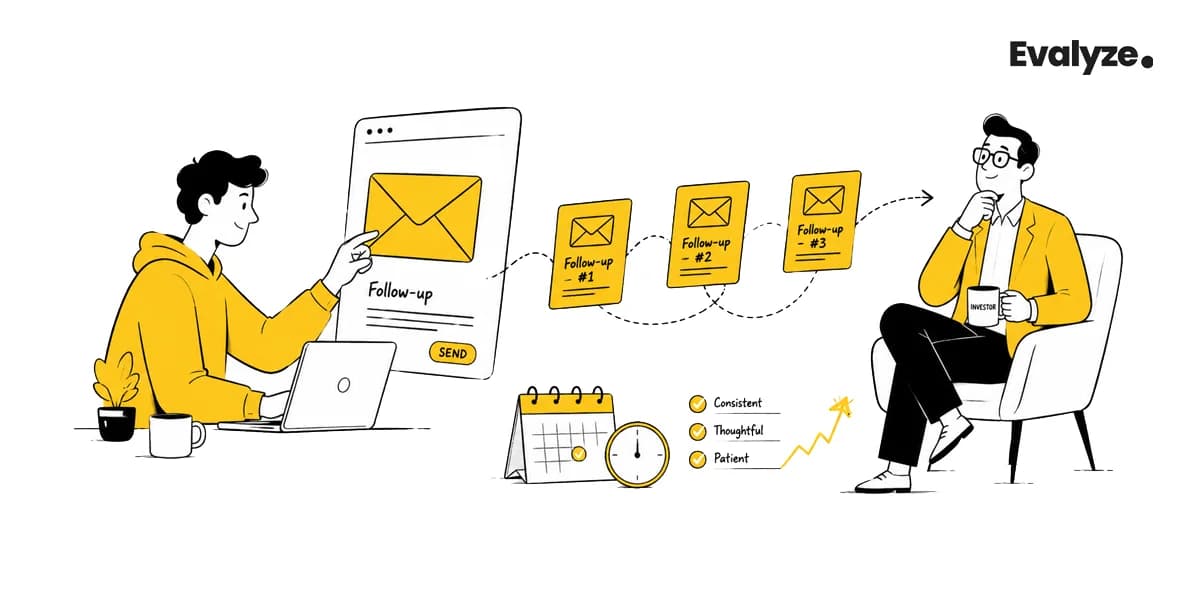
Send your follow-up on the same day or within 24 hours after an investor meeting. Mention one specific point from the conversation, share anything you promised, and suggest a clear next step.
If your first pitch received no reply, wait three to five business days before following up. Skip “just checking in” and give the investor a useful reason to respond, such as a new result, an answer, or a decision.
The templates below cover the follow-up situations founders face most often.
Key Takeaways
Not every investor conversation needs the same email. Find the situation closest to yours, then jump to the matching template.
| Your situation | Recommended timing | Template |
|---|---|---|
| You completed an investor meeting | Same day or within 24 hours | Post-meeting follow-up |
| The investor requested documents or answers | As soon as the materials are ready | Requested-materials email |
| Your first pitch received no response | After three to five business days | First follow-up |
| You reached a meaningful milestone | When it changes the investment case | Traction update |
| The investor showed interest but gave no next step | Within one or two business days | Diligence follow-up |
| The investor passed because of a specific concern | After addressing that concern | Post-rejection update |
| Your planned follow-ups received no response | At the end of the sequence | Close-the-loop email |
A standard cadence can help you stay organized, but the investor’s own timeline should always come first.
Suppose an investor tells you:
“I’ll discuss this with the partnership on Friday and get back to you early next week.”
Do not send a reminder on Friday just because three business days have passed. Give them the time they asked for. If you have not heard back by the end of the promised window, follow up one business day later.
The same applies when an investor asks you to reconnect after reaching a milestone. Contact them once you have real evidence that addresses their concern, not simply because a few weeks have passed.
For an unanswered first pitch, this sequence gives you a sensible starting point:
| Sequence step | Timing | What changes |
|---|---|---|
| Initial email | Day 0 | Send the original pitch |
| First follow-up | Day 3-5 | Restore context or add a brief update |
| Second follow-up | Day 7-10 | Share a useful answer, result, or milestone |
| Final email | Around Day 14 | Close the loop or propose reconnecting later |
Stop the sequence when the investor replies, declines, requests information, or gives you another date.
Monthly or quarterly investor updates are different from an unanswered outreach sequence. Ask before adding someone to recurring updates.
Choose the template that matches the current stage of your conversation. Then replace the brackets with details that could only apply to that investor and your company.
✍️ Use this when: You have completed an introductory call, pitch meeting, office meeting, or partner conversation.
⏰ Send it: On the same day or within 24 hours.
Subject: Thanks, [Name] - follow-up on [Company]
Hi [Name],
Thank you for the conversation today. Your question about [specific topic] helped me see where we need to explain [issue] more clearly.
As discussed, I’m sending [requested document, metric, customer reference, or deck link]: [link].
Our next milestone is [specific milestone] by [date]. Would it make sense to schedule a [follow-up call, product demo, or partner meeting] to look more closely at [topic]?
I’m available [time option one] or [time option two]. You can also choose another time here: [calendar link].
Best,
[Your name]
[Role], [Company]
Personalize:
❌ Do not send this if: You still need time to prepare an accurate answer. Send a short acknowledgment instead and tell the investor when the full response will arrive.
For a closer look at what may happen after the first conversation, read What Happens After the Pitch?.
✍️ Use this when: The investor asked for your deck, financial model, data room, customer information, or an answer you could not provide during the meeting.
⏰ Send it: As soon as the information is complete and accurate.
Subject: [Company] - requested materials
Hi [Name],
Following our conversation, I’ve prepared the materials you requested:
On your question about [topic], the short answer is [direct answer]. You can find the supporting figures in [document or section].
Would a short walkthrough be useful? I can make time on [day and time] or [alternative day and time].
Best,
[Your name]
[Role], [Company]
Personalize:
❌ Do not send this if: The materials contain conflicting figures, unfinished projections, or sensitive customer information that has not been approved for sharing.
Use controlled links instead of attaching several large files. Before sending, open every link in a private browser window to confirm that the investor can access it.
✍️ Use this when: You sent a relevant pitch to a qualified investor and did not receive a reply.
⏰ Send it: Three to five business days after the original email.
Subject: Re: [Company] - [specific traction signal]
Hi [Name],
I’m following up on the note below because [Company] appears to fit your work in [specific sector, stage, or portfolio area].
Since my first email, we have [new customer, product milestone, revenue result, signed pilot, or other relevant development].
We’re raising [amount] to reach [specific milestone]. Would you be open to a short introductory call next week?
Deck: [link]
Best,
[Your name]
Personalize:
❌ Do not send this if: You have since discovered that the investor is not a credible fit for the round.
Keep this email easy to understand and easy to forward. The investor does not need your full company history again. They need a quick reminder of why the opportunity might be relevant now.
✍️ Use this when: Your startup has reached a milestone that could change how the investor sees the opportunity.
⏰ Send it: Once the result is meaningful enough to justify reopening the conversation.
Subject: [Company] update - [specific milestone]
Hi [Name],
A short update since we last spoke: [Company] has now [reached the milestone].
That moves us from [previous position] to [current position] and addresses the question you raised about [market demand, retention, revenue, product readiness, or another concern].
We are still raising [amount] to reach [next milestone]. Would you be open to reviewing the updated numbers or scheduling another conversation?
Updated deck: [link]
Best,
[Your name]
Updates worth sharing may include:
A website redesign, event appearance, minor feature release, or general press mention rarely gives an investor enough reason to reconsider the company on its own.
❌ Do not send this if: The update sounds positive but does not change the company’s risk, growth case, or readiness for the round.
✍️ Use this when: The investor has shown interest or completed a meeting, but you are not sure what happens next.
⏰ Send it: Within one or two business days, unless the investor gave you another date.
Subject: Next step for [Company]
Hi [Name],
Thank you again for taking the time to review [Company].
Based on our conversation, the remaining questions seem to be [question one] and [question two]. We can address them through [product demonstration, metrics review, customer call, or data-room walkthrough].
Would the right next step be a follow-up with you, a partner meeting, or a review by another member of your team?
I can prepare the relevant materials once I know which path would be most useful.
Best,
[Your name]
This version does not assume the investor is ready for a partner meeting. It gives them room to explain their process while still moving the conversation forward.
❌ Do not send this if: The investor has already told you what comes next. Complete that task rather than asking them to explain it again.
✍️ Use this when: The investor gave you a specific reason for passing, and you have now addressed it.
⏰ Send it: After reaching the milestone or making the substantial change they wanted to see.
Subject: [Company] milestone update - [result]
Hi [Name],
When we last spoke, you mentioned that [specific concern] prevented you from moving forward.
We have now [specific action or result], including [supporting metric, customer, contract, or product evidence]. This changes [the relevant part of the investment case].
We’re continuing the round and plan to [next milestone] by [date]. Would this progress justify another look from your team?
Updated deck: [link]
Thank you again for being direct with your feedback.
Best,
[Your name]
Personalize:
❌ Do not send this if: The investor gave you a general “not a fit” response without a clear condition for reconsideration. Return only after a material change, not a minor update.
Investor rejection language is not always easy to interpret. Decoding Investors’ Feedback After a Pitch explains how to separate actionable concerns from polite passes.
✍️ Use this when: Your original email and planned follow-ups received no response.
⏰ Send it: Around Day 14 or at the end of your defined sequence.
Subject: Closing the loop on [Company]
Hi [Name],
I’ll close the loop on my earlier messages about [Company].
We’re building [one-sentence company description] and raising [amount] to reach [milestone]. Based on your focus on [specific investment area], I thought the round could be relevant.
If the timing is wrong, I’m happy to reconnect after [specific milestone or date]. If the company falls outside your current thesis, no response is needed.
Thank you for considering it.
Best,
[Your name]
❌ Do not send this if: The investor asked you to contact them later, has an active out-of-office response, or is already reviewing your materials.
Once the email is sent, mark the investor as no response, paused, or revisit after a milestone. The investor funnel template can help you keep track of contact dates, pipeline stages, and next actions.
A referral request makes sense when it follows a real conversation and the investor has suggested that your startup might fit somewhere else.
Subject: One referral question on [sector]
Hi [Name],
Thank you for the direct feedback on our round.
You mentioned that [Company] may be better suited to investors focused on [stage, sector, geography, or check size]. Is there one person or fund you think we should research?
I’ve included a short description you can forward:
[Company] helps [customer] solve [problem] through [product]. The team has [traction signal] and is raising [amount] to reach [milestone].
A name is more than enough. I appreciate the guidance.
Best,
[Your name]
Ask for a referral when the investor has suggested a better fit or has shown a genuine interest in helping. Not every rejection needs to end with an introduction request.
A good follow-up helps the investor remember the conversation, understand why the new information matters, and decide what to do next without digging through a long email thread.
Bring the investor back to the specific conversation you had.
✅ Better:
You asked how customer acquisition costs could change as we expand beyond founder-led sales.
❌ Too vague:
I wanted to follow up on our recent conversation.
The first version immediately reminds the investor what you discussed. The second asks them to do the work of remembering.
Share an answer, document, result, or decision that changes the conversation. Then explain what that information proves.
❌ Too vague:
We signed another customer.
✅ More useful:
We signed a second paid hospital pilot, giving us evidence that the sales process works outside our original university network.
The new customer is only part of the update. The evidence behind it is what may change the investor’s view.
Give the investor one decision to make:
An email that asks for a meeting, detailed feedback, a referral, and a deck review at the same time is harder to answer.
Offer two time options or include a calendar link. When you need a yes-or-no answer, ask a direct question.
❌ Avoid:
Thoughts?
✅ Use:
Would a 20-minute metrics review on Tuesday or Wednesday be useful?
A useful subject line tells the investor which company the email concerns and why you are contacting them now.
Skip vague subject lines such as “Checking in” or “Following up.” They give the investor no reason to prioritize the message.
Automation can help you remember dates, prepare drafts, and keep your investor pipeline organized. It should not make every investor receive the same message.
You still need to decide who belongs in the sequence, why they are a fit, and what has changed since the last contact.
Check the investor’s:
Sending more emails will not help when the people receiving them do not invest in companies like yours.
The guide to building an investor list explains how to qualify and prioritize investors before outreach.
Use a detail connected to the investor’s thesis, portfolio, public comments, or your earlier conversation.
👎 Generic:
I admire your impressive portfolio.
👍 Specific:
Your investment in [Portfolio Company] suggests that you already understand the procurement problem we face in regional hospitals.
The rest of the email can follow a repeatable structure. The reason you chose that investor should still feel personal.
A follow-up might be triggered by:
This keeps you from sending the same email to every investor on the same schedule.
Any response should stop the scheduled sequence.
Once the investor replies, the conversation has moved to a new stage. Your next email should respond to what they actually said rather than continue an earlier automation.
Every active investor record should contain:
With Evalyze Fundraising Automation, founders can prepare personalized outreach, schedule follow-ups, and manage investor conversations alongside their shortlist.
The AI-powered investor outreach guide explains where automation can save time and where the founder still needs to make the call.
Open data alone will not tell you whether your fundraising conversations are moving forward. Pay closer attention to actions that show real investor interest.
Replies ÷ delivered emails
This tells you how many delivered emails generated any response.
Track both:
The first tells you how the overall sequence performs. The second helps you understand the quality of the responses.
Meetings booked ÷ qualified investors contacted
Use qualified investors as the denominator. Otherwise, a large number of poor-fit contacts can make the result difficult to interpret.
Keep track of requests for:
These requests show that the conversation is progressing, even before another meeting is booked.
Measure the number of days between the first email and a confirmed action, such as a meeting, document request, partner review, or final pass.
Treat open rate as a directional signal rather than a firm measure of investor interest. Privacy protections, automated security checks, and email-client behavior can make open data less dependable than replies and meetings.
Before sending, confirm that:
A follow-up cannot turn a poor investor match into a strong one. It can make a relevant company easier to assess, move an active conversation toward a decision, and prevent important details from being forgotten.
Build the right list. Keep a clear record of what each investor says. Follow up when you have a reason.
FAQ
Your guide to the top 30 early-stage VCs and how to find the right fit.
September 15, 2025

Launch your startup with 32+ top product launch sites. Build week-one momentum, secure B2B reviews, and convert traction into a funded round with Evalyze.
May 23, 2026