How to Create an Investor Campaign with Evalyze.ai
Simplify and Enhance Your Fundraising with AI-Driven Investor Matching.
July 10, 2025
See how the Evalyze AI Pitch Coach audits your deck. Learn to identify the specific flaws and landmines that cost founders meetings.
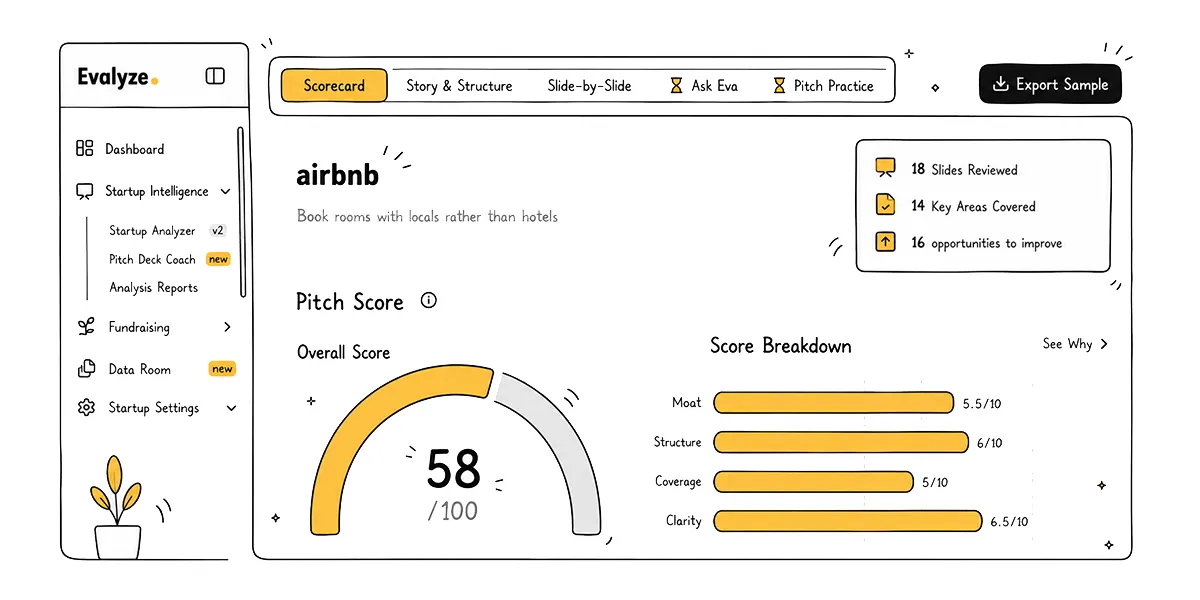
Evalyze’s AI Pitch Coach reviews your deck by deploying specialized AI agents that simulate a full investment committee. These agents work in parallel to audit your narrative, compare your metrics against successful raises, and flag the logical contradictions that human readers often miss.
If you want to see this in motion before reading the rest, here's the full walkthrough:
Evalyze's AI Pitch Coach is a multi-agent system that reviews your pitch deck the way a VC partner would in a meeting, scoring narrative flow, benchmarking metrics, flagging logical red flags, and predicting the toughest questions you'll be asked.
You upload a PDF, and roughly one minute later, you get a scored, slide-by-slide audit with specific fixes you can apply before your next investor meeting.
A few things worth being precise about, because the category is full of look-alikes:
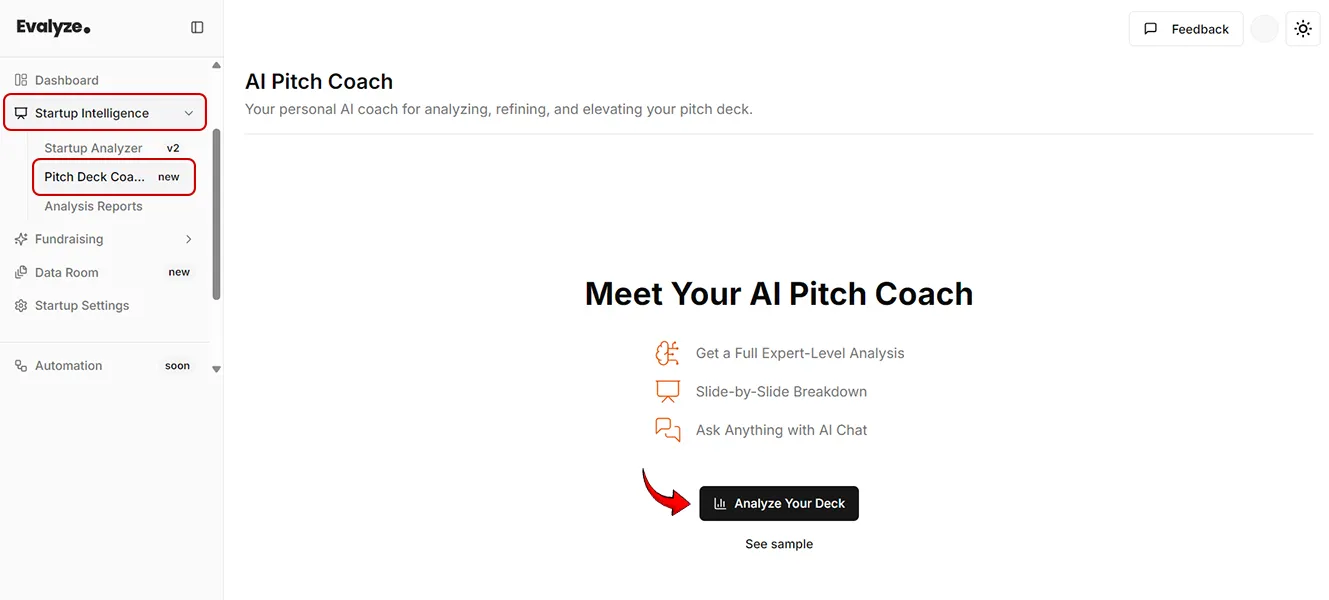
You select a PDF from your computer. That's the entire setup.
While the analysis runs, the system is doing four things in parallel:
That last one is what most tools miss. A single-pass LLM read won't catch that your Slide 10 says "$200M revenue projected by 2011" and your Slide 18 says "$2M revenue over 12 months" because by Slide 18, it's forgotten what was on Slide 10. The Pitch Coach's logic agent specifically looks for that.
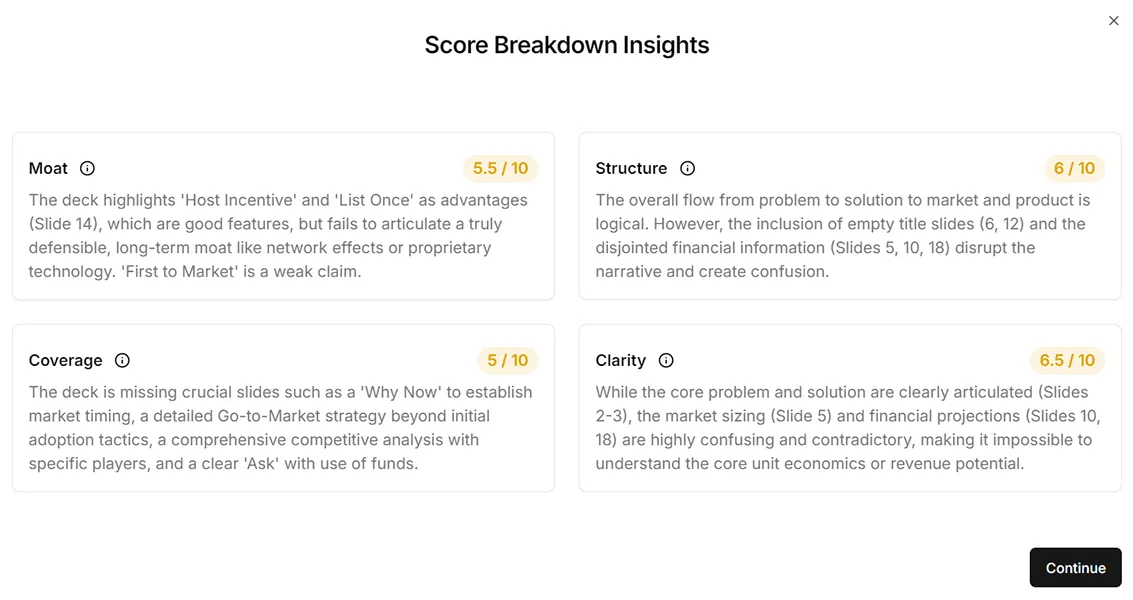
The first thing you see is a single number out of 100, along with four sub-scores.
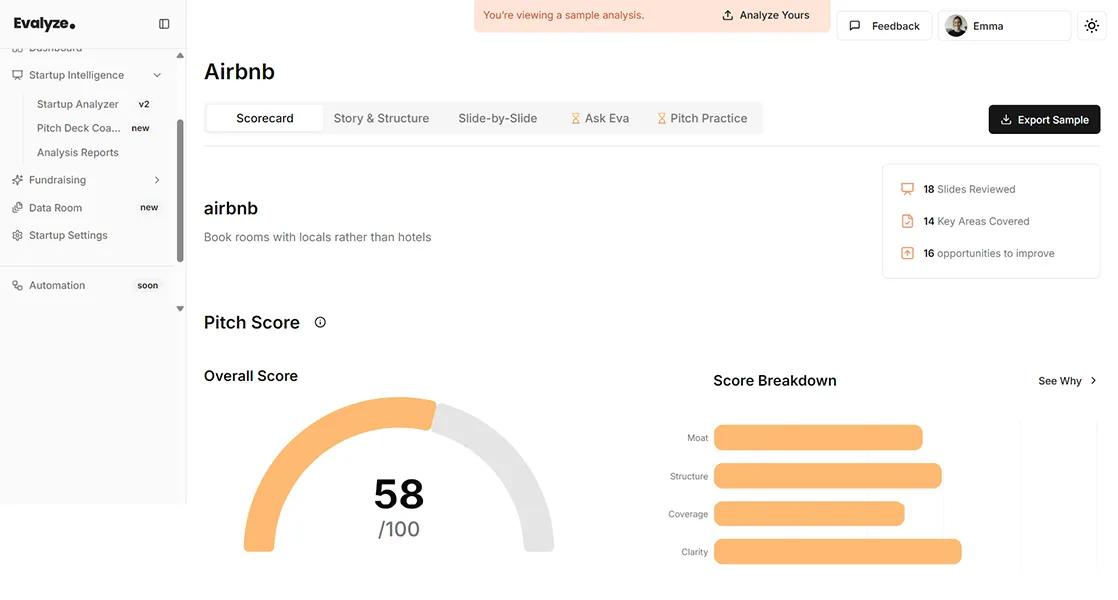
For Airbnb, it looked like this:
| Dimension | Score | What it measures |
|---|---|---|
| Overall | 58/100 | The composite of the four below |
| Clarity | 6.5/10 | Are core ideas immediately understandable? |
| Structure | 6/10 | Does the narrative flow from problem to ask? |
| Moat | 5.5/10 | Is there a defensible long-term advantage? |
| Coverage | 5/10 | Are critical slides (Why Now, GTM, Ask) present? |
You also get a green flag and a red flag. Airbnb's green flag was the dual-sided value proposition for travelers and hosts. The red flag was the financial inconsistency. We mentioned that the $200M / $2M / 84M trips numbers couldn't be reconciled across slides 5, 10, and 18.

Two notes on how to read this score:
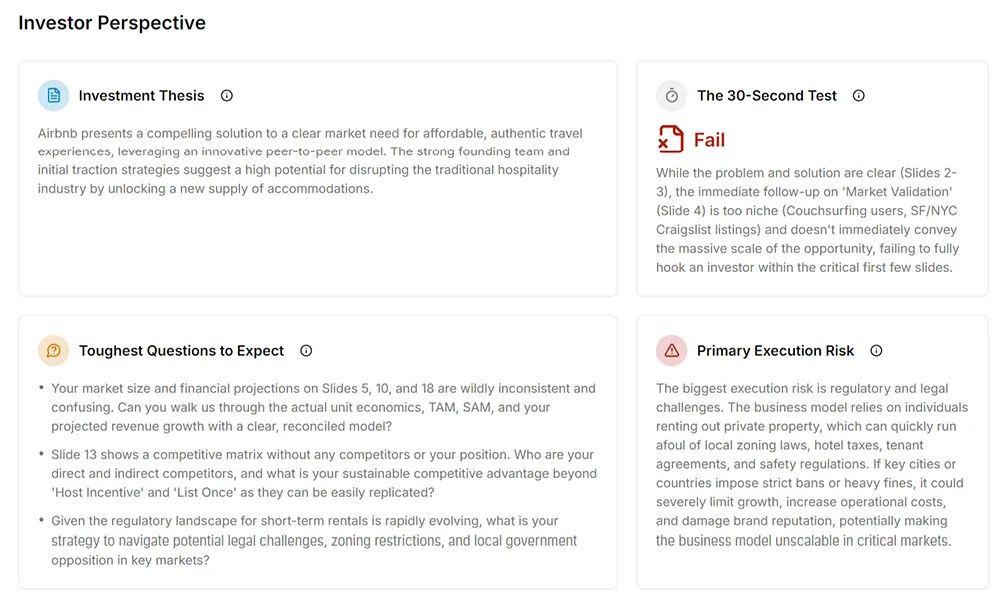
This section is where the AI Pitch Coach delivers its greatest value. While scores are useful for tracking progress, the Investor Perspective acts as a strategic script for your next VC meeting.
The AI provides a high-level summary of your deck’s strengths. Airbnb, it highlights a compelling solution to a clear market need and a strong founding team with the potential to disrupt the traditional hospitality industry through a peer-to-peer model.
Investors often decide whether to continue reading within the first few slides. The AI flags whether your deck hooks them immediately.
Based on gaps and contradictions in your deck, the system predicts the hardest questions you’ll face.
The AI identifies the "single biggest thing" that could kill the business. For Airbnb, it correctly identified Regulatory and Legal Challenges. Predicting that zoning laws and hotel taxes would be the primary battleground allowed the founders to prepare for the exact struggle they would face for the next decade.
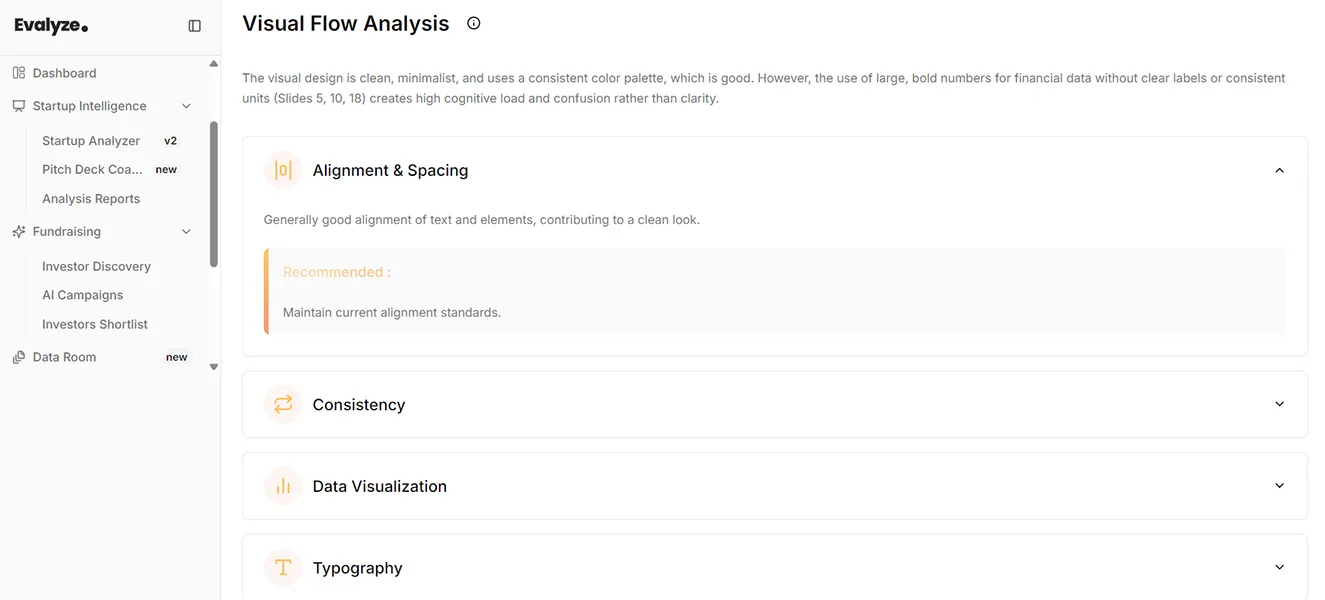
Switch to the Story & Structure tab for a top-down audit of your deck’s health. Instead of just guessing if your story makes sense, the AI performs a Structure Analysis to identify content gaps and a Visual Flow Analysis to catch design friction.
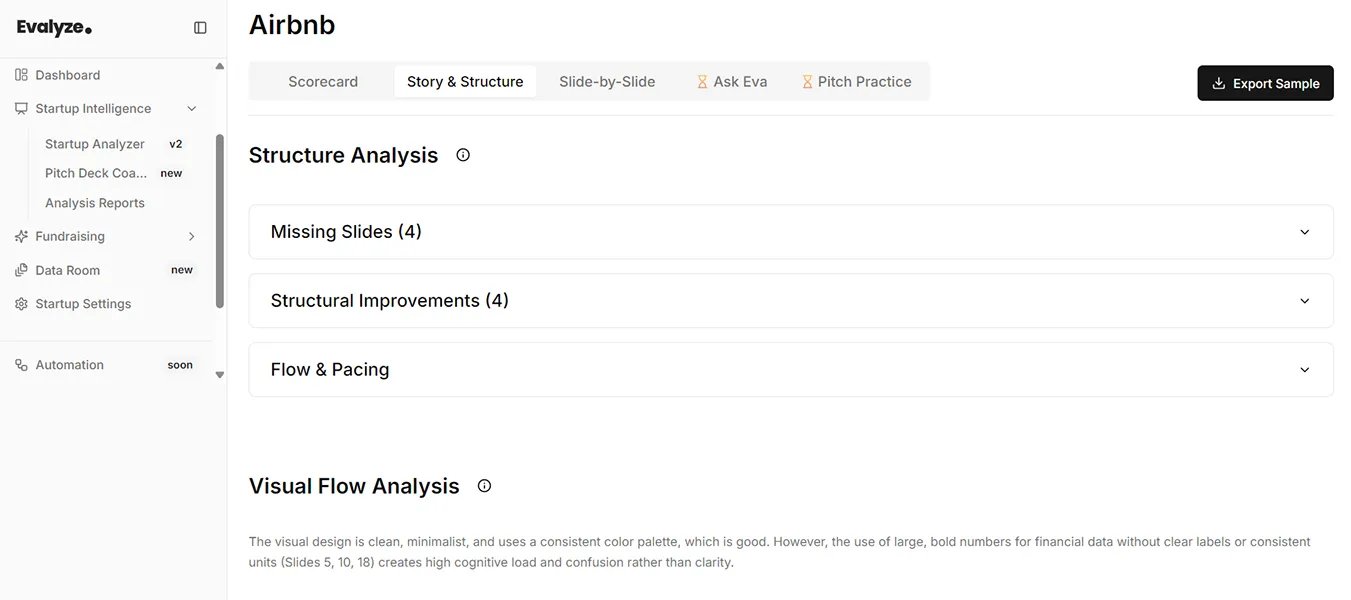
The tool doesn't just analyze what you wrote; it identifies what you forgot. For the Airbnb deck, the AI flagged 3 critical missing slides that left the narrative incomplete:
The Pitch Coach evaluates the "Cognitive Load" of your deck, essentially how hard an investor has to work to understand your slides.
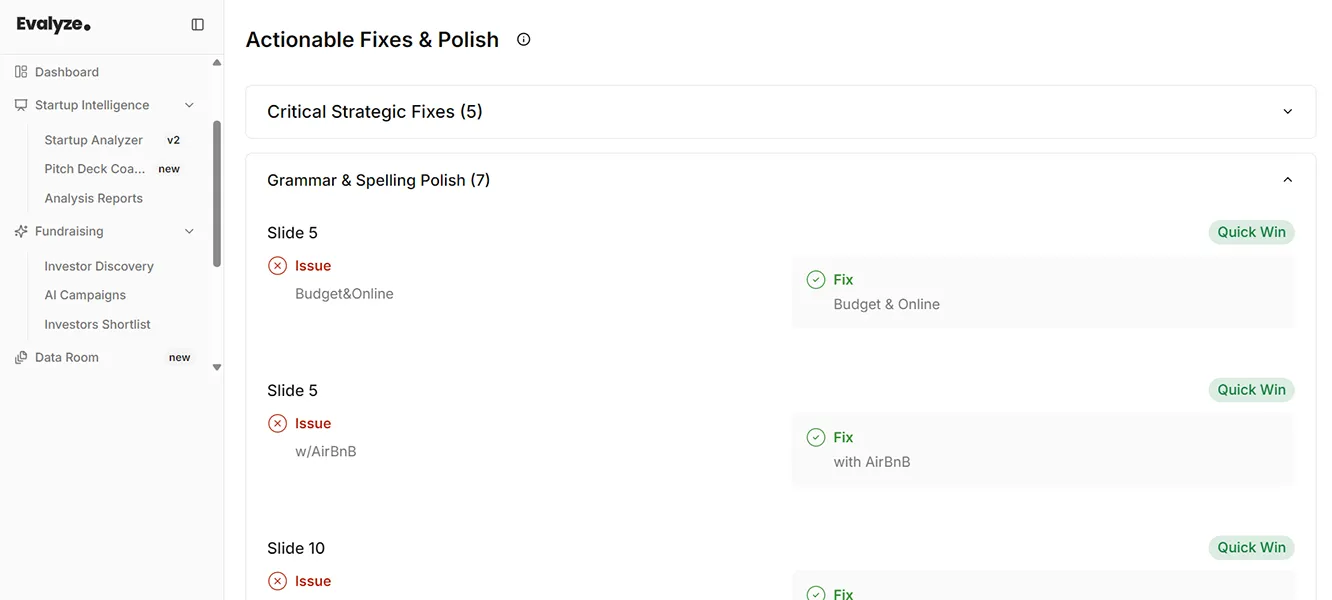
At the bottom of the tab, the tool provides a prioritized checklist divided into Critical Strategic Fixes and Grammar & Spelling Polish.
The Slide-by-Slide tab is your surgical toolkit. Instead of general feedback, the AI isolates every single slide in your deck, assigns an Effectiveness Score, and provides a granular roadmap for improvement.
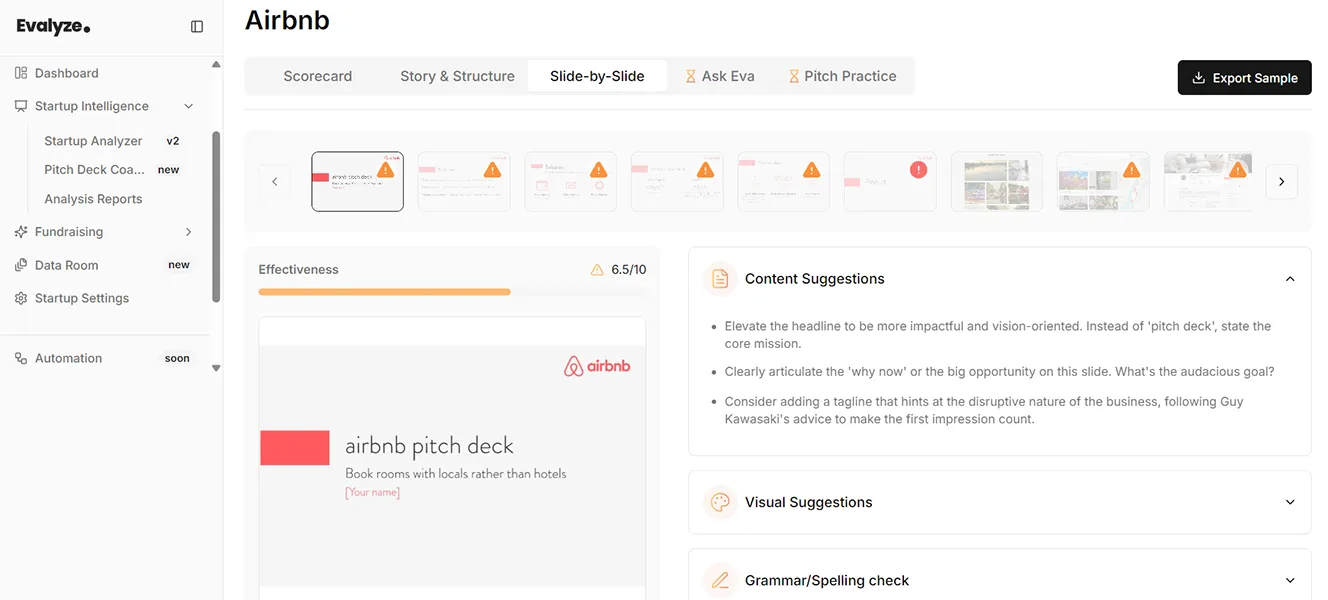
For the Airbnb Title Slide, the AI gave a 6.5/10. It acknowledged the clean design but pinpointed exactly why it wasn't a "10": it lacked a compelling hook.
The AI Pitch Coach breaks your workload into three distinct categories so you can triage your time effectively:
This is the feature founders ask for first when they see the score and panic. On any slide, you can click Revise with AI.
The system reads your slide in the context of the rest of your deck. It knows your business, your market, and your stage, and generates a tighter, benefit-driven rewrite.
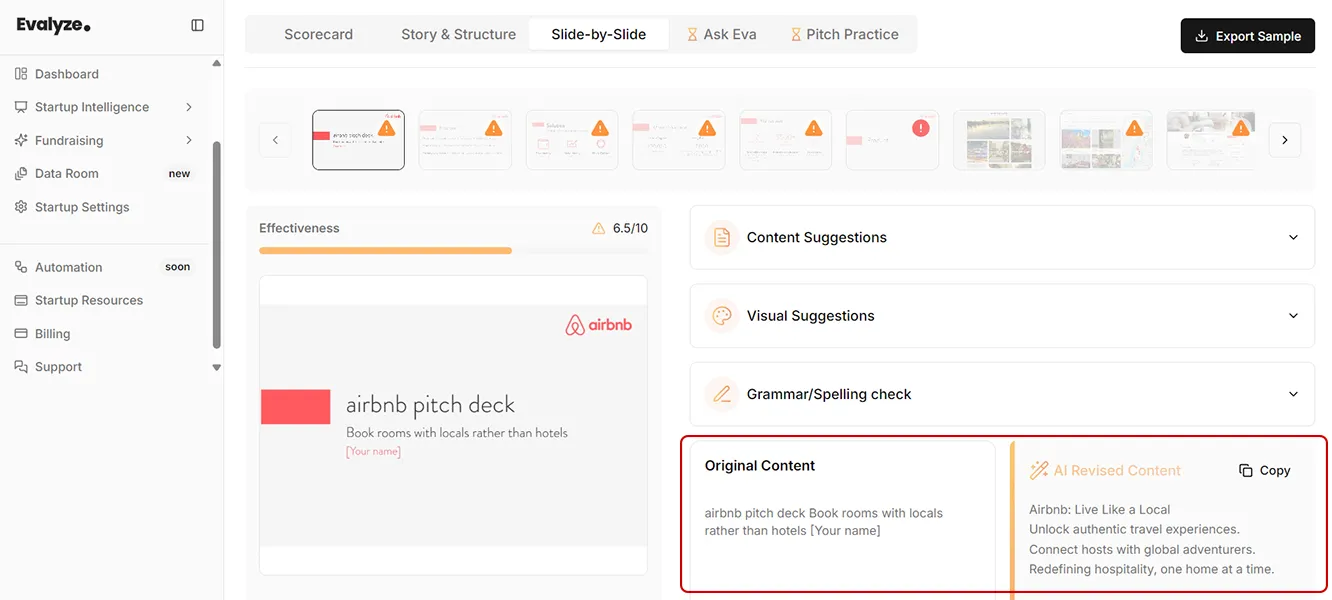
The Airbnb cover slide originally read:
"Airbnb pitch deck. Book rooms with locals rather than hotels. [Your name]"
The revised version:
"Airbnb: Live Like a Local. Unlock authentic travel experiences. Connect hosts with global adventurers. Redefining hospitality, one home at a time."
You can argue with the specific tone. The point is the rewrite isn't a generic "make this better" pass; it's contextual, it knows what slide you're on (cover vs. market size vs. team), and it produces something you can ship or edit, not a blank page to start from.
The same flow works for problem slides, market sizing, business model, and team bios. You can run it on every slide, accept the changes you like, and leave the rest.
Once the analysis is complete, clicking Export Report generates a comprehensive PDF containing your score, the Investor Perspective, slide-by-slide commentary, and every suggested rewrite. For the Airbnb sample, this resulted in a 26-page strategic roadmap.

The current AI Pitch Coach reviews your deck. The next phase of Evalyze is designed to review you and your strategy. We are currently finalizing two major updates to turn your dashboard into a full-scale training ground.
🚀 Launching Soon. Think of this as having a GP (General Partner) on call 24/7. Ask Eva allows you to engage in a high-level dialogue about the core of your business.
🚀 Launching Soon. If the Pitch Coach is the "pre-flight check," Pitch Practice is the scrimmage. This is where you move from the page to the performance.
Pro Tip: These features are currently in final testing. If you're a Pro user, they will appear in your dashboard the moment we flip the switch.
The AI Pitch Coach is an exclusive feature of the Evalyze Pro plan. If you’re already a Pro subscriber, you’ll find it waiting in your dashboard. If not, upgrading to Pro unlocks the full suite of tools, including the Pitch Coach, comprehensive export reports, and early access to Pitch Practice.
FAQ