

How to Use AI for Fundraising in 2026: A Founder’s Guide
Use AI for fundraising the right way in 2026. Score your pitch deck, match with the right investors, and skip 40 hours of cold research. Free tool inside.
April 30, 2026
Learn where to find investors for your startup, from investor databases and portfolios to founder networks, LinkedIn, accelerators, and AI tools.
Finding investors starts with knowing where relevant investors spend their attention and where their investment history is visible.
You can discover potential investors through investor databases like Evalyze, recent startup funding announcements, VC portfolio pages, LinkedIn, investor websites, founder networks, accelerators, angel networks, and startup communities.
Key Takeaway
A broad search for “startup investors” can produce hundreds of names that have little connection to your round.
Start with four basic questions:
| Question | Example |
|---|---|
| What stage are you raising at? | Pre-seed, Seed, Series A |
| What market are you in? | Fintech, SaaS, HealthTech, … |
| Where can the investor invest? | US, Europe, MENA, global |
| What size investment fits the round? | Based on your raise and financing plan |
Suppose you are raising a seed round for a B2B SaaS company. A fund that only invests at Series B is not useful just because it invests in software. The same applies to a US-only fund if your company falls outside its investment geography.
You do not need to fully score every investor yet. At this stage, you only need enough context to keep your discovery focused.
These seven methods provide practical ways to identify relevant investors before you start qualifying and prioritizing your list.
Investor databases give you a searchable starting point instead of requiring you to discover every investor manually.
The useful ones let you narrow the universe using criteria that matter to your round.
In Evalyze Investor Discovery, founders can search more than 10,000 investor profiles and filter by:
For example, a seed-stage AI startup could select Seed and AI, choose the relevant location, and set a check-size range that fits the financing.
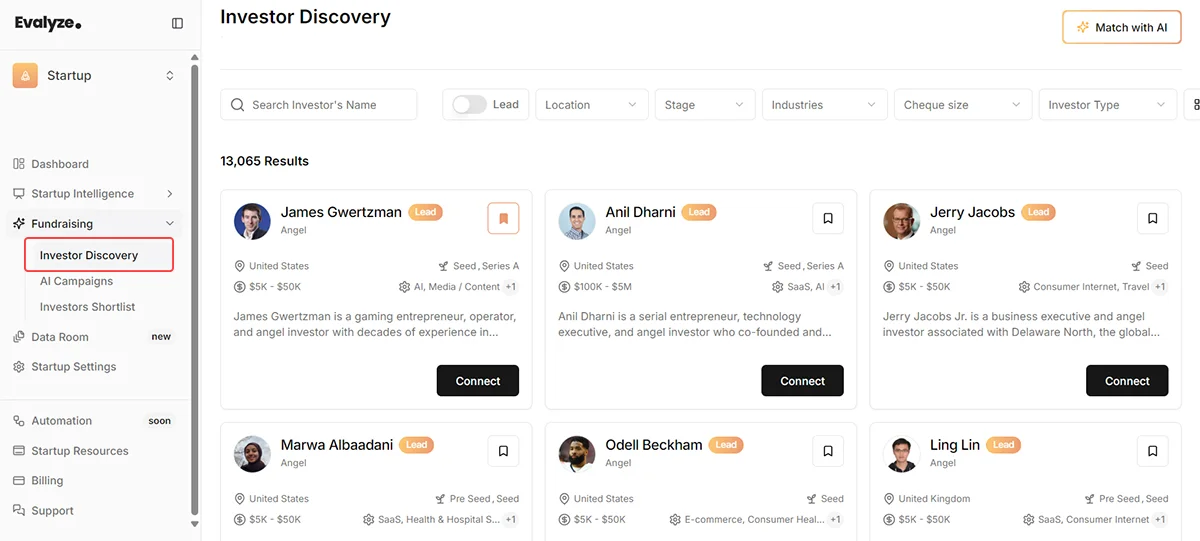
The full Evalyze Investor Discovery guide explains the filters, investor profiles, contact information, and bookmarking workflow.
If you are comparing different databases rather than deciding how to search them, see our guide to the best platforms to find investors for startups.
Another way to find investors is to work backward from startups that recently raised money.
Instead of searching only:
“Who invests in companies like mine?”
Also ask:
“Which companies similar to mine have raised, and who invested in them?”
The process is straightforward:
Pay attention to companies at a similar stage and in the same or an adjacent market.
The funding announcement gives you a discovery lead, not proof of fit. A fund's strategy may have changed, the relevant partner may have moved, or a portfolio company may be close enough to yours to create a conflict.
Use the round to find names. Qualify those names separately.
A firm's portfolio shows the companies it has actually backed.
That can be more useful than relying only on broad statements such as “we invest in software” or “we back ambitious founders.”
For example, a climate software founder could identify several climate software companies, see which firms invested in them, and then examine those firms' portfolios for related investments.
Portfolio research can also help you find the relevant partner. Investment announcements and company pages sometimes identify the fund professional who worked on the deal.
Keep one limitation in mind: similarity can become a conflict. If the investor already backs a direct competitor, research the situation before adding the firm to your outreach list.
Finding the fund is often only half the search.
A venture firm may have several partners covering different stages, sectors, or markets. Once you find a relevant firm, identify the person whose work is closest to your company.
Check their:
You eventually need a person, not just a fund logo.
If one partner focuses on enterprise software and another works mainly with consumer companies, contacting the right person makes your research much more precise before outreach even starts.
Founders, operators, advisors, customers, and people already supporting your company can also help you discover investors.
Specific questions work better than:
“Do you know any VCs?”
If you already have several promising firms, you can ask:
“Do you know anyone at these three funds?”
Or, if you are still researching:
“Have you worked with investors who back seed-stage B2B SaaS companies?”
The first goal is to uncover relevant names and relationships. Once you know whom you want to reach, the separate problem is getting an introduction.
Our warm intro guide covers that next step in more detail.
Accelerators, syndicates, and organized angel networks can be useful discovery channels, particularly at earlier stages.
Review the investors associated with programs relevant to your sector or region. Demo days, mentor lists, portfolio companies, and program networks can reveal investors you may not find through a simple web search.
Do not assume that every investor connected to an accelerator is interested in your startup. Treat the program as another source of names, then research the investor separately.
If individual angels are the main target for your round, use our dedicated guide on how to find angel investors for your startup rather than trying to build the entire angel strategy from this article.
Startup events can expose you to investors, but relevance matters more than event size.
A large technology conference may contain hundreds of investors and still produce few useful targets for a specialized company. A smaller event centered on your industry or funding stage may give you a much clearer research set.
Look at:
Review speakers, judges, sponsors, attending investors, and participating funds before the event. That turns the event into a research source instead of relying on chance conversations.
You can start finding investors without knowing them personally.
Public information is enough to build the first version of your target universe. Investor databases, funding announcements, portfolio pages, LinkedIn, investor websites, public application forms, accelerators, and founder communities can all reveal potential investors.
The important distinction is simple:
Finding an investor and getting introduced to an investor are separate tasks.
You can identify relevant funds and partners before you have a warm path to them.
Once you know which investors actually matter, check for mutual connections, founder introductions, public submission routes, or appropriate direct outreach.
Starting with discovery also makes networking more useful. Asking someone for an introduction to a specific investor gives them something concrete to respond to.
You can research investors before your company has revenue.
At that stage, focus on investors whose current strategy includes very early-stage companies. That may include:
These investors may consider companies before meaningful revenue exists.
That does not mean the idea alone is enough.
An early-stage investor may still want evidence that helps them evaluate the opportunity, such as:
The search is different because you need investors who are comfortable evaluating companies with less operating history.
Avoid spending time on investors whose strategy clearly requires a later stage of development.
Yes. AI can accelerate investor discovery by narrowing large datasets based on information about your startup and the investor.
It can help identify possible matches, compare stated investment criteria, filter large investor universes, and organize research.
The useful boundary is that AI matching is a research aid. It cannot guarantee that an investor is interested in your company or that the investor's current circumstances match the data available to the system.
Evalyze's AI Investor Matching currently scans 10K+ verified investor profiles and supports matching around factors including stage, sector, geography, and raise size.
That gives founders a way to reduce the amount of manual searching before reviewing individual matches.
If you want to use AI across pitch preparation, investor discovery, and other parts of the raise, our guide to using AI for fundraising covers the wider workflow.
If your main question is which tools are available, see our comparison of 20 AI fundraising tools instead of turning this investor-discovery process into a software roundup.
Start with three sources.
Suppose you are building vertical SaaS for logistics companies. Searching only for “SaaS investors” may be unnecessarily broad. Portfolio research may reveal investors with specific exposure to supply chain software, logistics technology, or vertical SaaS.
Once you find those investors, sector fit is only one part of qualification. Stage, geography, check size, current activity, and potential portfolio conflicts still need to be checked before outreach.
Old investor lists can contain real people and real investments while still being unsuitable for current outreach.
Before relying on an investor profile, look for recent signs of activity:
An investment made several years ago proves that the investor participated in that deal. It does not confirm that the same partner, fund strategy, stage preference, or investment range remains current.
This matters especially when you find an investor through an old article, spreadsheet, database entry, or funding announcement.
Check the current information before you contact them.
Once discovery has produced enough potential names, stop expanding the search long enough to work on the list you already have.
Check which investors actually fit your round. Our guide on building an investor list based on your startup goes deeper into stage, geography, check size, industry, and shortlisting.
Once outreach begins, use an investor funnel to separate prospects, active conversations, diligence, passes, and next steps.
At that point, the job has moved beyond finding names.
Evalyze Investor Database provides a searchable database to find investors by stage, industry, location, check size, investor type, and lead status. You can review profiles and save relevant investors to your shortlist before starting outreach.
FAQ
Use AI for fundraising the right way in 2026. Score your pitch deck, match with the right investors, and skip 40 hours of cold research. Free tool inside.
April 30, 2026

Evaluating a company's pitch deck is a critical part of assessing its potential for raising capital and long-term success. This blog post of Evalyze.ai will showcase 15 standout companies whose pitch decks helped secure millions of dollars in funding, fueling their growth and market impact. From innovative tech platforms to sustainable brands, each of these companies used a compelling pitch to connect with investors. We also provide downloadable links to their pitch decks, giving you a behind-the-scenes look at what it takes to create a winning presentation for potential backers.
December 23, 2024