

How to Build an Investor Funnel + Template
Set up a founder-friendly investor funnel, CRM stages, lead segmentation, follow-ups, and conversion tracking, plus spreadsheet + Notion templates.
December 28, 2025
A practical pre-seed fundraising checklist, readiness scorecard, traction milestones, cheque sizes, investor types, SAFE terms, and pitch focus, plus a clean plan.

Pre-seed fails less because "the market is tough" and more because founders raise before they have investor-grade signals.
Here's the clean definition: pre-seed is the earliest outside capital, often before revenue, used to turn an idea into proof (prototype, validation, early users).
This pre-seed fundraising checklist is a decision tool. It answers five questions:
Key Takeaways
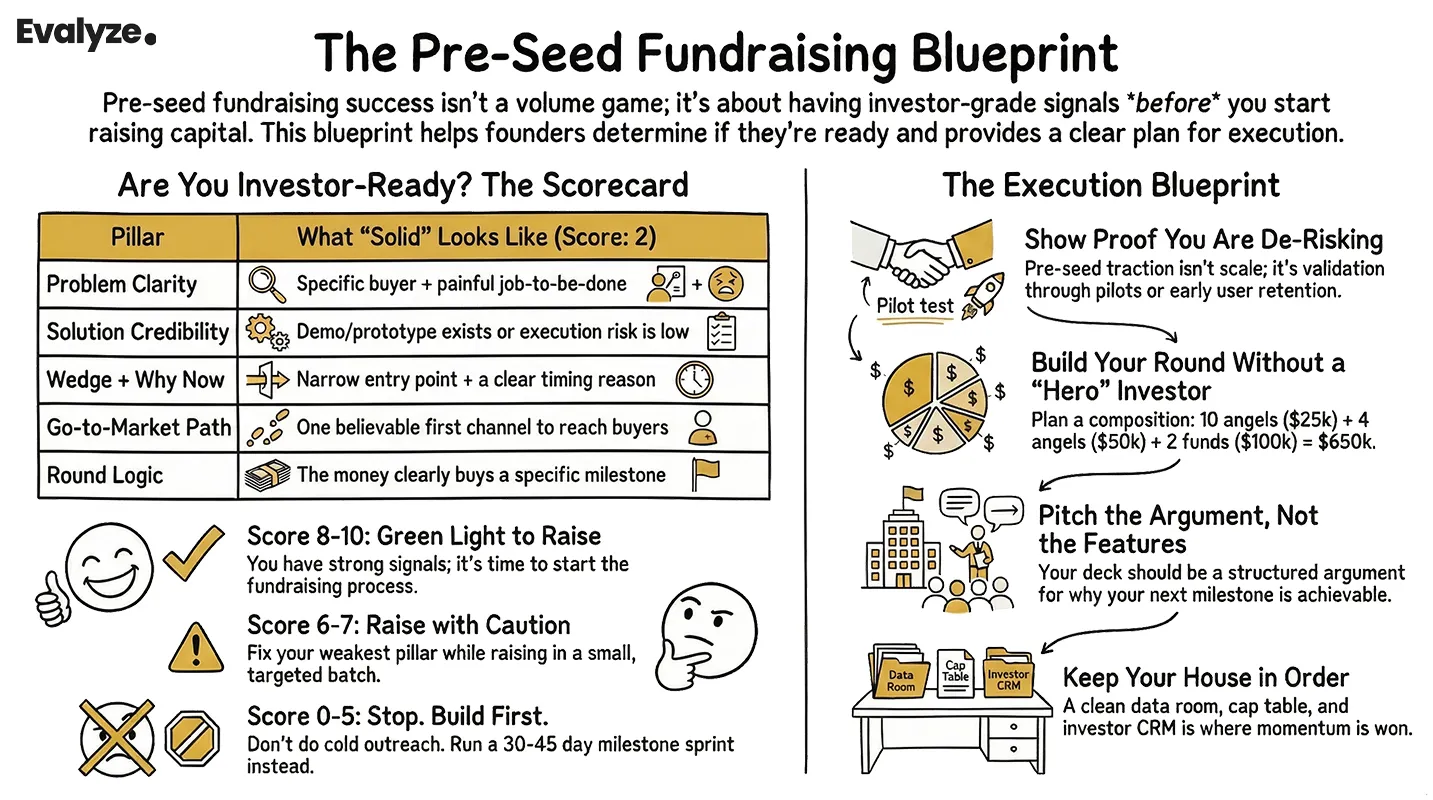
Score each pillar: 0 = weak, 1 = partial, 2 = solid
Total: 10
| Pillar | What "2/2" looks like |
|---|---|
| Problem clarity | Specific buyer + painful job-to-be-done + clear stakes |
| Solution credibility | Demo/prototype exists, or credible execution reduces build risk |
| Wedge + why now | Narrow entry point + timing reason (regulation, cost shift, platform change, behaviour change) |
| Go-to-market path | One believable first channel + why you can reach buyers efficiently |
| Round logic | The money buys a milestone; you can say what changes in 90 days |
Interpretation
Pro Tip:
If you scored 0-5, write a 30-45-day sprint plan with one output per weak pillar (e.g., "3 LOIs," "prototype benchmark," or "ICP + channel test"). Then re-score.
Must Read: When’s the Right Time to Seek Funding?
At pre-seed, traction is not "scale." It's de-risking.
The pre-seed goal is to build a prototype, validate the idea, and prove that founders can often execute on SAFEs or convertible notes because valuations are hard this early.
 Traction Milestones That Count.webp)
Good milestones:
Good milestones:
Good milestones:
Good milestones:
Example:
A B2B founder stops pitching AI for operations and pitches reducing manual reconciliation for mid-market clinics. They run 20 interviews, get 4 LOIs, ship a narrow demo, and convert 2 LOIs into a pilot. That's a fundable story because it's measurable.
Worth bookmarking: How Venture Capitalists Really Think
Stripe frames pre-seed rounds of a few hundred thousand to a million dollars, often done via SAFEs or convertible notes. Stripe also cites a median pre-seed SAFE raise amount of about $700,000 in 2025.
Carta's U.S.-based dataset (Q3 2025) shows startups raised $965M across 5,660 instruments (SAFEs + convertible notes), and that most pre-seed fundraises occur on post-money SAFEs.
-Typical-Cheque-Sizes.webp)
Don't plan around one hero cheque. Plan a composition that still closes without it.
Example composition:
That's $650K without needing a single "save-the-round" investor.
Explore more: How to Build an Investor List Based on Your Startup
Pre-seed terms are where founders accidentally lose future flexibility. Stripe notes it's not unusual to give up 10%-20% at pre-seed, even when using SAFEs/notes.
You don't need to guess dilution. With a post-money SAFE, you can model it directly: If you raise $500K on a $5M post-money valuation cap, that's roughly 10% ownership sold (500K/5M).
Different investor types filter for different signals. Most wasted fundraising happens when you pitch the right story to the wrong filter.
-Who-Invests-at-Pre-Seed.webp)
Time-saving rule: If you can't write a "why this investor" note in one sentence, don't send the first email.
Popular on Evalyze: How to Find Angel Investors for Your Startup
Your pre-seed pitch deck is not a feature tour. It's a structured argument that your next milestone is likely to happen.
-Pitch-Focus-Points.webp)
You might also like: What Is a Pitch Deck?
Investors may move fast at pre-seed, but they still expect basic diligence readiness.
-The-Investor-Materials-Checklist.webp)
This is the unsexy part that quietly wins rounds.
Before you go: Startup Due Diligence: The Complete Founder’s Guide
Once your signals are real, the bottleneck is usually clarity + targeting + iteration.
[Evalyze.ai(/) helps with three things:
Use it to sanity-check readiness and sharpen your deck before you go wide.
FAQ
Set up a founder-friendly investor funnel, CRM stages, lead segmentation, follow-ups, and conversion tracking, plus spreadsheet + Notion templates.
December 28, 2025
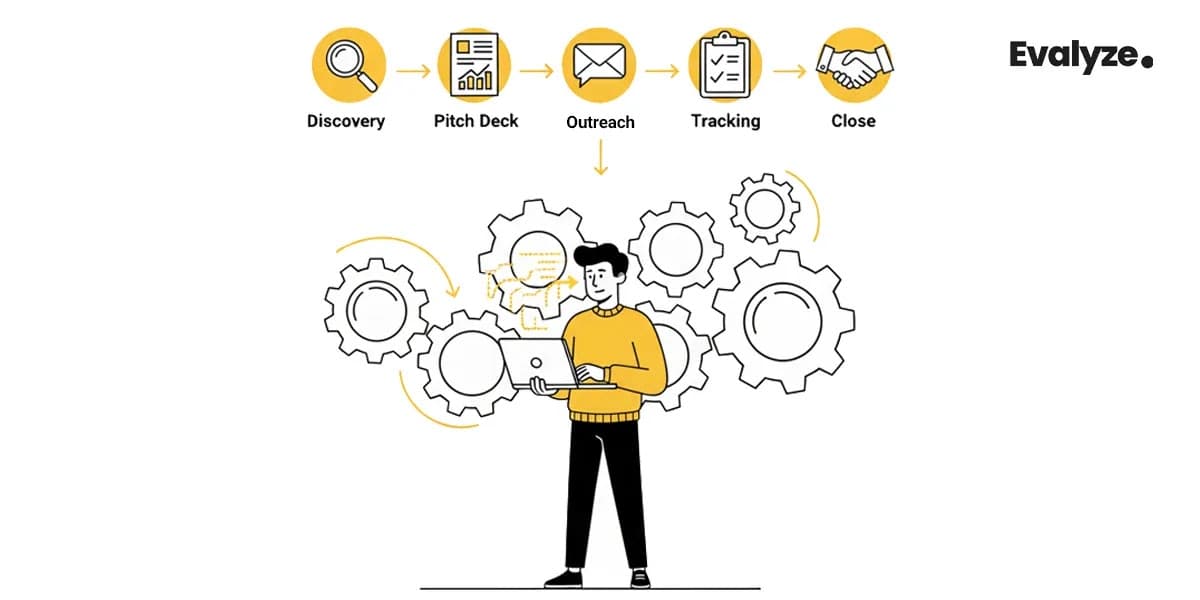
What to automate in fundraising (CRM, follow-ups, data rooms) and what not to. A trust-first playbook that won’t look like a bot farm.
December 25, 2025