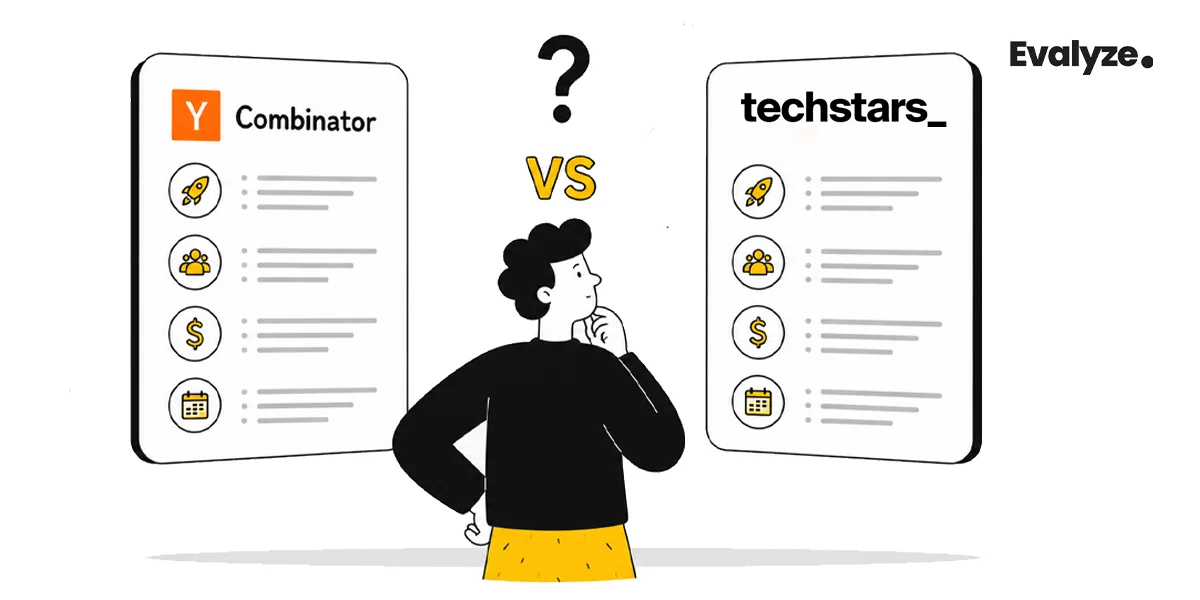
Y Combinator invests $500,000; $125,000 for a fixed 7%, plus $375,000 on an uncapped MFN SAFE. Techstars invests $220,000; $20,000 for 5% common stock (a Convertible Equity Agreement), plus $200,000 on an uncapped MFN SAFE.
Key Takeaways
YC and Techstars are influential startup networks; portfolio valuation figures should be treated as approximate unless officially sourced.
Techstars’ corporate and vertical accelerators can help startups reach enterprise partners, pilots, and early customers.
YC supports a small number of nonprofit startups with $100,000 in non-equity funding.
YC has a follow-on fund for alumni; Techstars is primarily an accelerator network, not a comparable VC platform.
Comparison Table: YC vs Techstars at a Glance
Y Combinator
Techstars
Total investment
$500,000
$220,000
Equity for cash
$125,000 for fixed 7% (post-money SAFE)
$20,000 for 5% common stock (CEA)
Additional capital
$375,000 uncapped MFN SAFE
$200,000 uncapped MFN SAFE
Est. total stake at $20M next round
~8.9%
~6%
Program length
3 months, in-person (San Francisco)
3 months, in-person (50+ city/vertical programs)
Batches per year
~4 (250-300 companies each)
Rolling cohorts across global programs
Fees
None
None
Structure
One global batch, partner office hours, weekly meetups
Local Managing Director, dense mentor pairing
Best for
Venture-scale software, max runway, brand
Capital-efficient, regional, or vertical-specific startups
How Much Each Accelerator Invests and What You Give Up
This is the question behind half your search history, so here it is without the hedging.
Y Combinator pays $500,000
The current YC funding structure has remained steady since 2022. It is split into two distinct parts on the official deal page:
$125,000 fixed stake: Converts into 7% equity using a post-money SAFE (simple agreement for future equity). This prices the company at an effective post-money valuation of about $1.78M.
$375,000 flexible cushion: Invested via an uncapped SAFE with a Most Favored Nation (MFN) clause. This means YC gets the best price terms set by any investor who funds you later.
Additionally, YC charges no hidden fees and retains a pro rata right, meaning they keep the option to invest more money in your future rounds to maintain their ownership percentage.
Techstars officially bumped its funding up from $120,000, starting with the Fall 2025 batch, a major update announced by CEO David Cohen.
The new $220,000 package breaks down like this:
$20,000 core investment: This buys a 5% stake in common stock through a Convertible Equity Agreement.
$200,000 expansion funding: This sits on an uncapped SAFE with a Most Favored Nation (MFN) clause.
There are no hidden program fees. Note that if you see older web pages quoting the previous $120,000 for 6% deal, that information is now stale and outdated.
The Dilution Comparison That Matters
Headline equity numbers can mislead because the SAFEs don't convert until your next priced round.
To see the real impact, let's look at a shared scenario where your next round prices the company at $20M:
Accelerator
Fixed Equity
Uncapped SAFE Dilution ($ into $20M)
Total Estimated Dilution
Total Cash Received
Y Combinator
7.0%
$375,000 ÷ $20M ≈ 1.9%
~8.9%
$500,000
Techstars
5.0%
$200,000 ÷ $20M = 1.0%
~6.0%
$220,000
On paper, this means YC costs about $56K per equity point, while Techstars costs around $37K. However, focusing solely on the "cost per point" hides the real operational tradeoff:
The YC Advantage: You are getting an extra $280,000 in cash in exchange for roughly 3% more dilution. If you can use that extra capital to build massive traction and raise your next round at a much higher valuation, the YC money completely pays for itself.
The Techstars Advantage: If you run a lean operation, work in deep tech with long cycles, or run a regional B2B play, you might not need the extra cash right away. In those cases, keeping that 3% of your company is the smarter move.
What an Uncapped MFN SAFE Means
Both accelerators use the exact same instrument for their larger check, which often confuses founders.
Here is exactly how the mechanics work:
The Uncapped Part: The SAFE has no preset valuation cap. Instead of pricing your company today, it waits and converts into equity at whatever valuation you negotiate with future investors.
The MFN (Most Favored Nation) Clause: This is a safety net for the accelerator. It guarantees that if you give another investor a lower valuation cap or better terms before your next official equity round, the accelerator automatically gets those exact same terms.
Ultimately, you set the price by raising well. The higher your next valuation, the less ownership that SAFE costs you. That is why the question "How much will they actually own?" has no fixed answer until you close your next round.
Network and Brand: Where YC and Techstars Genuinely Differ
Both Y Combinator and Techstars provide powerful network effects and brand validation, but they do so in fundamentally different ways.
Y Combinator: The Strongest Fundraising Signal in Tech
YC's brand power is the main reason it moves money so effectively. A YC stamp of approval significantly shortens the distance between Demo Day and a signed term sheet.
The Network Power: Its alumni list includes massive market leaders like Airbnb, Stripe, Dropbox, Coinbase, and DoorDash.
The Quantitative Signal: Investors actively scan YC batches looking for deals. This creates a real, measurable advantage in fundraising outcomes rather than just standard networking buzz.
The Trade-off: Scale. A single global batch now reaches 250-300 companies. This means you will get less individual hand-holding, and self-directed founders must actively compete for partner time.
Techstars: Mentorship Density and Local Roots
Techstars takes a highly localized approach to accelerator cohorts. For a founder who values being known by name in a room of regional investors, this density beats out pure global brand reach.
Proven Scale: They have supported over 10,000 founders and produced 22 unicorn portfolio companies, including SendGrid, Chainalysis, and Zipline.
Deep Ecosystems: Each program is run by a local Managing Director who pairs you with dozens of regional mentors. A Boulder cohort has a completely different ecosystem feel than London or Singapore.
Program Structure and Timeline
Both programs run for three months in person and culminate in a Demo Day, but they structure their cohorts quite differently:
Y Combinator: Concentrates everything in San Francisco. It relies on a high-intensity, centralized model featuring a three-day kickoff, weekly group dinners, and partner office hours. YC interviews and selects four batches of companies per year.
Techstars: Spreads across 50+ cities and vertical-specific programs, including specialized tracks like Space, Web3, Sustainability, and Fintech. Cohorts and applications open at various times throughout the year.
The Location Deciding Factor: If you need geographic flexibility, you can look into the Best Startup Hubs & Ecosystems for Fundraising to see where Techstars' distributed network is the better fit. If you want raw fundraising proximity, YC's centralized hub wins.
Choose YC if you are building a venture-scale software company, you are trying to figure out How Much Money to Raise at the Seed Stage for maximum upfront runway, and you want the strongest fundraising brand in tech.
High Capital Needs: The $500,000 check gives you a longer buffer to build product-market fit.
Global Investor Reach: The YC name shortens the path to investor inboxes and fast-tracks seed-round term sheets.
Self-Driven Teams: You thrive in large environments where you are comfortable proactively competing for partner attention.
The extra dilution is simply the price of admission for the strongest post-Demo-Day signal in the market, and for ambitious, capital-hungry startups, it is usually worth paying.
Which Founders Should Pick Techstars
Choose Techstars if you are highly capital-efficient, deeply tied to a specific region or industry vertical, or a first-time founder who wants a hands-on Managing Director rather than a massive 300-company batch.
Mentorship Density: You want a close, structured network of mentors and corporate partners tailored to your exact industry.
Localized Ecosystems: You plan to scale your business within a specific regional market or industry hub.
Equity Preservation: You prefer to keep more of your company early on while sacrificing a bit of upfront cash.
The smaller $220,000 check works perfectly if you are figuring out How Much Money Do You Need To Raise At The Pre-Seed Stage when your operational burn is low, and your personal network gap is the true bottleneck holding your startup back.
How to Get Accepted (The Part Most Founders Skip)
Here is the uncomfortable reality: the deal terms only matter if you actually get in.
Y Combinator accepts roughly 1% of applicants.
Techstars acceptance sits in the low single digits, especially after applications tripled over the last few years.
What gets you through the door is your team and your pitch deck, in that exact order. If you're building yours from scratch, look over our slide-by-slide guide on Crafting Seed to Series A Pitch Deck.
The Common Failure Points
The pattern we see at [Evalyze.ai(/) is incredibly consistent. Strong teams get rejected far more often because of a missing "why now" than because of the idea itself. Learn Why Your Pitch Deck Is not Working and how to fix it with clear storytelling.
The Trap: Opening your deck with a product description instead of a recognizable, time-sensitive problem.
The Result: The deck reads as either too early or too late, and partners pass before they even hit slide five.
Before you spend an entire cycle applying, it is worth pressure-testing your deck against the ones that have already successfully raised capital.
Evalyze helps you close these exact gaps before you submit your application. You can upload your pitch deck to get an objective analysis and an Investor Readiness Score based on real market data.
Matches your startup against a database of 10,000+ verified investors.
Replaces blind Crunchbase exports with people who actively back companies in your specific niche.
The free tier returns your first comprehensive deck score and 30 highly targeted investor matches at no cost.
Turn This Teardown Into a Closed Round
Two products, one workflow. Score your deck against the funded patterns, then send the corrected version to the named partners writing checks into companies like yours.