
20 Most Searched Startup Investors on Evalyze
Discover the 20 startup investors founders research most on Evalyze, including their firms, investment stages, focus areas, locations, and profiles.
September 5, 2026
A simple guide to Canadian startup grants you can actually get.

If you're building a startup in Canada, grants and incentives are one of the few ways to buy time without giving up equity. The hard part isn't that "there's no money," it's that programs are fragmented, rules change, and most government websites read as if a committee of exhausted lawyers wrote them.
This guide gives you the programs that matter, who's they're for, how much they pay, and how to avoid wasting weeks on the wrong thing.
Quick map of the landscape:
You'll see three main levels:
You can often stack multiple programs (for example, IRAP + SR&ED + a provincial wage subsidy), as long as you stay under the maximum percentage of public funding allowed for that project. Always check each program's "stacking" rules.
These are the workhorse programs most innovative startups should at least look at.

Good if: You're a tech or product company with real R&D going on, not just routine implementation.
Who it's for
Incorporated, profit-oriented Canadian SMEs (generally 1-500 employees) working on genuine R&D or new technology with clear commercial potential.
What you get
Non-repayable contributions that can cover a big share of technical salaries and subcontractors for a defined innovation project. In practice, projects often range from tens of thousands up to the high six figures; some larger projects can go higher.
Key conditions
Status
IRAP is a long-running, flagship innovation program with competitive, usually rolling intakes through NRC advisors. Funding levels and priorities are updated regularly, so always check the official NRC IRAP page or speak with an ITA before you build your budget around it.
Good if: You write code, build hardware, or do any systematic technical work beyond "normal engineering."
Who it's for
Corporations, individuals, and partnerships conducting eligible R&D in Canada, including software, hardware, engineering, and other scientific or technological development.
What you get
For Canadian-controlled private corporations (CCPCs), there is an enhanced refundable federal credit rate (commonly up to 35% of eligible SR&ED expenditures on the first spending bracket, currently up to about $3M per year). Above that limit, or for non-CCPCs, lower / non-refundable rates apply.
Key conditions
Status
SR&ED is a long-standing federal tax incentive claimed through your corporate tax return. Rates, limits, and admin rules do change, so always confirm the latest guidance on the CRA website or with a tax professional before filing.
Good if: You want a sharp grad student or postdoc to work on a real research/innovation problem inside your startup.
Who it's for
Canadian companies and organisations (for-profit or non-profit) that can partner with a graduate student or postdoc and a faculty supervisor at a Canadian university or college.
What you get
There are variants with slightly different contribution levels and higher-value options for postdocs and multi-intern projects.
Key conditions
Status
Mitacs Accelerate is a national program with applications accepted year-round. Funding models and streams evolve, so always check the current Mitacs Accelerate page.
Good if: You're ready to sell abroad and need help paying for the first serious push into new markets.
Who it's for
Canadian SMEs that want to enter or grow in new international markets where they currently have little or no sales. Typical criteria include:
What you get
Key conditions
Status
CanExport SMEs is a recurring federal program run by the Trade Commissioner Service with intake periods that open and close based on budget. Contribution rates and eligible activities change over time, so always read the current CanExport SMEs page before applying.
Good if: You want low-cost junior help over the summer and can create a real learning experience.
Who it's for
They want to hire youth aged 15-30 for summer roles.
What you get
Key conditions
Status
CSJ runs annually as part of the federal Youth Employment and Skills Strategy. Employer applications usually open in the fall for jobs starting the next year; always check the official CSJ page for this year's dates and eligibility.
Good if: You're a young founder and banks look at you like you're speaking Martian.
Who it's for
Founders aged 18-39 anywhere in Canada who have launched or are about to launch a business.
What you get
Key conditions
Status
Futurpreneur is a long-running national program with rolling intake. Loan amounts, interest rates, and age rules can shift, so always confirm details on Futurpreneur's site before you quote numbers to your co-founder.
Good if: You're a majority Black-owned business that's ready to grow and needs meaningful debt capital.
Who it's for
Majority Black-owned businesses operating in Canada at various stages, delivered through partners such as FACE and financial institutions like BDC and commercial banks.
What you get
Key conditions
Status
The Loan Fund is a core pillar of the federal Black Entrepreneurship Program, delivered through ongoing intake by partner organisations. Terms and delivery partners evolve, so always read the current guidelines on the BDC/FACE and federal program sites.
Good if: You're an innovative SME that wants to hire a recent grad but needs help with salary.
Who it's for
Innovative Canadian SMEs that want to hire post-secondary graduates aged roughly 15-30 into technical or business roles tied to innovation.
What you get
Key conditions
Status
YEP is an established IRAP stream under the federal Youth Employment and Skills Strategy. Intakes and budgets can vary, so always check the official NRC IRAP YEP page or talk to an ITA before promising anyone a job based on it.
Explore more: How to Raise a Small Amount of Capital for Your Startup
Now to the province-level tools that can stack on top of federal support.

Good if: You're an Ontario founder who needs a small grant + training to get moving.
Who it's for
Ontario residents 18+ who are starting, buying, or expanding a small business and can commit to working in it full-time. Delivered through local Small Business Enterprise Centres (SBECs).
What you get
Key conditions
Status
Starter Company Plus is a recurring provincial program delivered in local cohorts (often several times per year). Exact dates and criteria vary by region, so always check your local SBEC's page for current intake info.
Good if: You're a BC tech or innovation-driven company that wants to hire students or recent grads, especially from under-represented groups.
Who it's for
BC-based employers in tech or tech-related roles who want to hire a student or recent grad, with a strong focus on candidates from under-represented groups.
What you get
Key conditions
Status
ISI is a recurring program delivered by Innovate BC with defined yearly intakes. Grant value has consistently been "up to $10,000 per hire," but specifics and quotas change; always check the latest ISI guidelines before promising anyone a subsidised role.
Good if: You're a Quebec tech startup raising a pre-seed or seed round.
Who it's for
Young, innovative, high-growth Quebec startups, especially in tech and life sciences. The historic Impulsion PME matching program has been transformed into Fonds Impulsion, a provincial venture capital fund focused on early-stage tech.
What you get
Key conditions
Status
Fonds Impulsion is an active early-stage VC vehicle backed by Investissement Québec. It isn't a "grant," but for Quebec startups closing a round, it's a major piece of non-bank capital. Always check IQ's site or speak with the team/your lead investor about the current criteria.
Good if: You're a health or life sciences startup in Alberta that needs clinical/market validation money.
Who it's for
Alberta-based SMEs and researchers building health or life sciences technologies that need evidence, trials, and validation to reach real-world use.
What you get
Key conditions
Status
AICE is an active umbrella program with several streams. Names, caps, and themes (e.g., healthy ageing) evolve, so always read the specific AICE stream guide on Alberta Innovates' site before banking on a number.
Good if: You're an Alberta SME teaming up with a post-secondary researcher to adopt new tech.
Who it's for
Alberta SMEs that want to work with Alberta universities or colleges on emerging technology projects, leveraging NSERC Alliance or ARD grants.
What you get
Key conditions
Status
CASBE is an ongoing Alberta Innovates program that opens and closes intakes periodically. The program guide and intake status are updated on Alberta Innovates' site; always check there to confirm whether applications are currently being accepted.
Good if: You're a growing SME with a clear scale-up plan in a specific region.
Who it's for
Growth-oriented SMEs in specific regions (Atlantic, Prairies, Northern, Southern Ontario, Quebec, BC) delivered through the various regional development agencies (RDAs).
What you get
Key conditions
Status
REGI is a national framework run by RDAs. Specific Business Scale-Up & Productivity calls and focus areas vary by region and year, so always check your regional RDA site (e.g., PrairiesCan, ACOA, FedNor, PacifiCan) for current intakes and guidelines.
Good if: You're running a major, capital-intensive project with national impact, think "later-stage, not seed."
Who it's for
Companies (including SMEs) leading large, transformative projects, often with total eligible project costs well into eight or nine figures, in major clean-tech, manufacturing, life-sciences, or digital infrastructure plays.
What you get
Key conditions
Status
Canada has shifted from the original Strategic Innovation Fund toward a Strategic Response Fund-style model, but the idea is the same: large public support for major innovation projects.
For most early-stage founders, this is "good to know exists, not for this year." Always rely on current Innovation, Science and Economic Development (ISED) guidance for exact program names and criteria.
Founder's favourite: Best Platforms to Find Investors for Startups
You've already seen the main ones, but it's useful to group them:

You don't need a grant whisperer. You need a 20-minute research habit.

Search:
[Program name] + Government of Canada
[Program name] + [province]
Avoid SEO-spam "grant lists" as your primary data source.
Many guides explicitly say what percentage of project costs can come from all public sources combined ("up to 75% public funding," etc.). If you're stacking IRAP + CSJ + a provincial wage subsidy on the same salary, you must stay under that cap.
Federal and provincial programs open and close quickly, and budgets get reshuffled. Use email alerts, RSS, or even a monthly calendar reminder to skim:
Even a Notion or Google Sheet with program name, link, max $, type (grant/loan/tax credit), deadline, and owner on your team is enough to avoid chaos.
You don't need a consultant. You do need to respect the process.

One specific project:
Not "general company stuff."
It's boring. Read it anyway. It tells you exactly:
IRAP ITAs, provincial officers, and many program managers will tell you bluntly if you're a fit. That 15-minute call can save you weeks of guessing.
Some programs are literally first-come, first-served (ISI is a classic). Others crash under deadline stampedes. Submitting a day early is a competitive advantage.
The difference between funded and unfunded startups is often not "idea quality," it's whether they bothered to play the game properly.
Before you go: How to Find Angel Investors for Your Startup
Grants and incentives won't replace fundraising:
The smart pattern for Canadian founders:
Public money gives you proof; private money gives you runway. Evalyze exists to make that second step less painful once you've done the hard work with the first.
FAQ
Discover the 20 startup investors founders research most on Evalyze, including their firms, investment stages, focus areas, locations, and profiles.
September 5, 2026
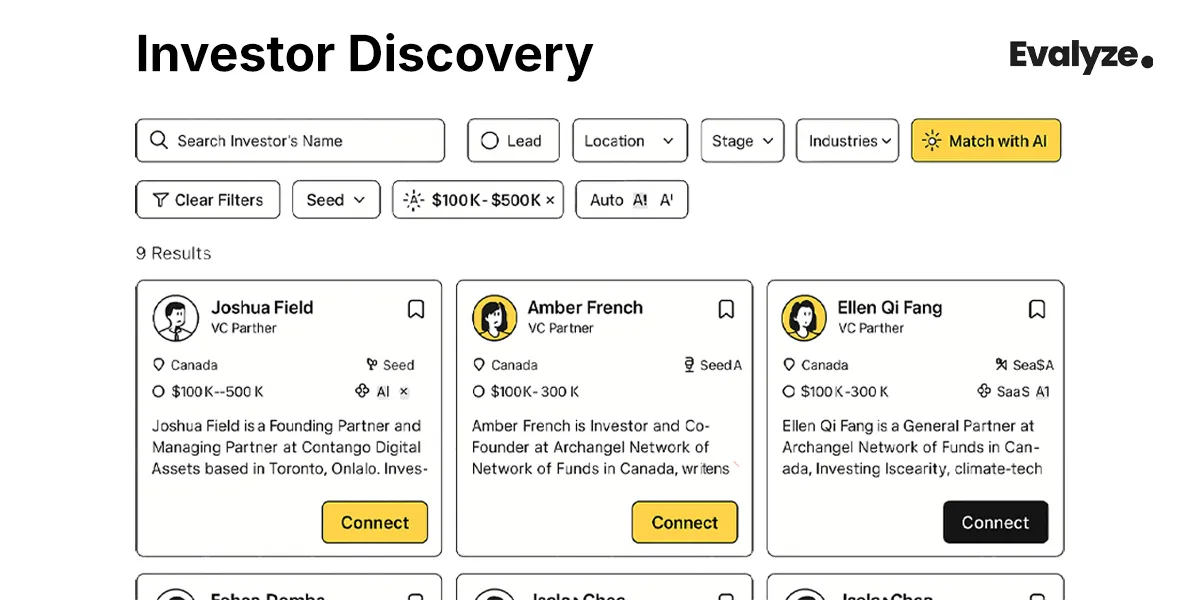
Learn how to use Evalyze’s new Investor Discovery tool to search, filter, and shortlist investors without AI.
November 11, 2025