

How to Build an Investor List Based on Your Startup
Learn how to build an investor list with Evalyze.ai. Step-by-step guide to find matched investors, shortlist the best fit, and raise smarter.
September 22, 2025
Learn how to find, qualify, approach, and choose a lead investor for your seed round, plus what to do if your round does not need a formal lead.
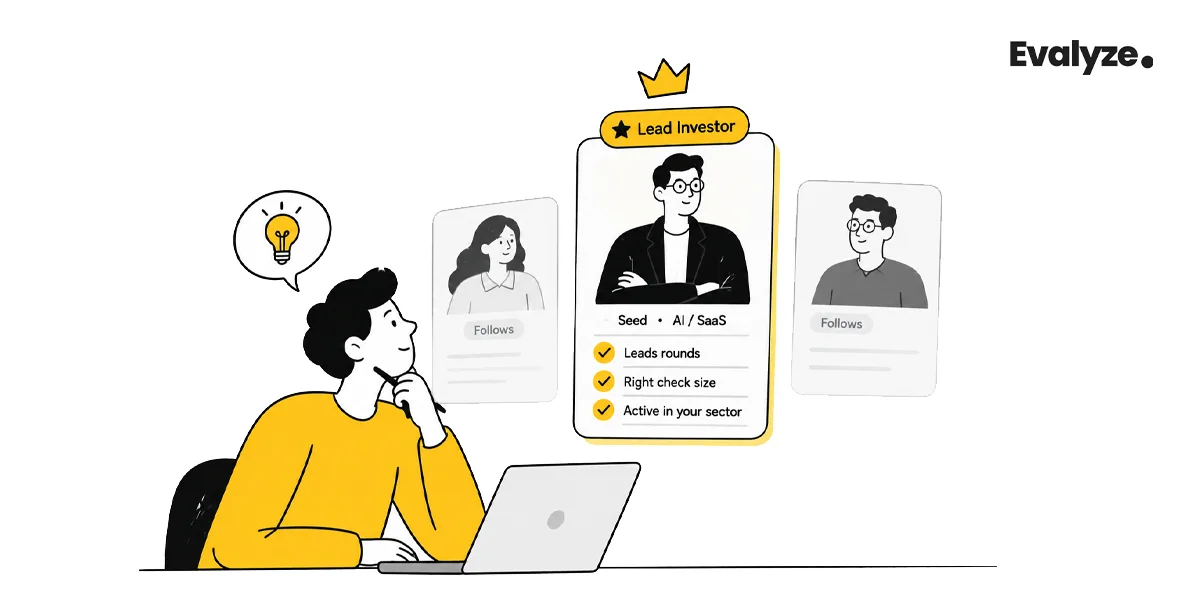
A lead investor usually makes one of the largest commitments to a funding round and takes a bigger role in moving the deal forward. In a priced round, that can include negotiating the main investment terms and taking part in deeper diligence. A seed round raised through SAFEs does not always need a formal lead.
If you do need one, searching for “seed investors” is too broad. You need investors who have actually led comparable rounds and fit your stage, sector, geography, round size, and company.
The job is to find the people who can credibly anchor your round.
Key Takeaways
A lead investor takes a more active role in financing than investors who simply participate in the round.
In a VC-led priced round, the lead will commonly make the largest or one of the largest investments. The lead may also negotiate major deal terms, conduct deeper diligence, coordinate parts of the process with other investors, and seek more involvement in company governance after the round.
The exact role varies by deal. The word “lead” alone tells you less than the investor's actual responsibilities.
| Investor role | What it usually means |
|---|---|
| Lead investor | Takes the primary role in the financing and makes a substantial commitment. In a priced round, the lead commonly handles much of the negotiation around the main terms. |
| Anchor investor | Commits meaningful capital early and helps give the round credibility, without necessarily taking the full formal role of a lead. |
| Follower / co-investor | Participates alongside other investors, often after the main structure of the round has been established. |
These labels are not perfectly standardized across venture firms. One fund may call itself an anchor, where another would use “co-lead.”
Ask what the investor plans to do rather than relying on the title.
No.
Y Combinator's guidance on SAFEs specifically states that founders raising money on SAFEs do not necessarily need a lead investor.
That distinction matters because “seed round” describes the stage of financing, not one mandatory deal structure.
A round made up of individual SAFE investments from angels and early-stage funds can come together without one investor formally negotiating the entire financing.
A priced equity round is more likely to have a lead because someone typically needs to negotiate the terms around valuation, rights, preferred stock, and governance.
The practical picture looks like this:
| Round structure | Lead situation |
|---|---|
| SAFE round with several angels or small funds | A formal lead may not be needed |
| Seed round with investors closing independently | A formal lead may not be needed |
| Priced equity round | A lead is common |
| Investors are interested but will only participate after someone anchors the round | Securing a lead becomes necessary to move those conversations forward |
| One institutional investor wants to make a large commitment and take the primary deal role | That investor may become the lead |
So before spending weeks searching specifically for a lead, establish what your financing actually requires.
If you are still deciding how much capital the seed round needs, work that out first. Our guide on how much money to raise at the seed stage focuses on the milestone, runway, and cost assumptions behind the number.
There is no fixed percentage that a seed lead must take.
One useful current benchmark comes from Carta.
In an analysis published on March 13, 2026, Carta reported that the median lead investor's share of a seed round had moved from about 50% historically to roughly 60%.
That gives founders a reference point. It does not mean your lead has to fund 60% of your round.
Round size, fund strategy, investor ownership targets, the number of participating investors, company demand, and the financing structure can all produce different results.
For example, using the 60% figure to decide that a $1 million round automatically requires a $600,000 lead would turn market data into a rule it was never meant to be.
Ask potential leads directly:
Keep the share of the round separate from the company's ownership. An investor funding 60% of the cash raised is not automatically buying 60% of the startup.
A fund website that says “pre-seed and seed” indicates its stage preference. It does not tell you how the firm behaves inside a round.
You need evidence of lead behavior.
Start with recent investments close to your own stage.
Look for explicit language around a fund's deals:
A fund that has repeatedly led seed deals is a much stronger lead candidate than one that simply appears in seed financing announcements.
Recency matters too. A lead investment from years ago may reflect a previous fund strategy or a partner who is no longer responsible for that sector.
An investor can be an excellent fit for the company and still be the wrong lead.
Suppose your round needs a substantial institutional commitment, while a fund's normal initial investment is far below that amount. The fund may still be a strong participant, but expecting it to anchor the financing creates a mismatch before the first conversation.
Use the investor's stated or observed check range rather than applying a universal minimum.
A lead candidate also needs to make sense for the company itself.
Research:
If your existing spreadsheet still mixes high-fit investors with names collected from broad searches, use our guide on how to build an investor list based on your startup to tighten the base list first.
A lead search works better when it starts from qualified investors rather than from every firm that has ever invested at seed.
You are not pitching a logo.
Find the person inside the firm who works in your category. Review which investments they have led, the companies they already support, and the themes they discuss publicly.
Fund titles can also be misleading. Do not assume that a specific job title automatically means the person can approve or lead your deal. Decision structures differ across firms.
Research can tell you that a fund can lead. The meeting tells you if it wants to lead your round.
Ask clear questions:
You do not gain anything by spending four meetings carefully avoiding the question.
You can narrow the research inside Evalyze Investor Discovery before reviewing investors individually.
Activate the “Lead” button to focus the results on investors identified as lead investors. Then combine that with the filters that define your round:
Lead → Stage → Industry → Location → Check Size
Investor Discovery also lets you filter by investor type and review individual profiles before adding them to your shortlist.
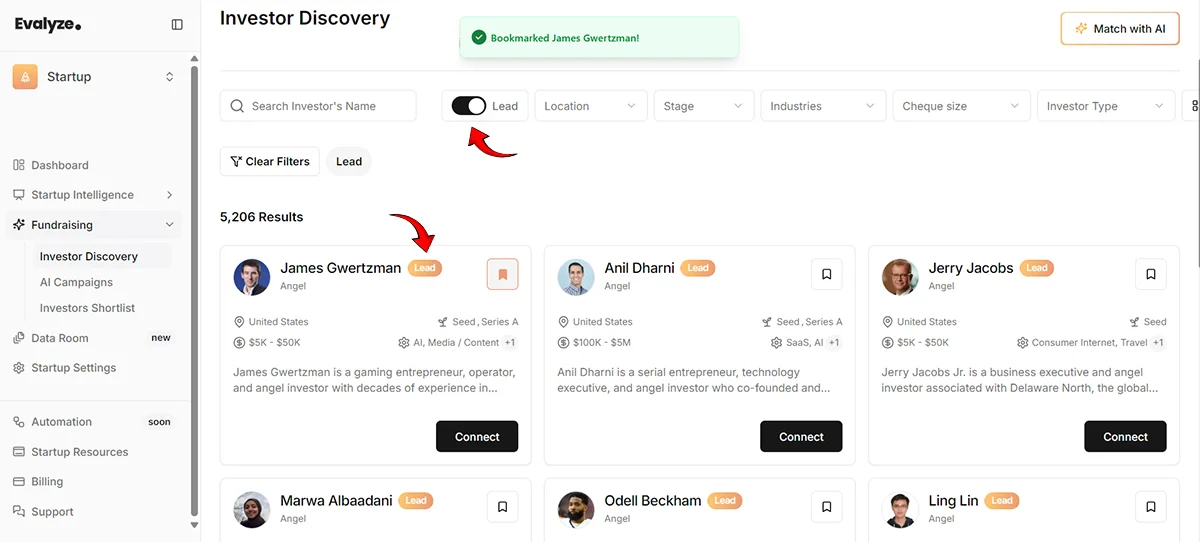
For example, a seed-stage fintech founder could activate Lead, select Seed, narrow the industry to Fintech, choose the relevant geography, and set a check-size range that fits the round. That produces a much more workable research set than searching the entire investor database.
The Lead filter should narrow your shortlist, not make the final decision for you. An investor who leads some rounds can still decide to follow, pass, or offer a smaller check in yours.
Open each profile and verify the fit before outreach.
If you want to see the full workflow, our guide to using Evalyze Investor Discovery explains the filters, investor profiles, bookmarks, and shortlist process.
Do not manage potential leads as if they were interchangeable with every other investor in the pipeline.
A dedicated lead shortlist quickly makes the gaps visible.
| Field | What to record |
|---|---|
| Investor / fund | Name of the target |
| Relevant partner | Person covering your category |
| Recent lead evidence | A comparable round they led or co-led |
| Stage fit | Seed or your exact target stage |
| Sector fit | Match with your category |
| Geography | Ability and appetite to invest in your market |
| Typical check | Fit with the commitment your round needs |
| Target ownership | Fit with the economics of the round |
| Portfolio conflict | Direct or close competitive investments |
| Outreach route | Introduction, direct email, application, other |
| Current status | Researching, contacted, meeting, diligence, interested, passed |
If you cannot answer several of those fields, you have found a prospect. You have not qualified a lead yet.
Your highest-priority lead candidates should not be your practice meetings.
Before approaching the investors you most want in the round, have a few conversations with relevant investors lower on your priority list. Pay attention to questions that keep coming up, parts of the pitch that take too long to explain, and objections you did not prepare for.
Then move your serious lead candidates into the process within a tighter period.
That makes it easier to compare investor interest at roughly the same point in the raise rather than having one fund at diligence while another has not received the deck yet.
Keep potential followers moving, too. If an investor likes the company but does not lead, ask if they would consider participating after a lead is in place.
Record that accurately. Interest is useful. It is not a commitment.
A structured investor funnel can help you separate qualified prospects, contacted investors, active meetings, diligence, passes, and investors waiting for another part of the round to move.
Your opening message should give an investor enough information to understand the company, round, and reason you chose them.
A useful structure is:
We're raising a $[X] seed round to reach [specific milestone]. Based on your investments in [relevant category/company] and your seed focus, I thought there could be a fit. We're currently speaking with potential lead investors and would be glad to share the deck if this falls within your current mandate.
The message does not need invented urgency.
Do not imply that other investors have committed if they have not. Do not call a casual conversation “strong interest.” Experienced investors see fundraising language every week.
Once the conversation becomes serious, get clarity on:
“Great meeting” is not a pipeline stage.
A next partner meeting, diligence request, follow-up question, or explicit pass tells you far more.
It usually means the investor is not willing to anchor the financing right now but may still participate if another investor takes that role.
Do not enter them in your spreadsheet as committed.
Ask:
“If we secure a lead on terms that work for the round, would you be interested in participating?”
If the answer is yes, follow with:
“What check range should I plan around if that happens?”
Now you have information you can actually use.
Keep the investor updated if a lead comes in. If the relationship is strong and the investor knows firms that are a better fit to lead, you can also ask for a specific introduction.
Then continue searching.
Waiting for a follower to turn into a lead can stall a round without giving you any new information.
Two lead offers create a better problem, but valuation alone should not decide it.
Compare the full relationship.
Review valuation, investment amount, ownership, liquidation terms, pro rata rights, and any other economic provisions in the proposed financing.
Have qualified legal counsel review the documents before you sign.
The fund may have a strong reputation, but your relationship will usually run through a particular partner.
Speak with the founders they have backed. Ask how the investor behaves after a difficult quarter, during the next raise, and when the company disagrees with them.
Being the lead does not automatically give an investor a board seat.
Carta's investor guidance notes that lead investors in priced rounds may seek a board seat or special voting rights. Those rights are negotiated as part of the financing.
That distinction matters. “Lead investor” is a deal role. Board control comes from the actual documents.
Some funds reserve capital for later investments in portfolio companies; others focus mainly on initial checks.
Neither model is automatically better. Know which one you are accepting.
If you are choosing between a smaller specialist fund and a larger institutional firm, our guide to Micro VCs vs. traditional VCs looks more closely at check size, founder attention, and follow-on capacity.
Review the current portfolio for direct competitors or companies close enough to create information concerns.
Ask about the firm's conflict policy rather than discovering the issue after diligence has started.
First, check if the round requires one.
A SAFE financing can sometimes come together through separate investments from angels, micro VCs, syndicates, and other early-stage investors without appointing a formal lead.
You may also find two investors willing to co-lead. If that happens, clarify who handles the main negotiation and how the decision process works. The title alone is not enough.
If qualified investors like the company but cannot write the amount needed to anchor the round, revisit the financing design:
Do not reduce the round just because fundraising is difficult. A smaller raise still has to fund a credible next milestone.
Repeated passes can point to a different problem.
If several genuine lead candidates independently raise the same concern about traction, terms, market, timing, or the company itself, record that pattern before starting another batch of outreach.
Before putting an investor in your lead shortlist, you should be able to answer:
A missing answer is a research task.
Several missing answers mean the investor is not ready for outreach.
Finding a lead gets much more manageable once your search starts with investors who have demonstrated lead behavior and can write a check that fits the financing.
In Evalyze Investor Discovery, activate the Lead button, add your stage, industry, and geography filters, and check-size filters, review the resulting profiles, and save the strongest candidates to your shortlist.
FAQ
Learn how to build an investor list with Evalyze.ai. Step-by-step guide to find matched investors, shortlist the best fit, and raise smarter.
September 22, 2025
A practical founder guide to choosing micro VCs vs traditional VC funds, check size, speed, follow-on support, and a simple decision worksheet.
December 16, 2025