

20 Startup Fundraising Tools For Founders
Fundraising feels chaotic until you build a system around it.
October 6, 2025
Compare 7 fundraising readiness assessment tools for startups. Discover how Evalyze helps founders assess investor readiness and prepare for fundraising.
Top fundraising readiness assessment tools for startups include Evalyze, which uses AI to analyze a startup's investment case.
Startup.Ready examines business fundamentals, while Pitchago combines venture assessment with ongoing development tasks. Waveup and Peachscore offer shorter fundraising questionnaires.
OpenVC identifies potential fundability red flags, and MYCOBI focuses on the evidence and documentation required for investment readiness.
The right fundraising readiness tool depends on where your startup stands, the evidence you already have, and what you still need to prove before approaching investors.
| Tool | Best for | Assessment method | Main output |
|---|---|---|---|
| Evalyze | AI startup assessment and investor discovery | Pitch deck analysis | 350-850 Investor Readiness Score; advanced reporting depends on plan |
| Startup.Ready | Diagnosing foundational business weaknesses | 33-question self-assessment | 0-150 score, pillar diagnostics, worksheets |
| Pitchago | Ongoing venture development | Assessment across 16 business areas | Venture Score, improvement tasks |
| Waveup | Quick VC fundraising preparation | 19-question questionnaire | 0-100% readiness score |
| OpenVC | Identifying fundability red flags | 30-question Fundability Test | Fundability Score, red-flag findings |
| MYCOBI | Evidence-based investment readiness | 25-criteria diagnostic | 0-1000 Investment Readiness Score, evidence-confidence assessment |
| Peachscore | Free initial fundraising assessment | 20-question questionnaire | Fundraising readiness score |
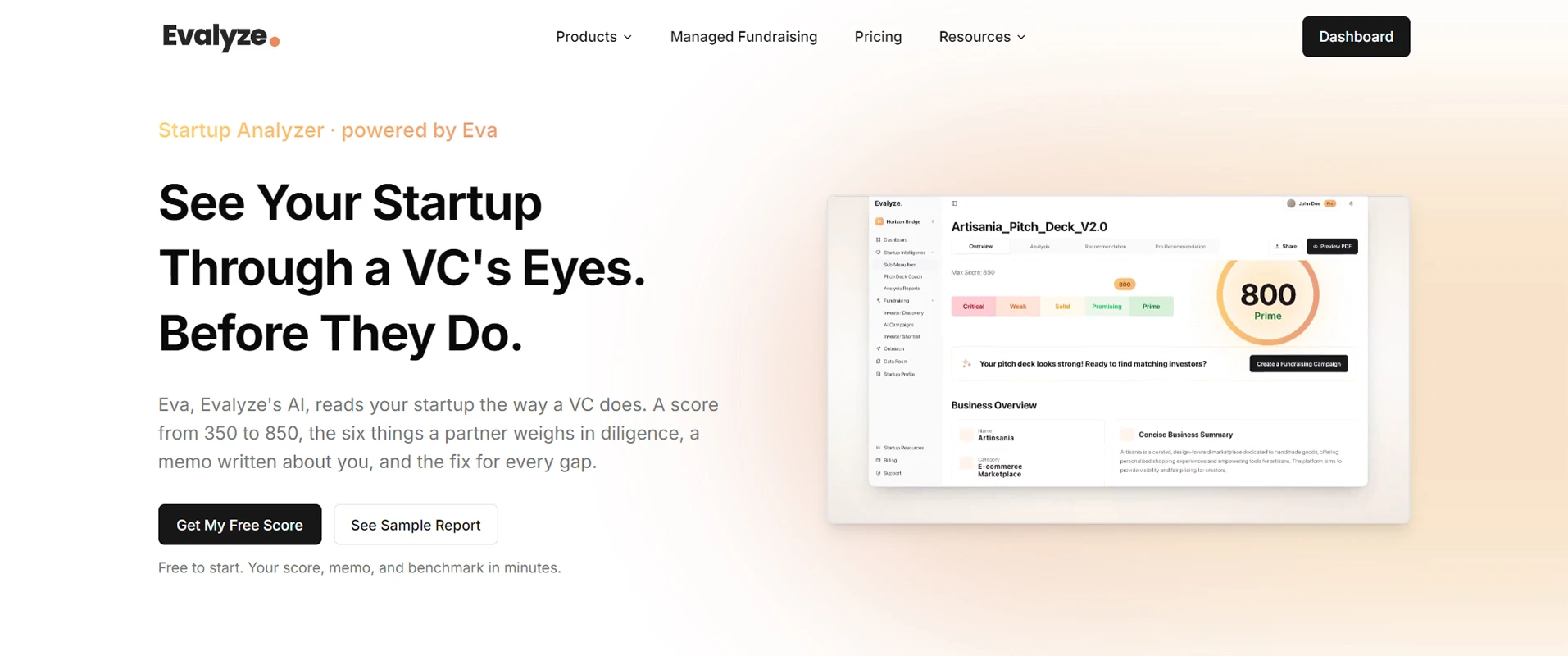
Evalyze Startup Analyzer, powered by Eva, evaluates a startup's investment case using an uploaded PDF or PowerPoint pitch deck.
It generates an Investor Readiness Score from 350 to 850, identifies weaknesses across six business dimensions, and offers a VC-style memo summarizing the startup's strengths and risks.
What Evalyze evaluates:
| Dimension | Assessment focus |
|---|---|
| Team & Founders | Founder expertise and execution capability |
| Traction & Metrics | Customer demand, adoption, and commercial progress |
| Problem & Solution Fit | Customer needs and solution relevance |
| Competitive Advantage | Differentiation and defensibility |
| Market Size & Opportunity | Market potential and growth opportunity |
| Scalability & Business Model | Revenue model and scalability |
Example: A pre-seed SaaS startup has experienced founders and promising user adoption, but its pitch deck leaves important questions unanswered about pricing, customer acquisition costs, and scalability.
By identifying weaknesses in the business model, the assessment gives founders specific areas to investigate before approaching investors.
Evalyze's free Starter plan provides an initial readiness assessment. Evalyze Pro adds advanced scoring, benchmarks, personalized recommendations, and downloadable reports.
Compare Evalyze's plans and features to find the right level of analysis for your fundraising stage.
Evalyze connects startup assessment with investor discovery and matching, allowing founders to research investors by funding stage, industry, geography, and investment preferences within the same platform.
Identifying relevant investors requires more than collecting names. Our guide to building an investor list based on your startup explains how to narrow your search using investment criteria that match your business.
Startup.Ready evaluates startup fundamentals through 33 questions across six pillars: Founder, Problem, Market, Business Model, Go-to-Market, and Financial.
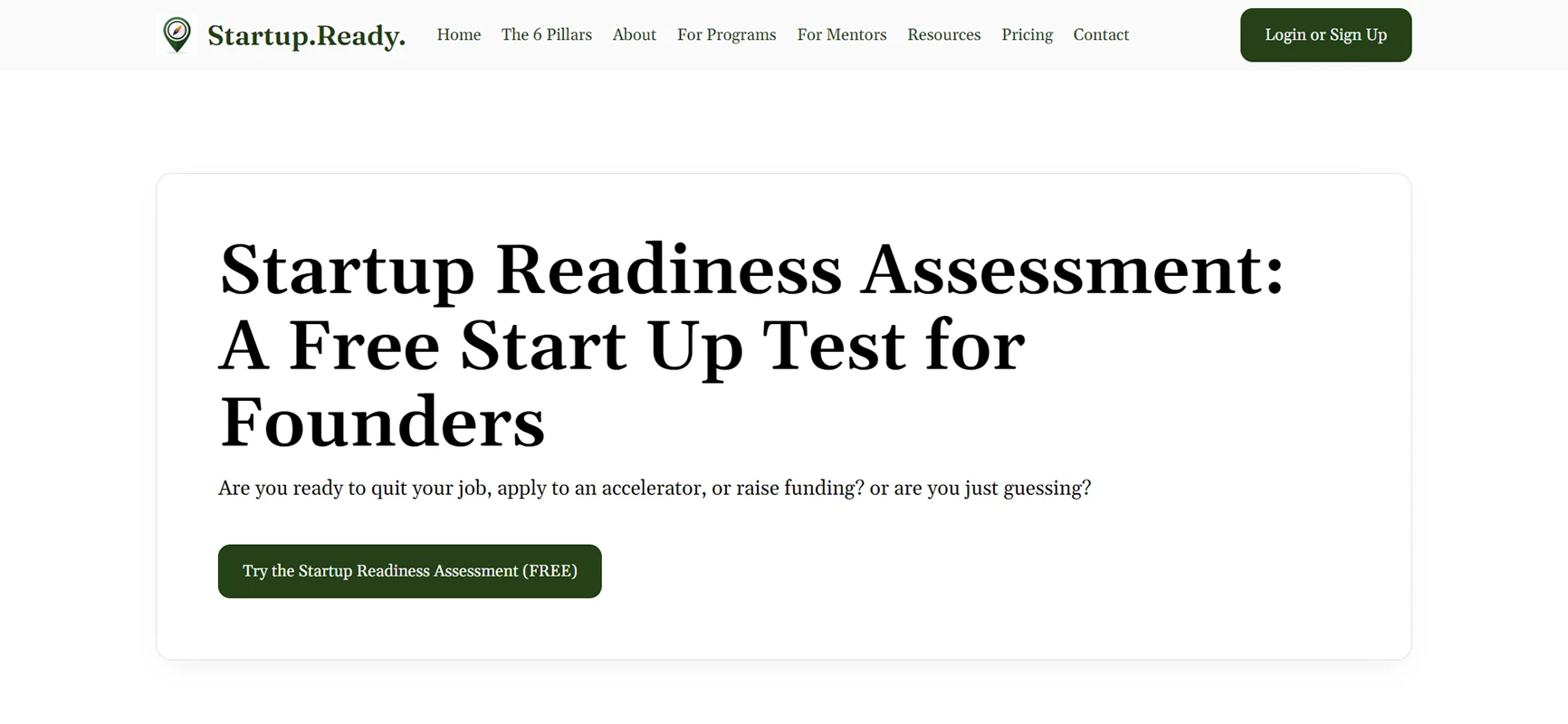
Founders receive a readiness score out of 150, individual pillar scores, and a diagnosis of their biggest constraint. The platform also recommends worksheets to address identified weaknesses, such as unclear customer segments or untested business assumptions.
The assessment takes approximately 20-25 minutes. The first two assessments are free, with additional assessments and progress tracking available through a paid plan.
Pitchago evaluates startups across 16 business areas, including management, business model, customers, competition, financials, and funding.
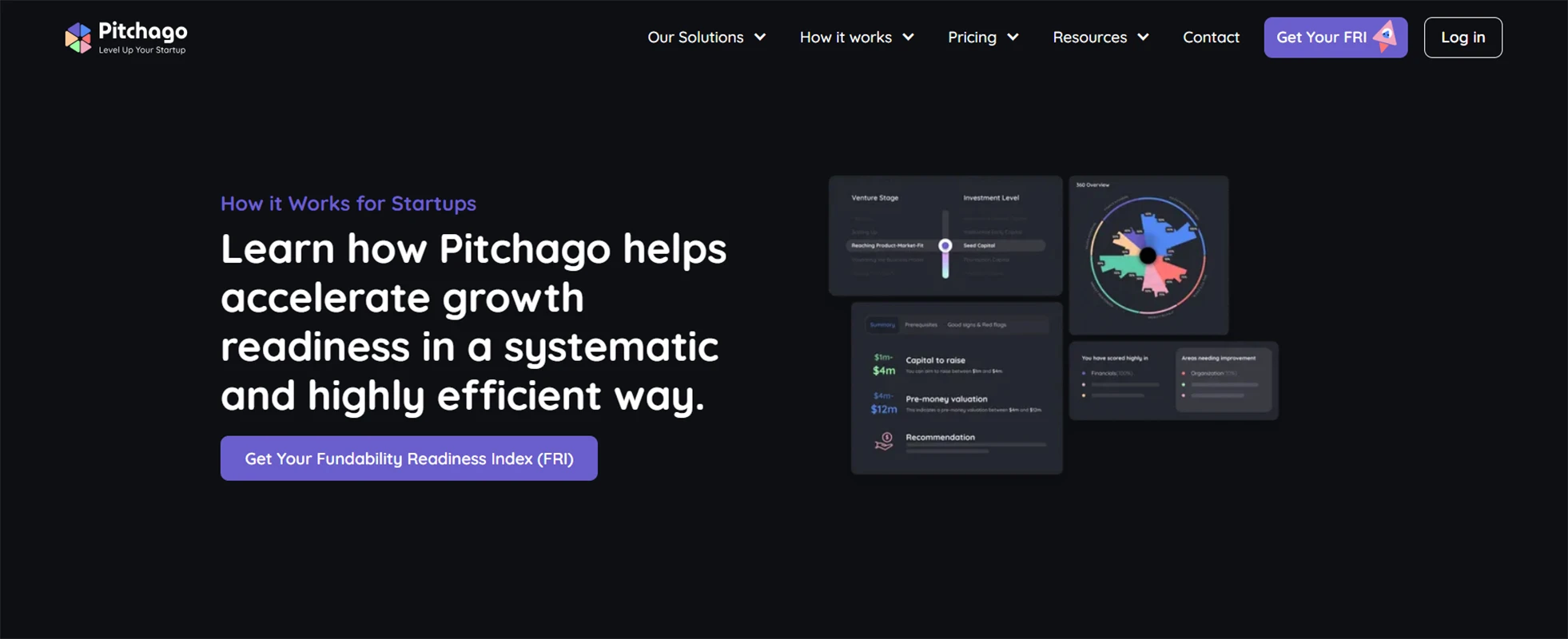
Founders receive a Venture Score highlighting areas for improvement. Its Level Up Wizard offers targeted assessments and recommended tasks that founders can prioritize and track as their business develops.
Unlike a one-time readiness check, Pitchago supports repeated assessments to monitor progress as business priorities change.
Waveup's Startup Fundraising Readiness Assessment uses a 19-question questionnaire covering funding stage, target raise, market opportunity, business model, financial planning, and competitive advantage.
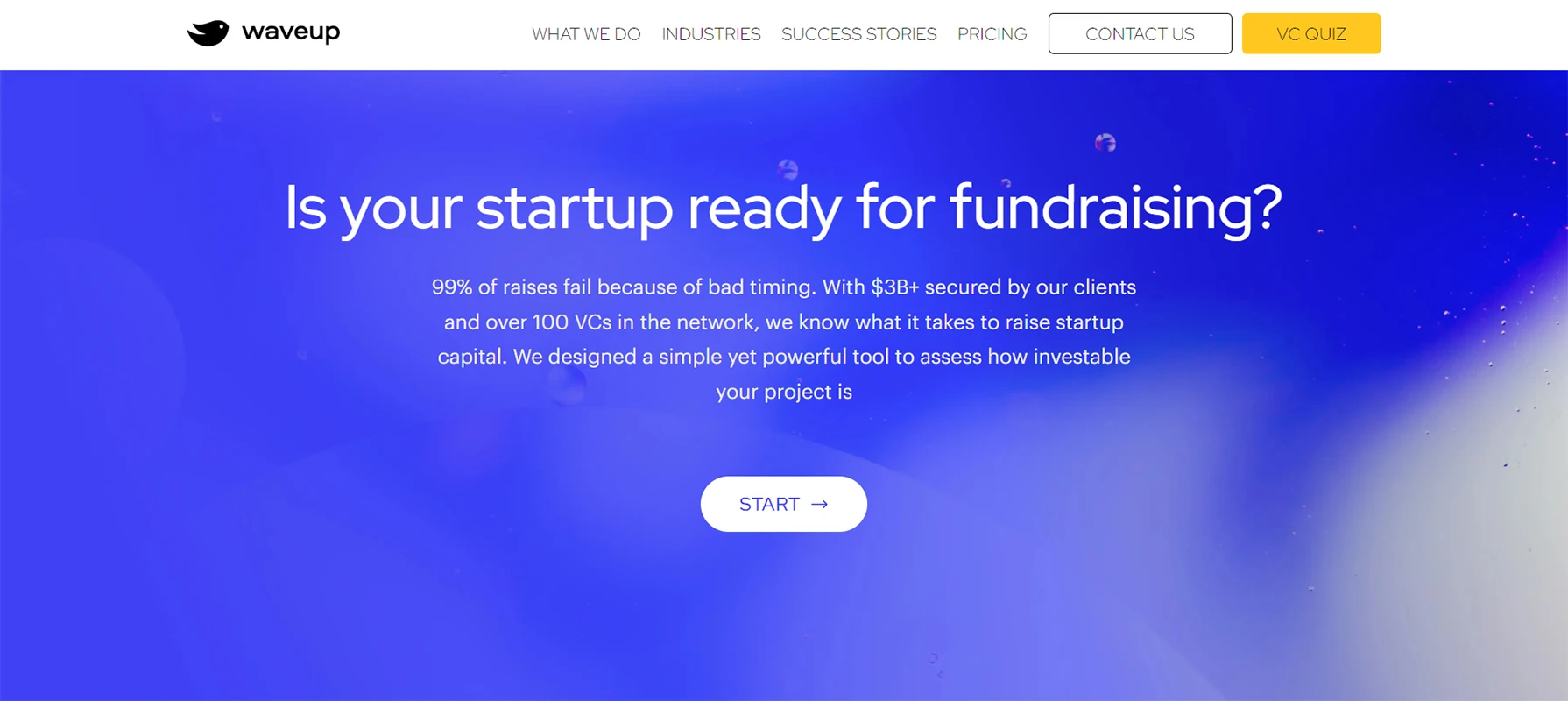
Founders receive a readiness score from 0% to 100% and feedback on their fundraising strategy after submitting their name and email.
Waveup also offers advisory services covering pitch materials, financial modeling, and investor relations.
OpenVC's Fundability Test uses 30 questions to assess 12 potential fundraising red flags.
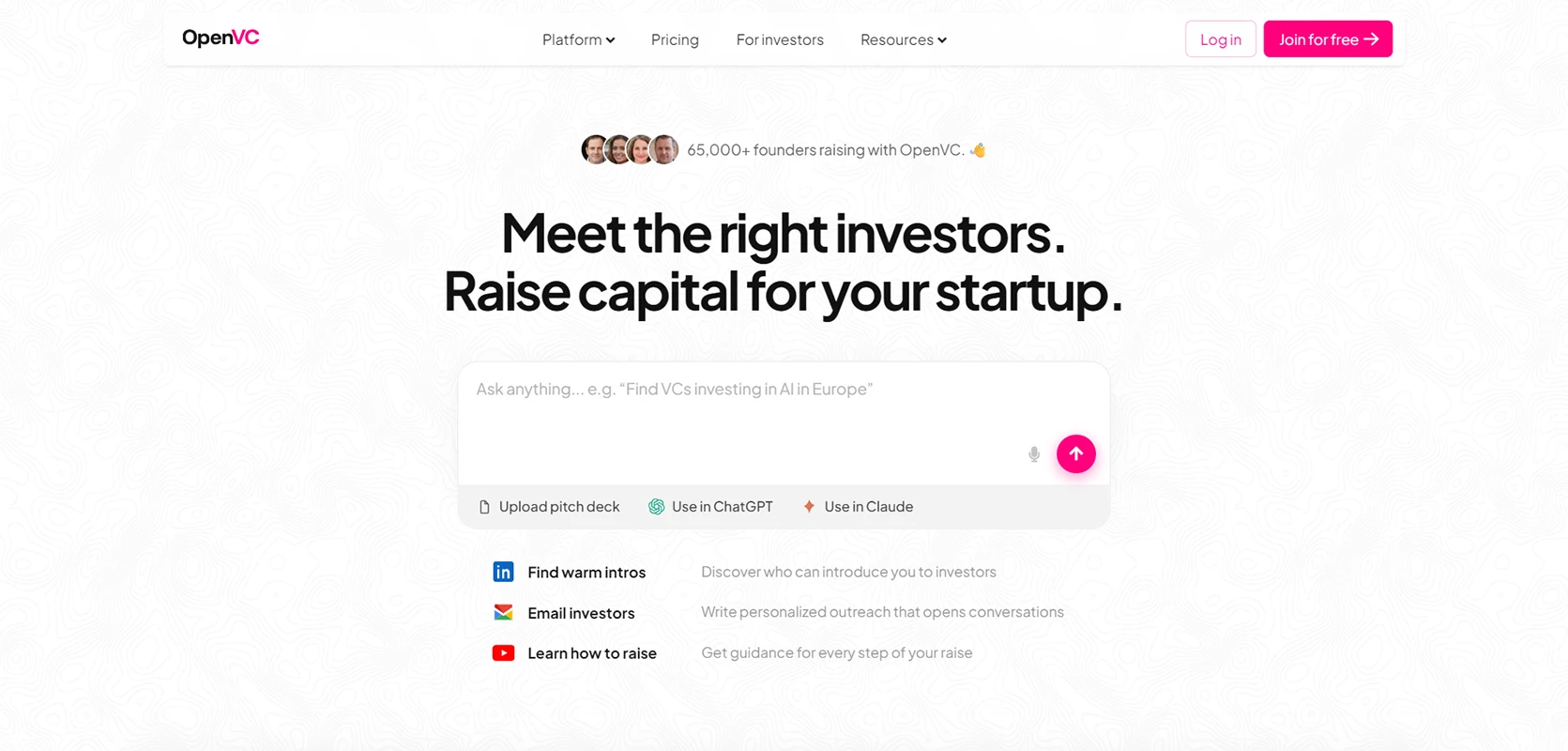
Founders receive a Fundability Score, a valuation range estimate, and feedback on potential weaknesses. OpenVC also uses assessment responses to refine investor search results.
Scores remain confidential, are not shared with investors, and can be recalculated after improvements.
For a closer look at how the two platforms differ in investor discovery, AI assessment, and fundraising workflows, read our Evalyze vs. OpenVC comparison.
MYCOBI's Investment Readiness Diagnostic evaluates startups against 25 criteria across five dimensions: Financial Health, Operational Maturity, Market Position, Governance & Compliance, and Traction.
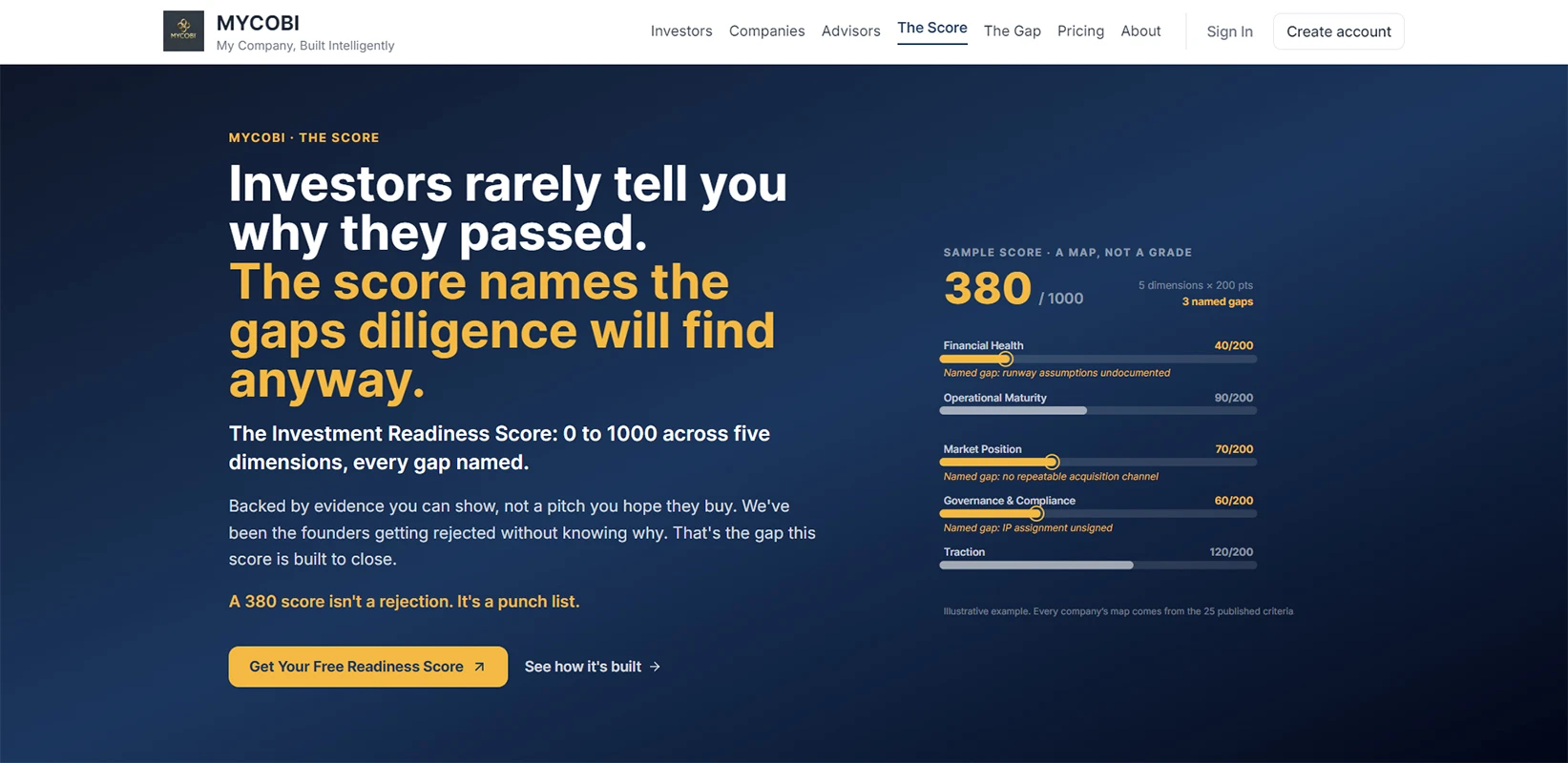
The platform generates an Investment Readiness Score from 0 to 1000, alongside dimension-level findings.
Its key differentiator is Evidence Confidence, which indicates how well a startup's reported information is supported by documents or connected business systems. For example, financial statements can help substantiate a founder's claimed cash runway.
MYCOBI also adjusts its assessment expectations according to the startup's funding stage.
Peachscore's Fundraising Readiness Assessment offers a free, 20-question assessment that takes approximately three minutes.
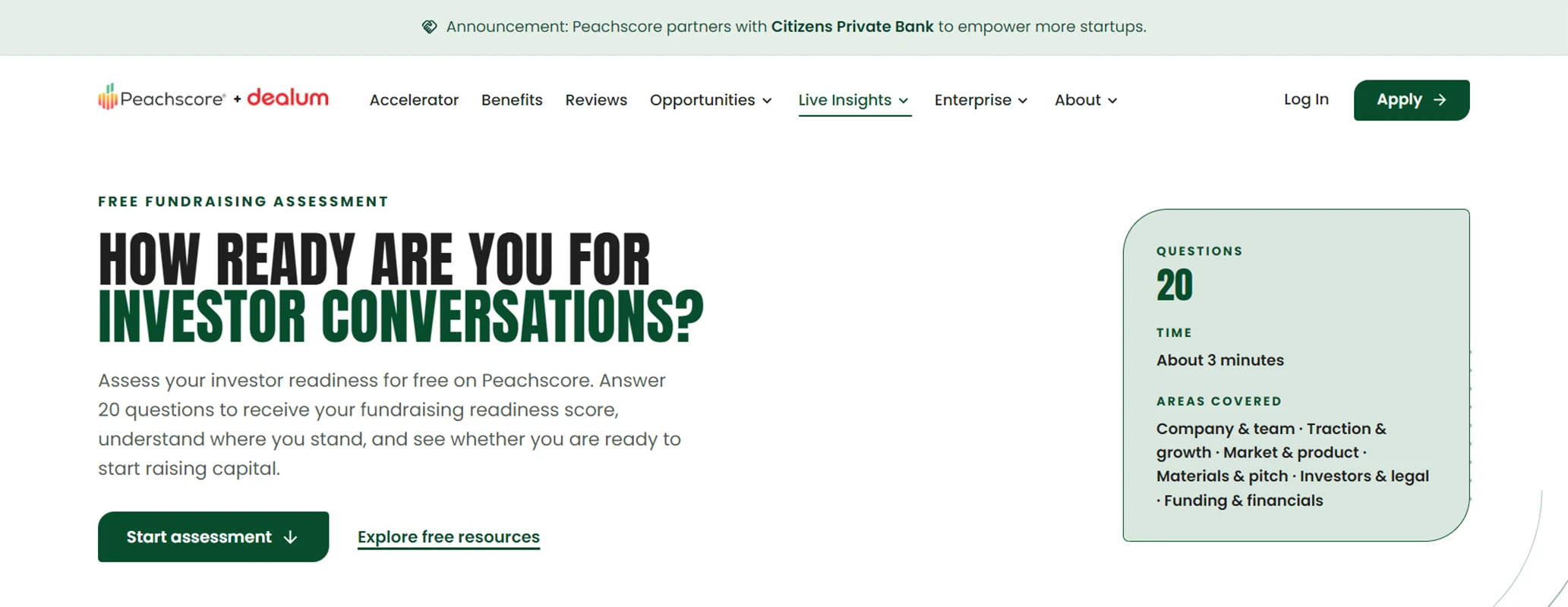
It considers the startup's funding stage, including idea, pre-seed, and seed, and provides a readiness score to help founders evaluate their fundraising preparedness.
The most useful assessment is the one that addresses the uncertainty affecting your next decision.
| Your situation | Recommended tool | Why it fits |
|---|---|---|
| You have a pitch deck and want to assess the investment case before researching investors | Evalyze | Evaluates the startup's business case and connects to investor discovery |
| You're validating an idea and don't have a pitch deck | Startup.Ready | Tests foundational business assumptions without requiring an established product or revenue |
| You're preparing a specific funding round and need a quick initial check | Waveup | Focuses its questionnaire on venture fundraising preparation |
| You want to assess business development repeatedly and work through improvement tasks | Pitchago | Links business-area assessments to ongoing tasks and progress |
| You're about to build an investor list and want to identify fundability concerns | OpenVC | Combines a red-flag assessment with investor search |
| You're preparing business records for more detailed due diligence | MYCOBI | Examines readiness alongside the evidence supporting company claims |
| You want a brief, free initial assessment | Peachscore | Provides a short fundraising questionnaire |
An investor readiness score is a diagnostic, not a prediction of funding success.
Each platform uses its own scoring methodology. For example, a score of 700 on Evalyze's 350-850 scale is not equivalent to 700 on MYCOBI's 0-1000 scale. Similarly, an 80% readiness score does not mean an 80% chance of securing investment.
What matters most is the reasoning behind the score.
Check whether the assessment relies on self-reported answers, pitch deck information, or supporting business records.
Use the findings to identify weaknesses, verify assumptions, and decide what needs improvement before fundraising.
A startup readiness assessment examines the strength of your business case. A pitch deck review examines how effectively you communicate that case.
A startup can have strong traction but a confusing presentation. Equally, a polished deck cannot compensate for an unproven business model.
Evalyze offers two distinct tools:
| Product | What it evaluates | Score |
|---|---|---|
| Startup Analyzer | Business fundamentals and investment readiness | 350-850 |
| AI Pitch Coach | Pitch deck content, structure, and presentation | 0-100 |
AI Pitch Coach also provides slide-level feedback to help founders improve their investor narrative.
Learn more about how AI pitch deck scoring works and when to use it alongside a startup readiness assessment.
Turn your assessment results into a prioritized action plan, rather than focusing only on improving the score.
Before approaching investors, use our pre-seed fundraising checklist to prepare the supporting documents and information needed for your raise.
Understanding your startup's fundraising position starts with examining the business case you intend to present.
Evalyze Startup Analyzer provides a free basic Investor Readiness Score, with advanced analysis, benchmarks, and recommendations available through Pro.
Use it to identify areas that deserve closer attention before building your investor outreach strategy.
FAQ
Yes. Pre-revenue startups can demonstrate readiness without sales. Evidence may include customer interviews, prototypes, pilot agreements, letters of intent, or early product usage. The assessment should reflect the startup's funding stage, industry, and available evidence rather than applying the same benchmarks to every company.
Start with your pitch deck, business model, target market, team information, and current traction. If available, include customer research, financial projections, funding requirements, and planned use of funds. Requirements vary by platform. Some tools use questionnaires, while others analyze uploaded documents. Check the provider's data-handling policies before sharing confidential information.
Reassess after meaningful business milestones, such as launching a product, validating customer demand, gaining traction, or updating financial projections. The goal is to measure actual progress, not repeatedly generate a new score without improving the underlying business.
Fundraising feels chaotic until you build a system around it.
October 6, 2025
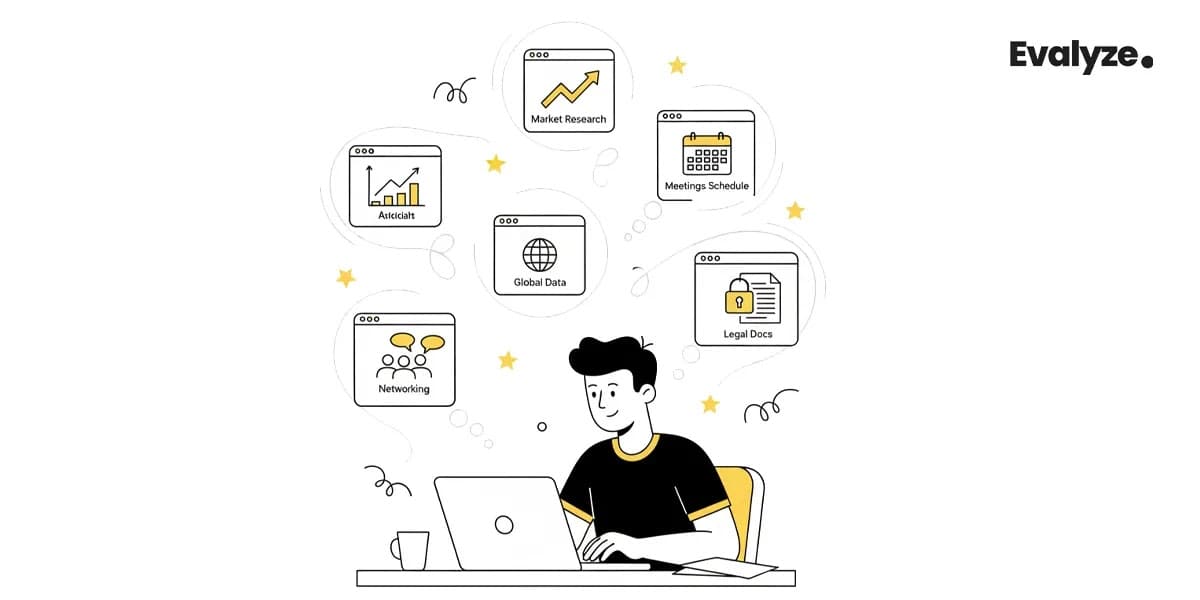
A founder-friendly guide to 20 AI tools for investor matching, pitch decks, outreach, and data rooms, plus a practical workflow to use them.
December 18, 2025