

How to Build an Investor List Based on Your Startup
Learn how to build an investor list with Evalyze.ai. Step-by-step guide to find matched investors, shortlist the best fit, and raise smarter.
September 22, 2025
Check recent VC investments, fund timelines, and partner activity before outreach. Learn how to verify sources and avoid inactive investor leads.
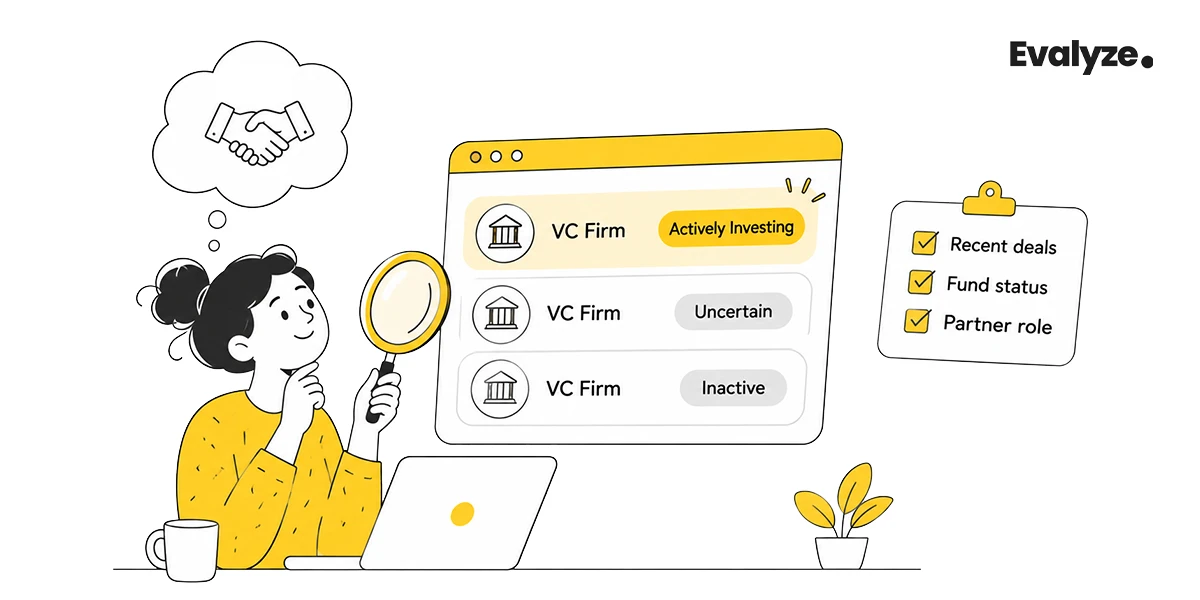
To tell if a VC is actively investing, check its recent first investments in new portfolio companies, identify which fund made those investments, and verify that the relevant partner still works there.
A recent deal confirms investment activity, but it doesn't prove the firm has capacity for your round. If public records are incomplete, ask the investor directly before prioritizing outreach.
A VC firm might have an active website, regularly updated social accounts, and an impressive portfolio. None of those tells you if it's writing new checks.
An actively investing VC is generally a firm making investments through one or more funds. For outreach purposes, however, the useful question is more specific:
Is this investor currently making first investments in startups like yours?
Three factors determine how confidently you can answer:
You won't always find public evidence for all three. Fund agreements and remaining capital aren't necessarily disclosed, and firms don't announce every transaction.
The aim is to identify credible prospects while recording what remains unconfirmed.
The latest investment date in a database is a useful starting point, but it can give you the wrong impression for several reasons.
Funding rounds aren't always announced when they close. A deal reported in August may have been completed months earlier.
When researching transactions, record the investment date separately from the announcement date. If you only have the latter, label it accordingly. Also, check the company's announcement against the investor's portfolio page. A database can omit transactions or update its records later than the original source.
Suppose a VC invested in a company's seed round in 2022 and participated in its Series A in 2024 and Series B in 2026. The 2026 deal shows that the investor is still deploying capital. It doesn't establish that the fund is making first investments in new startups.
VC funds commonly reserve capital to support existing portfolio companies. Depending on their agreements, they may continue making follow-on investments after the period for making new investments has ended.
For founders, the distinction is straightforward: a recent follow-on says less about your chance of securing a first check than a recent new portfolio-company investment.
Some venture firms continue managing their portfolios after slowing or stopping new investments. These are sometimes described as zombie VC firms.
In June 2025, Fortune reported PitchBook data showing that the number of US zombie VC firms had increased from 382 at the end of 2021 to 574 at the beginning of 2025.
The 2025 classification covered firms that had raised a fund within the previous six years but had no known investments since late December 2023.
Those figures reflect PitchBook's historical research criteria. A firm missing from recent deal announcements isn't necessarily inactive. Its investments might be undisclosed, or it may be deploying capital more slowly.
Some signals establish that a transaction occurred. Others suggest a firm has capital or intends to invest. They shouldn't be treated as interchangeable.
| Signal | What it tells you | What remains uncertain |
|---|---|---|
| Recent first investment announced by the startup or VC | The firm invested in a new portfolio company | Capacity for another investment |
| New fund announcement | The firm announced a new investment vehicle | Whether deployment has started |
| Dated partner statement about current investing | The partner's stated investment focus | Available capital and willingness to invest |
| SEC Form D for a US fund | Information about an exempt securities offering | Remaining investable capital |
| Investor database deal history | Transactions recorded by the provider | Completeness and freshness |
| Directory label such as "active" | The provider's classification | Underlying evidence, unless disclosed |
| Social posts and event appearances | The firm's public professional activity | Actual investment capacity |
A recent, verified first investment is strong evidence of new-company investing. A fund announcement or a partner's statement can help establish the firm's current direction.
When these signals conflict, investigate the specific transaction and fund rather than relying on an overall activity label.
Start with the firm's website and portfolio page. Review its last five to ten publicly announced deals, where available, and look for corresponding startup announcements.
For each transaction, establish:
The investment date, or announcement date if the transaction date is unavailable.
The company's funding stage.
Whether this was the VC's first investment in that company.
Which investor entity participated.
To distinguish a first investment from a follow-on, check the company's earlier rounds. If the VC participated previously, the newer transaction is generally a follow-on.
Example: You're raising a $1 million seed round for a B2B SaaS startup.
You find three investments announced by a VC during 2026. Two are follow-ons in existing portfolio companies, and the third is a first investment in a Series C startup. The firm is making investments, but the records don't establish that it's currently pursuing new seed opportunities.
Keep it under consideration if its stated strategy fits your company. Then investigate its current seed investment mandate before prioritizing outreach.
If the type of investment is unclear, record it as unconfirmed. Don't assume every funding announcement represents a new portfolio-company investment.
A VC firm may manage several funds with different investment periods, strategies, and restrictions.
For example, a firm could be using Fund III for new investments while Fund II primarily supports existing portfolio companies.
Find the latest announced fund and record its name, vintage, and closing dates where available. Then look for evidence connecting recent investments to that fund.
An investment period is the phase during which a fund generally has authority to make new investments under its governing agreement. The period can be subject to extensions, restrictions, and exceptions.
Fund vintage, first close, and final close aren't necessarily the same date. You can't reliably determine when a fund's investment period expires from its vintage year alone.
There is no universal cutoff.
As an initial research rule, investigate fund capacity more closely when the latest publicly identified fund is approximately four years old or older, particularly when you can't find a successor fund or recent first investments.
This four-year point is an Evalyze research heuristic, not an industry standard.
Investment pace varies substantially. In its Q1 2024 VC Fund Performance Report, Carta reported that 2022-vintage US venture funds in its sample had deployed approximately 43% of capital after 24 months, compared with 60% for the 2020 vintage at the same age.
The analysis covered 1,803 US venture funds administered through Carta, with vintages from 2017 through 2022.
These historical figures show why age alone is unreliable. An older fund may retain capacity for new investments, while a newer fund may deploy capital slowly.
Your research should establish which vehicle is currently investing and if its mandate includes startups like yours.
A firm's recent activity doesn't tell you which partner should receive your pitch.
The partner who previously covered your sector may have left, changed roles, or stopped investing at your stage.
Check the firm's team page, the partner's LinkedIn profile, and recent investment announcements. Look for evidence that the person still holds an investing role and works with companies in your sector.
Historical investments can establish relevant experience. They don't necessarily reflect the partner's current responsibilities.
Partner departures can also affect fund operations. Some venture fund agreements include key-person provisions that restrict new investments when specified senior individuals leave or reduce their involvement.
The Institutional Limited Partners Association's Private Equity Glossary describes these provisions. Their effects depend on the agreement, so an individual partner's departure doesn't automatically mean a fund has stopped investing.
If the partner has moved elsewhere, update your records and identify the appropriate current contact.
For US venture funds raising capital under Regulation D, SEC Form D filings can provide useful information about a fund's securities offering.
Search the SEC's EDGAR database using the firm's name and known fund entities. The legal name of a vehicle may differ from the firm's public brand.
According to the SEC's Form D guidance, Form D is a notice associated with an exempt securities offering. For applicable Regulation D offerings, it generally must be filed within 15 days after the first sale of securities.
The filing may report the offering amount and the amount sold. However, it cannot independently tell you:
A recent Form D can support your research into a fund's fundraising activity. It doesn't establish current deployment capacity.
The absence of a recent amendment also doesn't prove that the fundraising effort failed. Amendment requirements depend on the circumstances.
For investors outside the US, use the relevant public records where available. Not every venture fund is subject to SEC Form D requirements.
Suppose an investor database lists a firm's last deal in 2024, but the firm appears in a startup's August 2026 funding announcement.
First, check what the newer announcement actually documents. Was the investment completed in 2026? Was it the firm's first investment in that company? Which vehicle participated?
A recent publication can describe an older transaction, so the publication date alone doesn't resolve the conflict.
Apply these rules:
You don't need to resolve every discrepancy before deciding which investors deserve further research. You do need to avoid presenting uncertain information as established fact.
Use three classifications in your investor list.
| Classification | Evidence required | Recommended action |
|---|---|---|
| Recently active | Verified first investment in a new portfolio company within the past 12 months | Prioritize if the investor fits your round |
| Activity unconfirmed | No verified recent first check, incomplete records, or conflicting evidence | Investigate further or ask directly |
| Confirmed not making new investments | Reliable current statement or direct confirmation that the relevant fund no longer makes new investments | Deprioritize that vehicle and check for a successor fund |
The 12-month window is Evalyze's suggested research threshold for recent activity. It isn't a standardized industry definition.
A firm with no publicly documented first investment for 18 months may still be investing. Similarly, a first check announced last month doesn't guarantee that another investment is available.
Use the classification to prioritize research and outreach, not to predict which investors will fund your startup.
Consider a fictional firm called Example Ventures.
You're raising $1.2 million for a US-based B2B SaaS company. The firm's portfolio looks relevant, and an investor directory labels it active.
You collect the following information:
| Research field | Illustrative finding |
|---|---|
| Investor | Example Ventures |
| Latest announced fund | Fund II, 2022 |
| Latest first-check announcement | August 2026 |
| Reported transaction date | May 2026 |
| Investment stage | Seed |
| Sector | B2B SaaS |
| Relevant partner | Listed on the current team page |
| Current fund capacity | Unconfirmed |
| Typical check size | Unconfirmed |
| Activity classification | Recently active |
Example Ventures and these records are fictional. They demonstrate the research method.
The May 2026 transaction provides evidence of a recent seed investment. However, the records don't establish the firm's current check size or remaining capacity.
💡 Decision: Keep Example Ventures on your shortlist, then confirm its current seed investment mandate before sending a personalized pitch.
You have a reason to contact the firm and a clear question to resolve. That's more useful than a database label without supporting evidence.
An investor list becomes easier to maintain when each status has evidence behind it.
A spreadsheet or CRM is sufficient. Include these fields:
| Field | Information to record |
|---|---|
| Investor and partner | Firm name, relevant partner, current role |
| Latest known fund | Fund name, vintage, disclosed closing dates |
| Last first investment | Startup, stage, transaction or announcement date |
| Recent follow-ons | Identified investments in existing portfolio companies |
| Fund capacity | Confirmed, unconfirmed, or restricted, with supporting evidence |
| Activity status | Recently active, unconfirmed, or confirmed not making new investments |
| Sources | URLs supporting individual findings |
| Review date and next action | Last checked, contact, investigate, or recheck |
Link to the source documenting each finding. A firm's homepage alone isn't evidence of a specific transaction.
For an active fundraise, reviewing investor information quarterly is a reasonable maintenance starting point. Recheck high-priority contacts immediately before outreach, particularly when your source information is old.
If you're still assembling your initial list, start with How to Build an Investor List Based on Your Startup.
Some information won't be available publicly. Once you've identified a relevant investor, direct questions can resolve uncertainty faster than additional database searches.
Four questions are particularly useful:
You don't need to include all 4 in your initial email. Lead with why your startup is relevant to the investor, then discuss fund status and investment criteria as the conversation develops.
For later-stage due diligence, see 5 Questions to Ask Before Saying Yes to an Investor.
Before verifying investment activity, narrow your list to investors who fit your startup's stage, sector, and funding needs.
Evalyze Investor Discovery helps you research investors by stage, sector, and geography. Evalyze AI Investor Matching identifies relevant investors and explains the reasons behind each match.
Use these recommendations to build your shortlist, then verify recent investments and partner activity before outreach. A strong match indicates potential fit, not available capital or investment interest.
Learn more in AI Investor Matching: What a Match Score Should Explain.
Use Evalyze to identify investors aligned with your startup and understand why each match may be relevant. Verify their current investment activity before contacting them.
Start your fundraise →
FAQ
Yes, if the firm has a strong fit with your startup and you haven't found evidence that it has stopped making new investments. Keep the activity status unconfirmed and use a concise, relevant message to establish if the investor is considering new opportunities. Prioritize investors with verified recent activity first when your research and outreach capacity is limited.
You can establish many useful signals through VC portfolio pages, startup funding announcements, partner profiles, and applicable regulatory records. Free research may take longer, and some transactions won't be publicly documented. Record sources and dates as you go. Paid databases can reduce research effort, but you still need to verify their records when current investment activity is central to your outreach decision.
Partly. You can still examine recent investments, public statements, sector focus, and current professional activity. However, an individual angel investor may invest personal capital rather than through a traditional VC fund. Fund vintage, investment periods, and institutional fund filings may therefore be irrelevant. For angels, recent personal investment activity and direct confirmation of current investment interests are usually more applicable research signals.
Learn how to build an investor list with Evalyze.ai. Step-by-step guide to find matched investors, shortlist the best fit, and raise smarter.
September 22, 2025
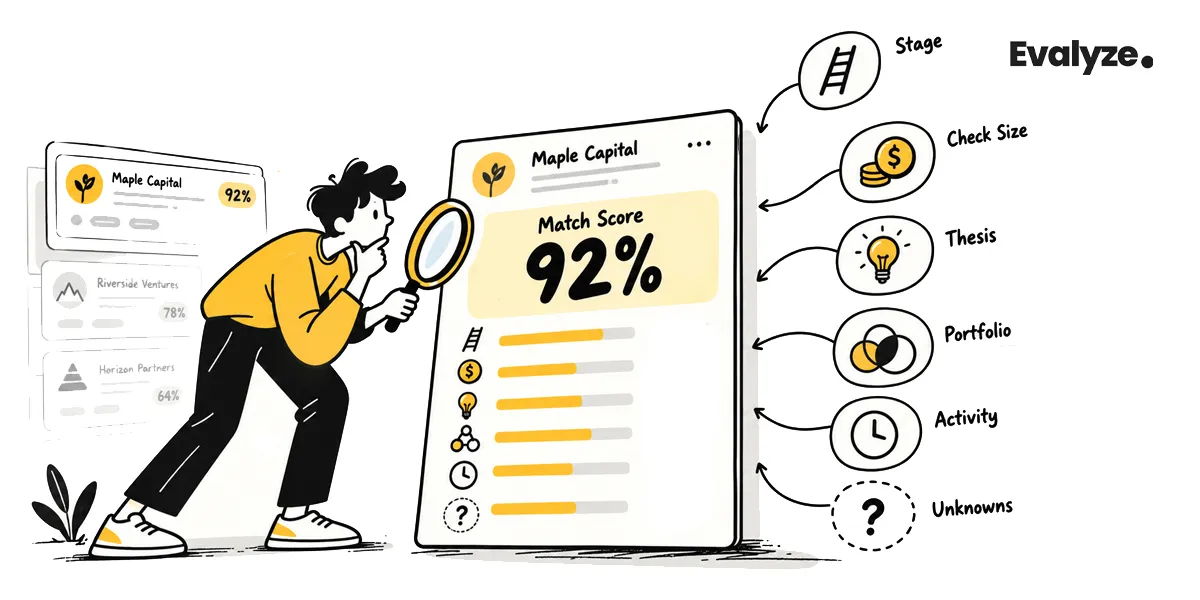
Learn what an AI investor match score means, what should sit behind it, and how to evaluate investor fit before outreach.
October 10, 2026