⏳ Limited-Time offer: GetOFF and upgrade your fundraising workflow!
Upgrade
Fundraising

How Much Money Do You Need To Raise At The Pre-Seed Stage?

Learn how to calculate your pre-seed funding ask using runway, burn rate, milestones, and market benchmarks.
How Much Money Do You Need To Raise At The Pre-Seed Stage?

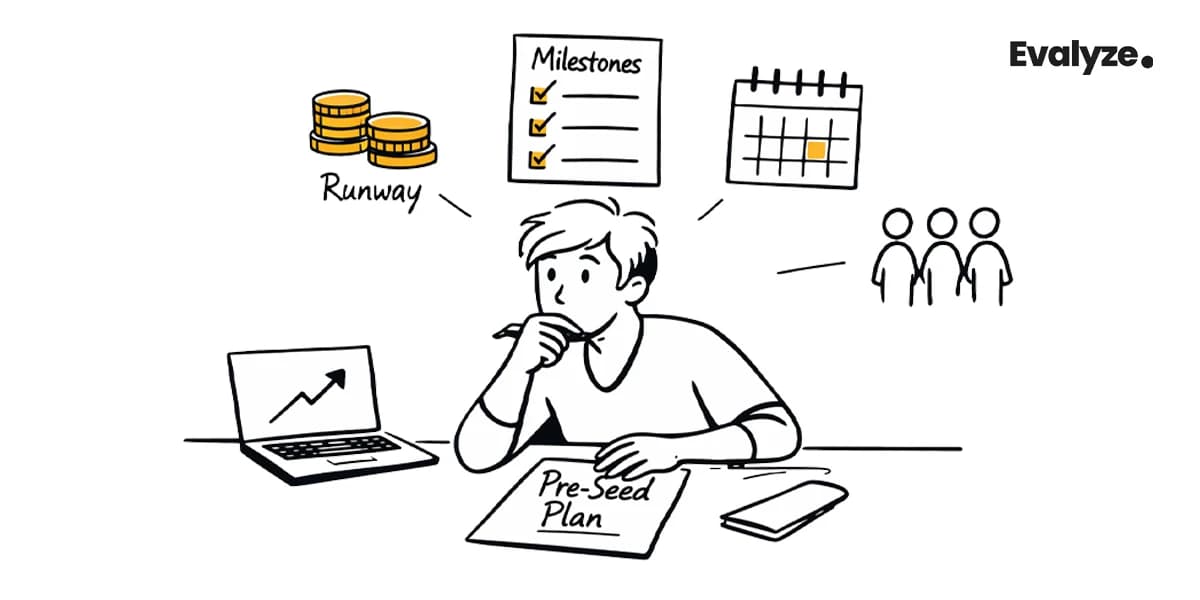
At pre-seed, the “right” amount isn't a trend you copy from Twitter. It’s the minimum capital that buys you enough time to hit the next investable milestone without creating a fundraising hole you can’t climb out of.

Founders usually misjudge pre-seed asks in two predictable ways:

  1. They ask for a round size based on what they’ve heard (“Everyone raises $X”).
  2. They ask for a round size based on hope (“We’ll figure out revenue quickly.”)

Investors fund a plan with credible inputs: burn, milestones, and a timeline.

Also: market data shows pre-seed rounds vary widely and have skewed smaller in many datasets, with a large share under $1M in some quarters. That means you can’t assume “big pre-seed” is the default; you have to justify your number.

Key takeaways

  • Your pre-seed ask should buy milestone runway, not ego runway.
  • Build a phase-based burn model, then add buffer + seed fundraising runway.
  • Define minimum vs target raise so negotiations don’t break your plan.
  • Benchmark your number against market data only as a sanity check, not as the method.
  • If your plan collapses with 30% less capital, it’s too fragile; either fix the burn rate or scope.
Pre-Seed Fundraising Infographic

The Output You’re Trying To Compute: “Milestone Runway”

Your pre-seed raise should answer one sentence:
“How much do we need to reach the milestone that makes a strong seed round likely?”

Y Combinator frames fundraising around raising enough to reach a meaningful next stage (often profitability in later rounds, but in early stages: a milestone that materially de-risks the business).

For most pre-seed companies, the “seed-ready” milestone typically looks like one of these (pick the one that fits your startup type):

  • B2B SaaS: repeatable sales motion evidence (not necessarily scale), clear ICP, early pipeline conversion pattern.
  • Consumer: retention/engagement signal that suggests product-market fit direction.
  • Marketplaces: liquidity in a narrow-wedge market; early take-rate proof.
  • Deep tech / regulated: validated technical feasibility + credible path through compliance/regulatory constraints.

A Founder’s Checklist: Questions That Determine How Much You Should Raise

Use this as your pre-seed “capital needs audit.” If you can’t answer these, you’re not ready to set your ask.

A Founder’s Checklist

1) What Exact Milestone Ends The Pre-Seed Stage For You?

Be specific and measurable:

  • “Launch MVP” is not a milestone.
  • “MVP launched + 10 paying customers in ICP + 2 referenceable case studies” is.

Write it as a scoreboard, not a wish.

2) How Many Months Will It Realistically Take To Hit That Milestone?

Do not use best-case timelines. Use base-case.

  • Map the work in phases: build → test → iterate → sell → learn.
  • If you have a long sales cycle, your timeline is longer. If you’re regulated, longer again.

3) What Is Your Monthly Burn By Phase?

Break burn into phases, because your costs change as you hire and launch.

At a minimum, model:

  • People (salary/contractor)
  • Cloud/tools
  • GTM (ads, outbound tools, events, content)
  • Legal/accounting
  • Misc + travel + devices

4) What Hiring Plan Is Required To Reach The Milestone?

This is usually the #1 driver of burn.

Answer:

  • What roles are truly required pre-seed (must-have) vs nice-to-have?
  • What can be fractional/contract vs full-time?

A common pre-seed mistake is hiring too early (especially sales) before product and ICP clarity.

5) What Are Your “Non-Negotiable” Costs?

Examples:

  • Security/compliance requirements (SOC2 planning, audits later)
  • Regulatory counsel
  • Data licensing
  • Industry certifications
  • Hardware/prototyping

If these exist, they must be explicitly budgeted. Otherwise, your raise is fiction.

6) What Assumptions Are You Making About Revenue Before Seed?

Be brutally conservative.

Ask:

  • When will the first revenue realistically happen?
  • How long is the sales cycle?
  • What’s the collection delay?
  • Is revenue recurring or one-off?

If revenue is uncertain (typical at pre-seed), don’t let it “save” your runway model.

7) What Is Your Contingency Buffer?

You need a buffer because:

  • Hiring takes longer than expected
  • Iterations take longer
  • Sales cycles slip
  • Your first GTM channel fails

A practical buffer is a time buffer (months) rather than a vague percentage, because time is what kills startups.

8) What’s The Minimum Raise vs The Target Raise?

You should have two numbers:

  • Minimum viable raise: keeps the company alive long enough to hit a meaningful milestone.
  • Target raise: funds the base-case plan with a buffer.

This helps in real negotiations when investors push for a smaller check size.

9) How Much Dilution Are You Willing To Accept At Pre-Seed?

Your raise amount isn’t only “needs.” It’s also “terms.”

If your raise forces excessive dilution, you can damage the seed cap table. This is why many founders use SAFEs/notes at pre-seed (the structure varies by region and investor norms). The data from Carta also show common instrument patterns (e.g., SAFE usage) and how terms vary across instruments.

10) What Happens If You Raise 30% Less Than Planned?

Stress-test:

  • Which hires get cut?
  • Which scope gets cut?
  • Does milestone slip?
  • Do you still avoid a “bridge round” trap?

If 30% less causes collapse, your plan is too fragile.

The Simple Formula To Compute Your Pre-Seed Ask

Use this structure:

The Simple Formula To Compute Your Pre-Seed Ask

Step 1: Build A Milestone Timeline (Months)

Example:

  • Build + iterate MVP: 4 months
  • Pilot + learn: 3 months
  • Convert pilots → paying: 3 months
    Total base-case: 10 months

Step 2: Model Burn By Phase

Example:

  • Months 1-4 burn: $35k/month
  • Months 5-10 burn: $55k/month
    Base burn = (4×35k) + (6×55k) = 140k + 330k = $470k

Step 3: Add Buffer (Time-Based)

Say +3 months at the higher burn rate:

  • Buffer = 3 × 55k = $165k

Step 4: Add One-Time Costs

Legal, setup, security tooling, device purchases, etc:

  • One-time = $25k

Step 5: Add Fundraising Runway

You don’t raise seed overnight. If you want to avoid fundraising while cash is near zero, add time for the seed process:

  • Add 2 months runway: 2 × 55k = $110k

Total target raise: 470k + 165k + 25k + 110k = $770k

That number becomes your “target.” Your “minimum” might be closer to the base burn without a full buffer.

Sanity-Check Your Number Against Market Reality

It’s smart to benchmark, just don’t let benchmarking replace thinking.

Sanity-Check Your Number Against Market Reality

Recent datasets show many pre-seed rounds are under $1M in some periods, with a meaningful portion even below $250k in certain categories/structures. But benchmarks vary a lot by geography; some reports highlight regional differences in early-stage median ranges.

Use benchmarking for these questions:

  • If your ask is far above typical, can you justify why your milestone requires it?
  • If your ask is far below typical, are you underfunding and walking into a bridge round?

Before you go: How to Adapt Your Pitch Deck for Virtual Investor Meetings

Use Of Funds That Investors Believe

Credible Use Of Funds

  • Headcount directly tied to milestone (engineer, product, GTM experiments)
  • Clear GTM test budget with learning goals
  • Infrastructure/security that’s required for your buyer
  • A runway plan that includes fundraising time

Red Flags

  • “Marketing” as a blob with no channel plan
  • Hiring sales before you have ICP clarity
  • Assuming revenue ramps fast with no evidence
  • A plan that leaves you raising seed with 2 months cash

FAQ

1. Is there a “standard” pre-seed amount?
No universal standard. Data snapshots show distributions and medians that move with markets and differ by region, so treat them as reference points, not rules.

2. Should I raise for 12 months or 18 months of runway?
Raise for the time to hit a seed-worthy milestone, plus a buffer, and include time to run the seed process. For many teams, that often lands closer to 12-18 months total runway, but compute it from your plan, not a slogan.

3. What if investors want me to raise less than I planned?
That’s why you model the minimum vs the target. If you can’t hit the milestone with a smaller round, you either (a) cut scope, (b) reduce burn, or (c) accept you’re increasing bridge-round risk.

4. How do I justify my ask on the pitch deck?
Show a one-slide “use of funds” tied to: milestone → timeline → hires → burn → runway. Investors want to see that your number is computed, not vibes.