8 Small Business Grants in the US
A simple guide to US small business grants you can actually apply for.
December 3, 2025
Find the hubs where investors respond and where you can actually build.

Scrolling "best startup cities" lists is not always a practical way to find funding.
Founders don't move to a city because it's cool. They move (or incorporate) because the ecosystem makes two hard things easier:
This guide gives you a decision tool: a practical scoring framework you can reuse, a map of "government support signals," and the simplest way to locate real angel networks (not "random rich people on LinkedIn"). Rankings can help, but only if you use them as a filter, not as a verdict.
Key Takeaways
Most lists quietly optimize for one metric: total funding, number of unicorns, or "startup buzz." That's fine if you're writing a report. It's not fine if you're choosing where you'll spend your next 18 months of life.
Some startup city rankings are more useful than others because they show how they scored each city on multiple factors, provide a clear scale (for example, 1-10), and include a combined total, rather than pretending that one magic number captures an entire ecosystem.
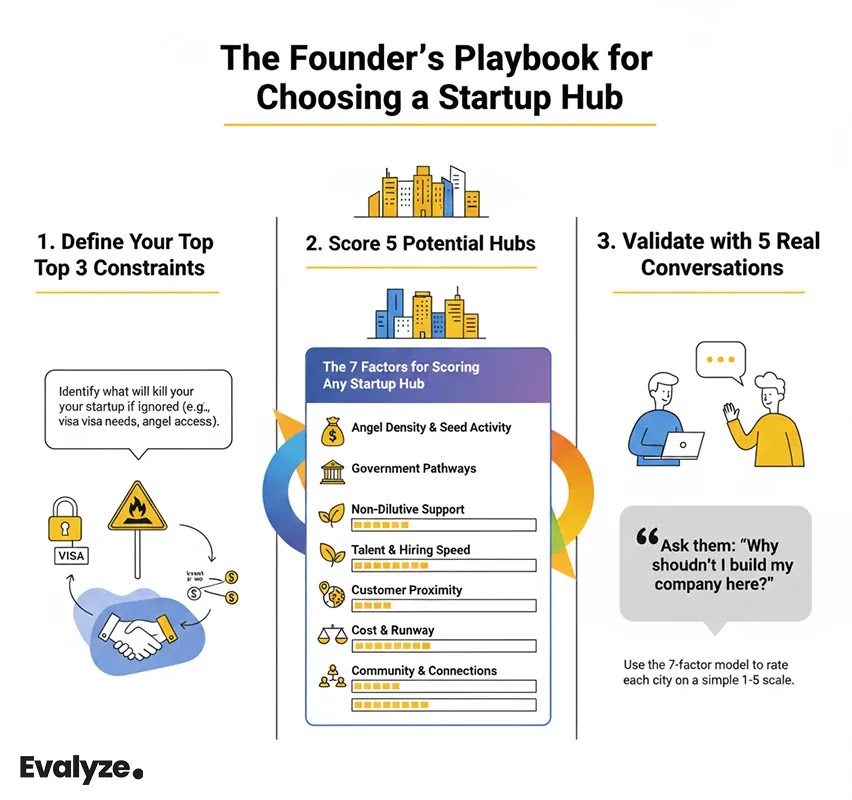
Here's a founder-friendly model you can use in any city or country.
Copy/paste this checklist and rate each factor 1-5 (or 1-10 if you're feeling spicy):
Definitions
Founder's favourite: The 20 Most Searched Startup Investors on Evalyze
Two rankings can disagree without either being "wrong." They're just measuring different things.
Start wide, then go deep.
First, use a global list with lots of city coverage to get 10 candidates. Then sanity-check your top 3 using a report that publishes its methodology, what datasets it pulls from, how it removes duplicates, and how it measures ecosystem strength.
Rule that saves founders from bad decisions:
Rankings are a filter, not a decision. Use them to produce a shortlist, then validate with real investor and founder conversations.
Don't miss: How to Use Evalyze Investor Discovery
The right hub depends less on the city's "startup brand" and more on your constraints. Here are common founder situations and what to prioritize.
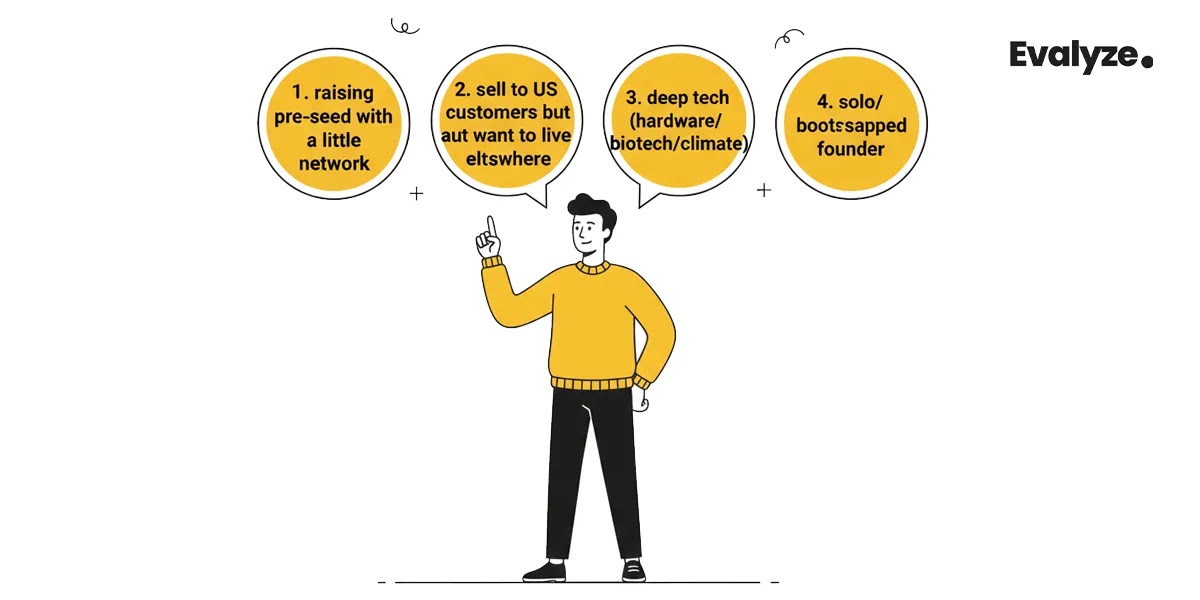
Your biggest enemy isn't competition. It's silence.
Choose hubs with:
The magic metric here is warm intro density: how many people are one intro away from someone who invests.
Practical move: In your shortlist hubs, try to book 5 founder coffees in a week. If you can't, intros will be slow.
You don't need to live in the US to sell to the US, but you do need:
A hub can be "top-ranked" and still be wrong if you're constantly awake at 2 a.m. to run demos. Score customer proximity and travel friction higher than local hype.
Deep tech usually needs:
In your scoring model, weight non-dilutive support and talent higher than "number of startups." City rankings that reward raw startup counts can understate the strength of deep-tech hubs.
You're optimizing for runway and execution speed, not prestige.
Pick places with:
A slightly "smaller" ecosystem can beat a famous one if it gives you 6 more months of survival.
Too useful to skip: How to Build an Investor List Based on Your Startup
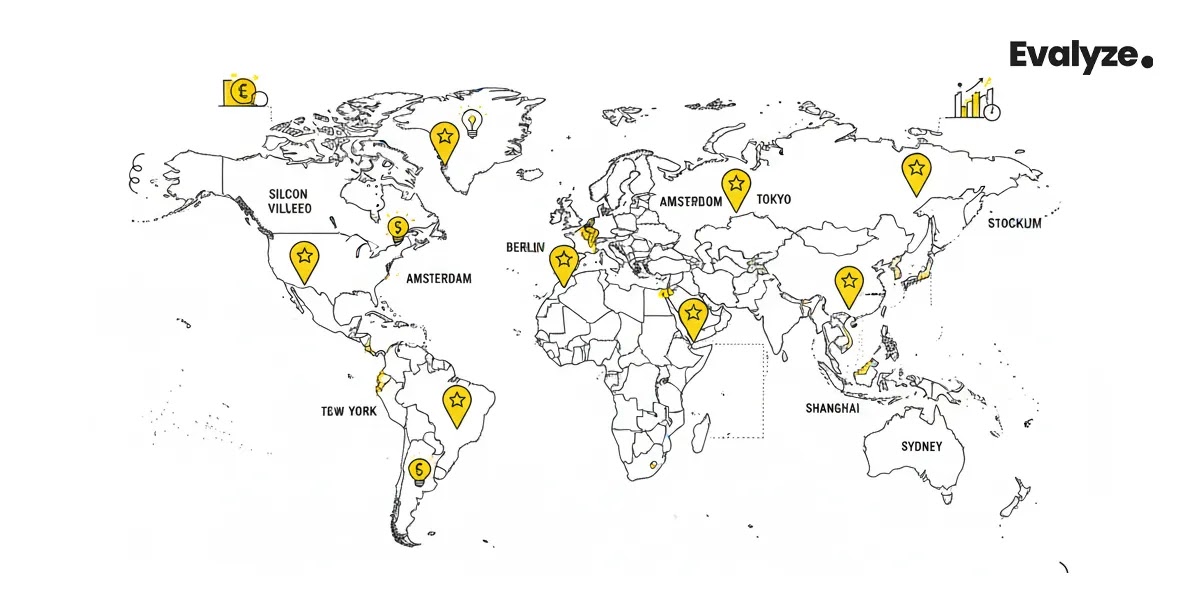
This section is not immigration advice. It's an ecosystem signal map; countries that built founder-friendly pathways tend to have a more intentional startup infrastructure.
1. Canada: Start-up Visa Program
Canada's Start-up Visa requires pitching to a designated organization, securing support, and meeting language and settlement funds requirements.
2. France: French Tech Visa (Founders)
France's French Tech Visa is aimed at non-EU/EEA/Swiss founders building an innovative project in France.
3. UK: Innovator Founder visa
The UK route requires an endorsement by an approved endorsing body. GOV.UK also states the visa duration is 3 years, and typical decision times are ~3 weeks outside the UK and ~8 weeks inside the UK (fees vary by applying/extending/switching).
Also useful: the UK explicitly notes the old "Start-up visa" is closed and points founders toward Innovator Founder.
4. Estonia: Startup Visa
Estonia positions its Startup Visa as a pathway for non-EU founders to grow a scalable startup in Estonia (and to help startups hire non-EU talent).
5. Finland: Startup Permit
Finland's model is nicely structured. Business Finland evaluates your startup's growth potential and issues an Eligibility Statement, which you attach to your residence permit application.
6. Singapore: Startup SG
Startup SG is framed as national support for startups at all stages, providing access to resources such as talent, funding, and networks. Enterprise Singapore describes components such as Startup SG Accelerator and shared infrastructure.
If you want a "density signal," Enterprise Singapore also describes the Startup SG Network ecosystem, which scales thousands of startups and hundreds of VCs/incubators/accelerators.
7. Chile: Start-Up Chile
Start-Up Chile is widely referenced as a government-backed programme launched in 2010 to help turn Chile into a regional innovation hub. Their application pages emphasize looking for tech-based, innovative, scalable, high-impact startups.
Reality check (read this before you plan your life around a programme):
Explore more: 11 Fundraising Myths That Are Holding Your Startup Back
"Angels in Berlin" is not a plan. You need names, groups, processes, and fit.
Before you chase intros, filter angels by:
Build your target investor list for a hub (in minutes)
Once you pick a hub (say, "London" or "Toronto"), the next step is to build a tight, hub-specific list of angels and seed funds that invest in your stage and category.
That's exactly where Evalyze.ai helps: turn "this city has angels" into "here are 40 investors who invest in startups like mine", then export that list into your outreach workflow.
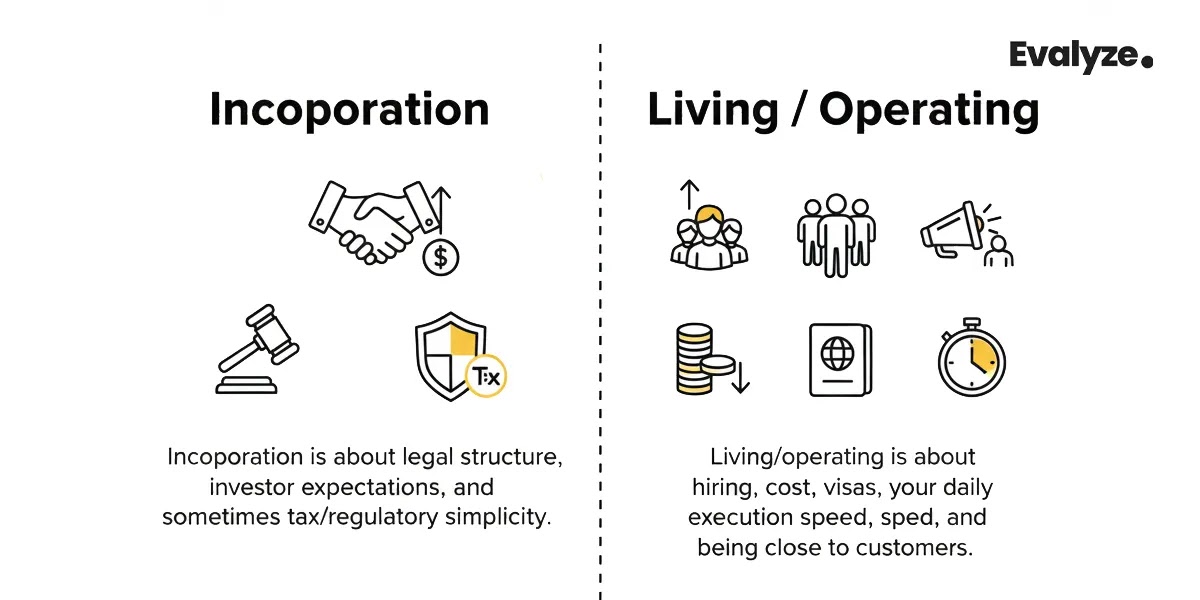
This comes up constantly in founder forums for a reason: you can build in one place and incorporate in another, but it's a trade.
Mini decision rule:
Keep learning: +30 Best Platforms to Launch Your Startup
Here's a process that takes a weekend and saves you months.
Choose the constraints that will actually kill your startup if ignored:
Don't overthink. Give each hub a score of 1-5 for each factor.

You'll usually see a pattern: one hub wins on money and community, another wins on runway and visas.
Talk to:
Ask one question that reveals the truth fast:
"If you were me, what would make you not build here?"
Validate a hub by investor fit + deck readiness
After you shortlist a few hubs, test fit, not hype. For each hub, define your startup profile, then use Evalyze.ai to find matching angels and build a hub-specific shortlist. Run your deck through Evalyze to catch weak spots before outreach.
Now "best city" means:
Where you have the best investor match and a ready-to-pitch deck.
FAQ