
Evalyze.ai vs. OpenVC: Which Platform Fits Your Fundraise?
Evalyze.ai vs OpenVC: Compare investor discovery, AI pitch coaching & CRM. See which platform helps founders go from deck audit to warm intros.
May 27, 2026
Crunchbase helps with market research. Evalyze helps founders score decks, match investors, and build fundraising campaigns. See which tool fits.
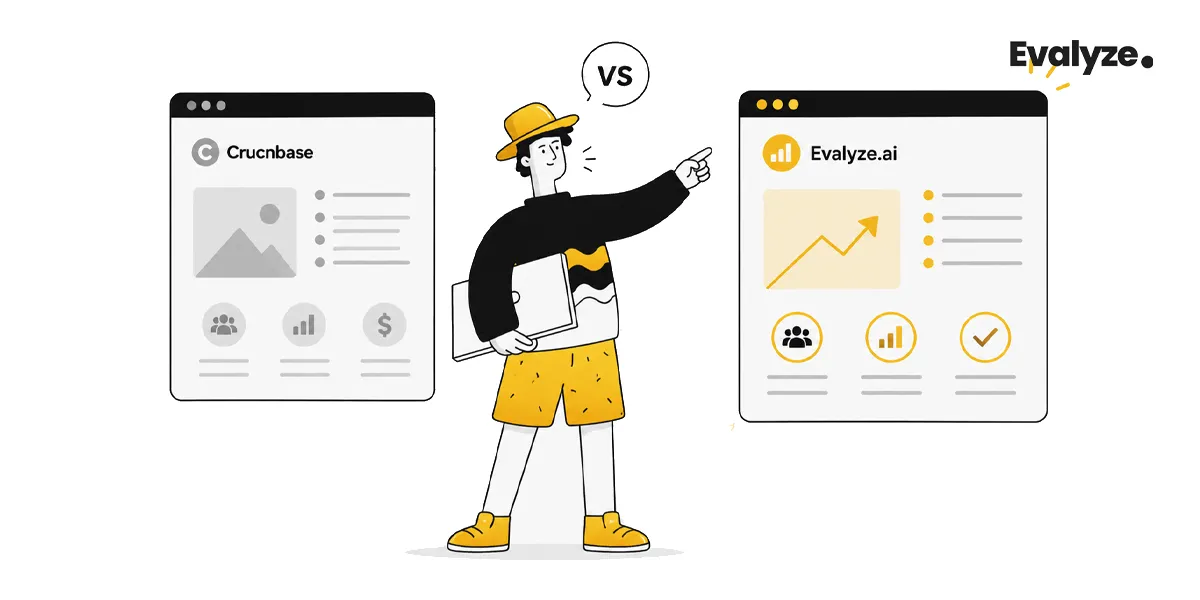
Use Crunchbase if you need broad company data, funding-round history, competitor research, or market mapping. Use Evalyze if you are a pre-seed, seed, or Series A founder trying to turn your pitch deck into a qualified investor list and fundraising campaign.
Crunchbase helps you research the market. Evalyze helps you act on your raise.
A founder can pull hundreds of investor names from a database and still have no usable fundraising pipeline. Relevance, timing, and sequence matter more than list size.
Key Takeaways
Crunchbase is better for broad private-company research, funding-round tracking, competitor mapping, and market intelligence.
Evalyze is better for pre-seed to Series A founders who need investor matching, pitch deck analysis, and fundraising execution.
Crunchbase gives you data. Evalyze turns your deck and startup profile into a more focused investor workflow.
Use Crunchbase if you are mapping markets. Use Evalyze if you are actively preparing outreach.
It’s incredibly easy to confuse a massive spreadsheet of contacts with an actual fundraising strategy. When you jump into a traditional tool and filter for a seed-stage SaaS startup in the United States, or an AI, fintech, or healthtech project in Europe, you can instantly pull up hundreds of names.
But a long list of names isn't a pipeline. Before you can even send a single cold email, you are still left doing the hard part to answer the hard questions:
Are these funds actively writing checks at your exact stage?
Do they lead rounds, or do they only participate through syndicates?
Have they backed a company in your sector recently, or is their fund quietly dormant?
Is your pitch deck objectively strong enough to get a meeting, or will it fail a first-pass review?
What should your opening outreach email look like to actually get a reply?
How will you prioritize who to approach first, and how will you track the subsequent follow-ups?
A database simply hands you raw, unrefined material; a fundraising workflow gives you a repeatable sequence. That operational gap is the core difference between how you use Crunchbase and how you use Evalyze.
If you are still building your first list, start with a focused process for how to build an investor list before exporting hundreds of names from any database.
Crunchbase is one of the best-known private-company data platforms. It is useful because it gives founders, investors, analysts, and sales teams a wide view of companies, funding activity, investors, leadership changes, and market signals.
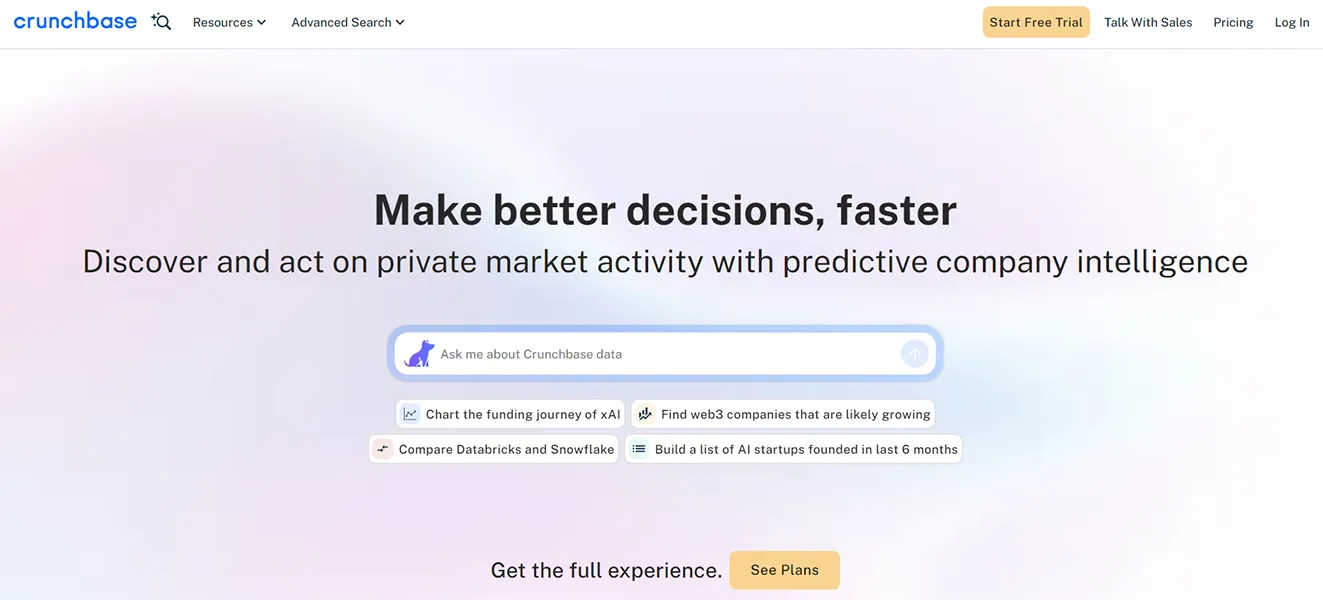
Crunchbase Pro is positioned around private company lifecycle coverage, live financials, heat scores, funding history, investor data, leadership changes, automatic notifications, notes, tags, and monthly exports.
Crunchbase also says it delivers 30M+ verified data updates annually across 4M+ private companies. That makes Crunchbase strong for research-heavy work.
Track which companies recently raised in your category.
See which investors backed comparable startups.
Map competitors before a fundraise.
Understand funding activity in a market.
Build a broad first-pass investor universe.
Monitor companies, investors, and market signals over time.
For a founder, this can be valuable before fundraising starts. If you are entering a market and want to understand who funds similar companies, Crunchbase is a serious research tool.
The problem starts when a founder treats Crunchbase like a fundraising machine.
Crunchbase can help you find investor names. It does not automatically tell you whether your deck is ready, whether your ask matches your stage, whether your positioning fits the investor’s thesis, or which investors to contact first.
That means the founder still has to do the heavy work:
Filter investors manually
Export lists
Clean spreadsheets
Check each fund website
Validate stage fit
Check recent activity
Remove investors with portfolio conflicts
Find contact paths
Write outreach
Track follow-ups
For a sales team, that manual work may be acceptable. For a founder with six months of runway, it becomes expensive. Not expensive, only in subscription cost; Expensive in time.
Evalyze has a narrower job than Crunchbase: help founders prepare for a raise, improve their pitch, and find investors who fit.
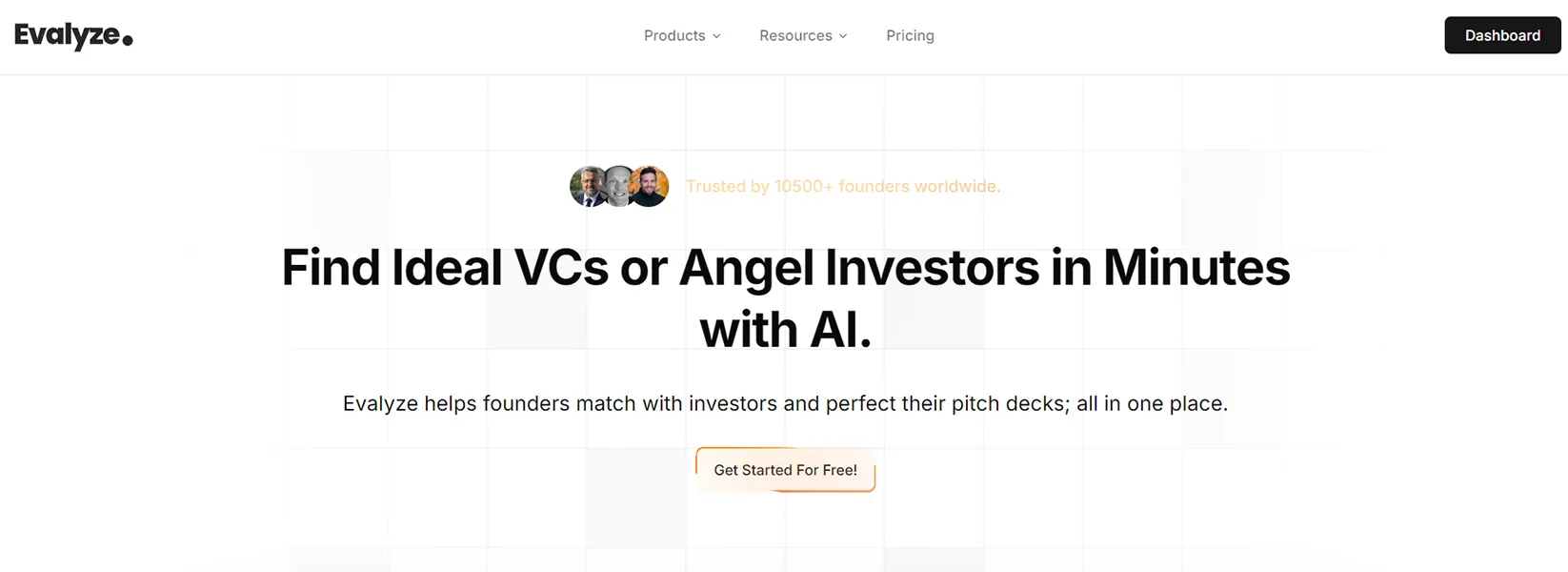
Instead of starting with a blank search bar, Evalyze starts with your startup.
Core workflow:
Upload your pitch deck
Evalyze reviews the deck and gives you an Investor Readiness Score, so you can catch weak slides before investors do.
Find matched investors
The platform matches your startup with investors based on stage, sector, geography, and fundraising fit.
Build a shortlist
Founders can save relevant investors instead of managing another messy spreadsheet.
Move toward outreach
Evalyze supports the campaign side of fundraising, including investor matching, shortlisting, exports, and fundraising automation features.
For a deeper workflow, read our guide on how to use AI for fundraising in 2026, especially before combining investor matching with outreach.
The Starter plan gives founders access to the AI Startup Analyzer, limited Investor Discovery, pitch deck uploads, and an AI Investor Matching Campaign with 30 investors.
The Pro plan expands the workflow with full Investor Discovery, 10K+ investor matching, AI Pitch Deck Coach, investor shortlisting, advanced recommendations, CSV/PDF exports, and larger file uploads.
Evalyze.ai changes the order of fundraising work. Instead of starting with a huge investor database, founders start with their pitch deck, readiness score, and investor fit.
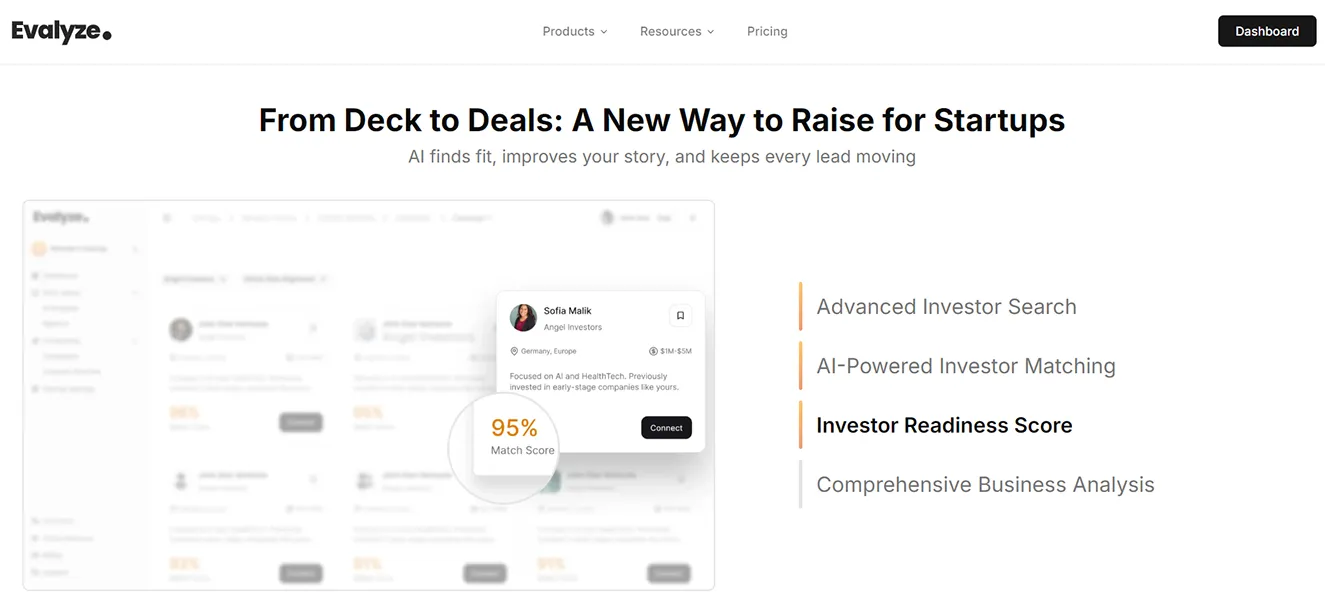
Many founders build investor lists first. Then they send a deck that has weak traction context, a vague ask, or a market slide that investors do not trust.
Evalyze helps founders catch those issues earlier with AI pitch deck analysis and an Investor Readiness Score.
What it can flag:
| Deck area | What can go wrong |
|---|---|
| Traction slide | Numbers appear without growth context |
| Ask slide | The raise amount is listed without a milestone |
| Market slide | The market size feels too generic or top-down |
| Team slide | Founder-market fit is not clear enough |
These are easier to fix before the first investor email.
A longer investor list does not automatically create a better raise. Evalyze helps narrow the list by signals that matter during outreach:
Stage
Sector
Geography
Investor type
Cheque size
Investment history
Fundraising fit
This gives founders a cleaner starting point than a raw spreadsheet of names.
Fundraising needs more than discovery. Founders also need a way to prioritize, shortlist, contact, and follow up with investors.
Evalyze supports that workflow through investor matching, shortlisting, exports, and fundraising automation features.
The practical difference:
| Task | What the founder needs |
|---|---|
| Before outreach | Deck score and investor-readiness feedback |
| During list building | Matched investors, not random names |
| During outreach | Shortlist, prioritization, and campaign tracking |
| After replies | A clearer view of who responded, who went quiet, and who needs follow-up |
Crunchbase gives founders a wide research base. Evalyze turns the fundraising process into a tighter sequence: check the deck, find relevant investors, build a shortlist, then run outreach with more control.
| Category | Crunchbase | Evalyze |
|---|---|---|
| Target user | Sales teams, analysts, investors, founders, market researchers | Pre-seed, seed, and Series A founders actively preparing or running a raise |
| Primary use case | Private-company research, funding data, competitor mapping, investor discovery | Pitch deck analysis, investor readiness, investor matching, fundraising campaign workflow |
| Best strength | Large private-company dataset and market visibility | Turning a founder’s deck and startup profile into a focused fundraising workflow |
| Onboarding friction | Search, filter, save, export, clean, qualify | Upload deck, analyze readiness, match investors, build shortlist |
| Actionability of data | High for research, lower for execution unless founder builds the workflow | High for fundraising execution because matching and deck feedback sit inside one process |
| Setup time | Longer if the goal is a qualified investor campaign | Shorter if the founder already has a deck and basic company details |
| Pitch deck feedback | Not the core workflow | Core feature |
| Investor matching | Search/filter-based | Fit-based matching workflow |
| Outreach support | Requires external tools or manual workflow | Fundraising automation and outreach features are part of the product roadmap |
| Best fit | Market mapping, competitive intelligence, broad investor research | Founder raising now and needing a tighter list before outreach |
Still comparing tools? Read our broader guide on which investor platform works better for fundraising before choosing your workflow.
Crunchbase is useful for understanding the market. Evalyze is stronger when you are ready to turn your deck, investor fit, and outreach plan into a real fundraising workflow.
FAQ
Evalyze.ai vs OpenVC: Compare investor discovery, AI pitch coaching & CRM. See which platform helps founders go from deck audit to warm intros.
May 27, 2026
Learn where to find investors for your startup, from investor databases and portfolios to founder networks, LinkedIn, accelerators, and AI tools.
August 21, 2026