
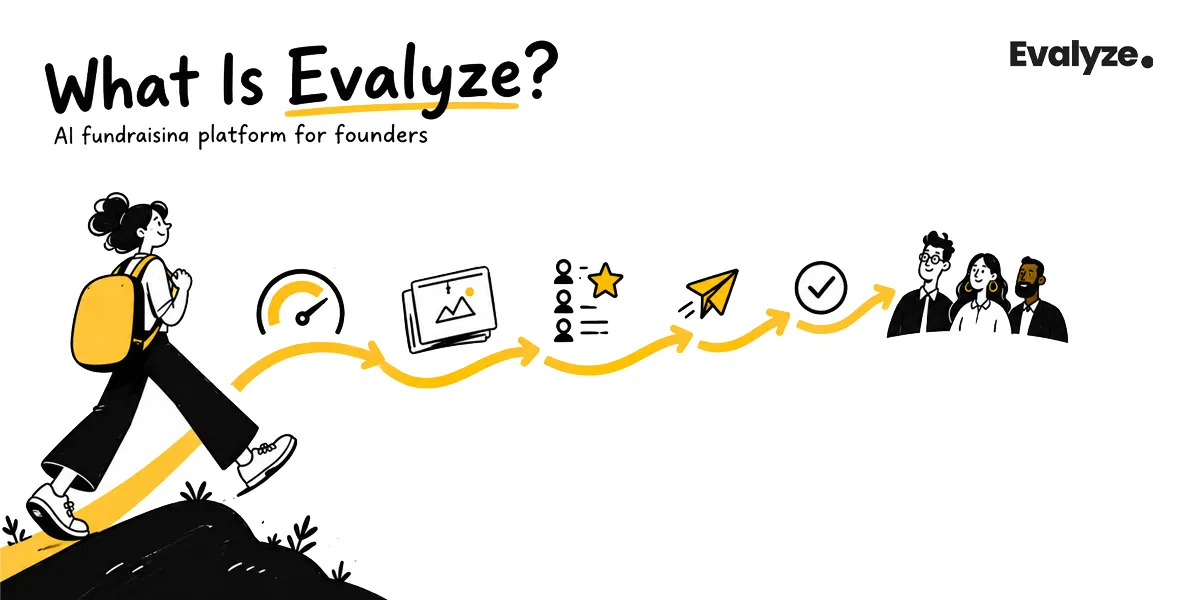
What Is Evalyze? AI Fundraising Platform for Startup Founders
Evalyze helps founders assess fundraising readiness, improve pitch decks, find matched investors, and manage personalized investor outreach.
September 12, 2026
Compare DIY and managed fundraising, what founders can delegate, and when Evalyze Managed Fundraising may fit an active startup raise.
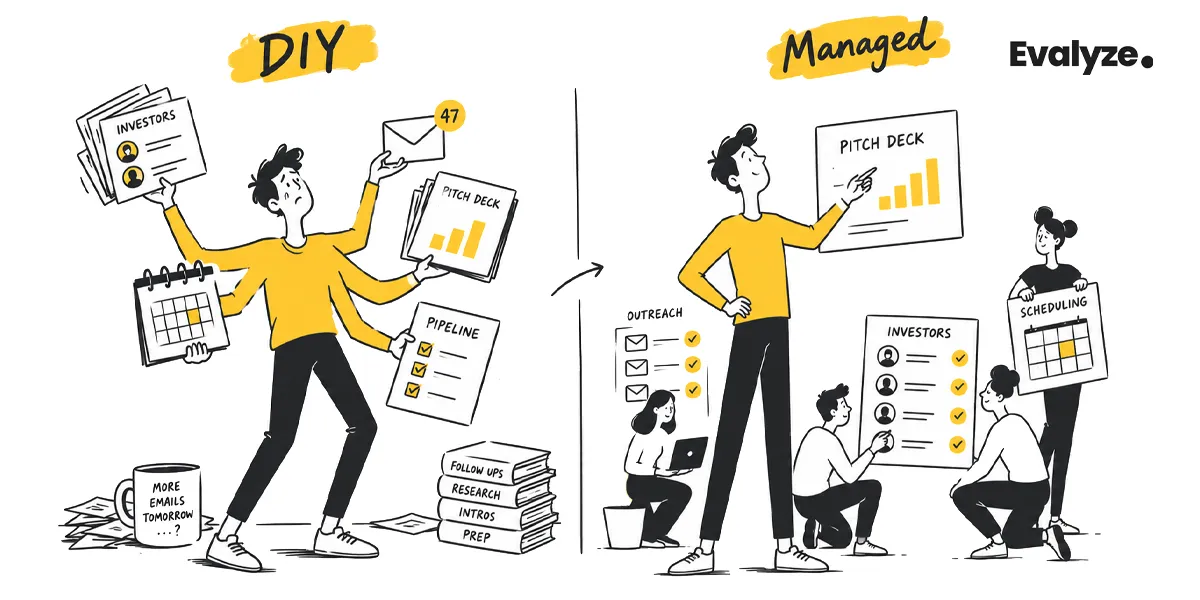
Managed fundraising makes sense when a founder is actively raising but lacks the time or internal capacity to manage investor targeting, outreach, pipeline execution, and meeting preparation.
DIY fundraising is usually a better fit when the founder already has a qualified investor network, a working fundraising process, and enough time to run the campaign without pulling too much attention away from the company.
The decision comes down to one question: which parts of the raise need the founder, and which can be delegated?
Key Takeaways
Evalyze Managed Fundraising is a hands-on fundraising service for founders actively raising capital.
The team supports investor targeting, materials review, pipeline building, personalized outreach sent in the founder's name, follow-up management, warm-introduction opportunities where relevant, pitch preparation, and diligence readiness.
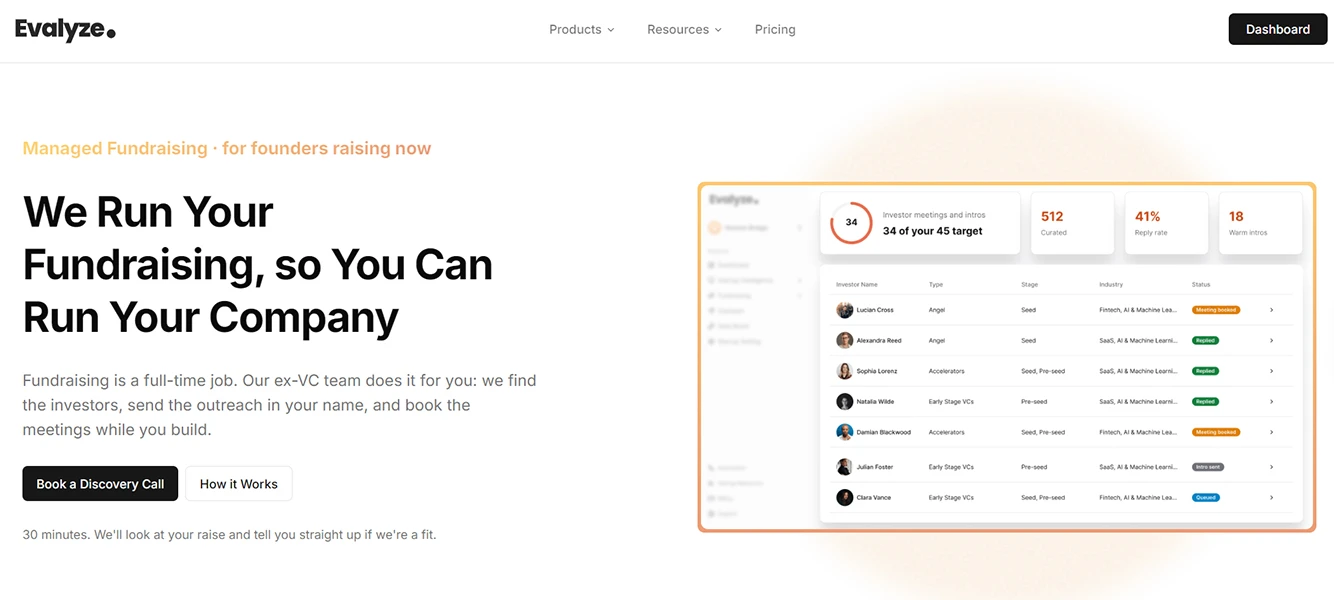
It combines the Evalyze fundraising platform with direct execution support.
The founder still leads investor conversations, explains the business, builds relationships, and makes financing decisions.
"With Evalyze Managed Fundraising, founders can delegate fundraising execution without giving up ownership of the raise."
Founders who only need pitch deck analysis, investor matching, shortlisting, and outreach tools can use Evalyze's self-service platform instead.
Fundraising takes more than investor meetings. A founder also has to:
Fundraising guidance consistently treats preparation, investor outreach, meetings, and follow-ups as separate parts of the process, and running them well requires concentrated founder attention.
"For founders already raising, the challenge is capacity: keeping fundraising moving without pulling too much attention away from the company."
Software, specialist advisors, and managed fundraising solve different parts of that capacity problem.
| Area | DIY Fundraising | Managed Fundraising |
|---|---|---|
| Strategy | Founder builds the process | Developed with hands-on support |
| Investor research | Founder researches targets | Research and qualification can be supported |
| Investor prioritization | Founder sets the sequence | Team can help structure the pipeline |
| Pitch materials | Founder reviews or hires separate help | Materials review may be included |
| Outreach | Founder prepares and sends messaging | Team can support preparation and execution |
| Follow-ups | Founder manages tracking | Team can support the workflow |
| Pipeline | Founder maintains the system | Pipeline management can be supported |
| Meeting preparation | Founder prepares independently | Coaching or mock pitches may be included |
| Founder involvement | High | Still high where investor judgment is involved |
| Best fit | Founder has capacity and a working process | Active raise needs coordinated execution support |
Neither model is automatically better.
A repeat founder with an established investor network may gain little from broad managed support. A founder entering an active raise without a qualified pipeline or repeatable process may benefit much more.
Repeat founders may already understand investor sequencing, follow-ups, diligence, and meeting preparation.
If the process already works, outside support may only be useful for a specific task.
A useful network contains investors who actually fit the current company and round.
Industry experience, stage fit, and the quality of the investor relationship all matter when building a target list.
If you already have those relationships, a major part of the research workload is reduced.
DIY remains practical if fundraising can receive focused attention without consistently displacing product, customer, or company work.
A weak investor list may call for investor discovery platform. A weak pitch may need deck review or coaching. Financing documents may require qualified legal counsel.
Use support that matches the actual problem rather than expanding the scope unnecessarily.
Managed Fundraising becomes more relevant when several parts of an active raise need attention at the same time.
Investor research happens between meetings. Follow-ups sit in different places. The deck changes without a clear feedback loop. Nobody has a reliable view of who has been contacted and what happens next.
Hands-on support can give the fundraising process clearer ownership while the founder remains focused on investor conversations.
A long investor list is useful only if the names fit the round.
Investors should match factors such as company stage and industry. The route to each investor also matters: an existing relationship, credible introduction, inbound connection, or cold outreach may require a different approach.
A qualified pipeline should help answer:
If the list cannot answer those questions, adding more names will not solve the targeting problem.
Fundraising requires concentrated work and can demand substantial founder time and energy.
Research, scheduling, CRM updates, outreach preparation, and follow-up administration are all tasks that can consume attention without requiring the founder personally.
A weak investor list can be addressed with investor discovery. Weak meeting delivery may need pitch coaching.
Managed support becomes more relevant when targeting, pipeline management, outreach, and pitch preparation all need attention during the same raise.
Founders can delegate more of the operations than the judgment.
| Fundraising Work | Can It Be Delegated? | Founder Role |
|---|---|---|
| Investor research | Yes | Set criteria and review priority investors |
| Database filtering | Yes | Confirm pipeline fit |
| CRM administration | Yes | Review status and important decisions |
| Meeting scheduling | Yes | Attend investor conversations |
| Outreach drafts | Yes | Approve positioning and company claims |
| Follow-up administration | Yes | Step in for substantive conversations |
| Deck feedback | Yes | Decide what accurately represents the company |
| Mock pitches | Yes | Practice and improve responses |
| Data room organization | Partly | Approve information and access |
| Investor meetings | Founder-led | Pitch and answer investor questions |
| Financing decisions | Founder-led | Decide with the board and relevant advisors |
| Final negotiations | Founder-led | Make company-level financing decisions |
"Delegate the work that prepares and supports investor conversations. Keep the conversations and company-level decisions with the founder."
External support can improve access, preparation, and execution. Investor conviction still has to be built in the conversation.
Managed fundraising is one option among several.
Some founders need a platform to run the raise themselves. Others need targeted expertise or broader execution support.
| Model | What It Primarily Provides | Founder Involvement | Best Fit |
|---|---|---|---|
| Fundraising platform | Pitch analysis, investor research, matching, outreach, and workflow tools | High | Founder can run the raise but wants better tools |
| Specialist consultant or coach | Expertise in one defined area | High | One part of the raise needs improvement |
| Fundraising advisor | Strategic guidance across more of the process | High | Founder can execute but wants experienced input |
| Managed fundraising | Strategy plus hands-on operational support | Medium to high | Several parts of an active raise need coordinated support |
Evalyze supports both self-serve and managed fundraising.
Founders who want to run the raise themselves can use the Evalyze AI fundraising platform for pitch deck analysis, Investor Readiness scoring, investor discovery and matching, shortlisting, and investor outreach.
Founders who need broader execution support can use Evalyze Managed Fundraising for investor targeting, pipeline building, outreach execution, warm-introduction support where relevant, pitch preparation, and other agreed parts of the raise.
FAQ
Evalyze helps founders assess fundraising readiness, improve pitch decks, find matched investors, and manage personalized investor outreach.
September 12, 2026

Connect Gmail, choose investors, create personalized emails, edit drafts, send outreach, and track every reply with Evalyze.
September 12, 2026